

This is a research-based guide built from Bambu Lab’s official documentation, community forum reports, and manufacturer specs — not hands-on lab testing.
Choosing between a textured vs smooth PEI plate for your Bambu Lab printer comes down to one trade-off: the textured plate is the forgiving, glue-free workhorse for everyday printing, while the smooth plate delivers a sleek, flat bottom surface and tighter Z-axis precision — at the cost of needing glue stick as a release agent for PETG and a few other materials.
If you only buy one plate, community consensus is clear: get the Textured PEI. It handles PLA, PETG, TPU, ABS, and even nylon with minimal fuss, and prints self-release as the bed cools. The Smooth PEI earns its place when the bottom of your print is a visible surface — display models, faceplates, parts that need a factory-flat finish.
Quick answer
Textured PEI = best all-rounder, no glue for most filaments, matte bottom finish. Smooth PEI = flat glossy-matte bottom and better dimensional precision, but always use glue with PETG or you risk destroying the sheet. Most Bambu owners end up with both — or the Dual-Texture plate that combines them.
Textured vs Smooth PEI Plate: Head-to-Head Comparison
| Feature | Textured PEI Plate | Smooth PEI Plate |
|---|---|---|
| Bottom finish | Matte, lightly textured | Flat, smooth-matte (PEI sheet) |
| Glue needed | No for PLA/PETG/TPU; yes for ABS/ASA/PC/PA | Yes for PETG (release agent) and engineering filaments |
| Print removal | Self-releases as bed cools | Needs cooling + flex; PETG can weld without glue |
| Construction | PEI powder coating on 0.5 mm spring steel | PEI sheet bonded with heat-resistant 3M adhesive |
| Durability quirks | Restore grip with 600-grit sanding | Sheet can bubble; heal on heatbed at 80°C+ |
| Best for | Functional parts, daily driver, beginners | Display pieces, flat visible bottoms, tight tolerances |
Textured PEI Plate: The Default Workhorse
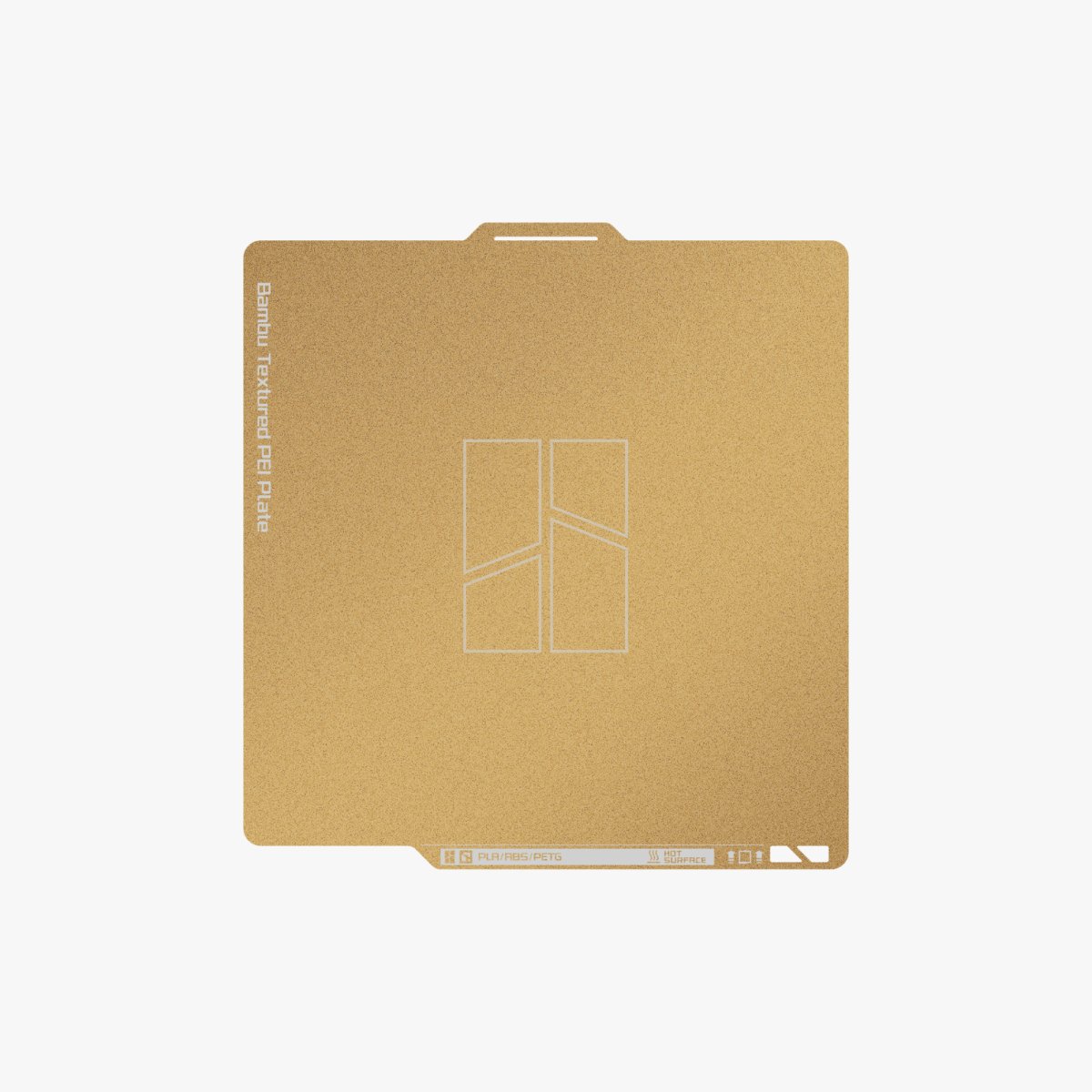
The Textured PEI Plate is the surface most Bambu printers ship with, and for good reason. It uses a PEI powder coating applied directly to a 0.5 mm magnetic spring-steel sheet. According to Bambu Lab’s official build plate documentation, the current manufacturing process improved both durability and adhesion enough that no glue is needed for most everyday materials.
In practice, that means PLA, PETG, and TPU grip reliably on a clean plate, and finished prints pop off on their own once the heatbed drops to roughly 35°C or below. For high-shrinkage engineering materials — ABS, ASA, PC, and PA — Bambu still recommends a thin layer of glue stick to manage adhesion. If you fight warping with those materials, our guide on printing ABS without warping on Bambu printers covers the full playbook.
The texture itself is a feature, not a compromise: it leaves a uniform matte pattern on the bottom of prints that hides layer lines and small first-layer imperfections. Community users widely report it as the more forgiving surface for imperfect Z-offsets and dusty plates.
Smooth PEI Plate: Flat Bottoms and Tighter Precision
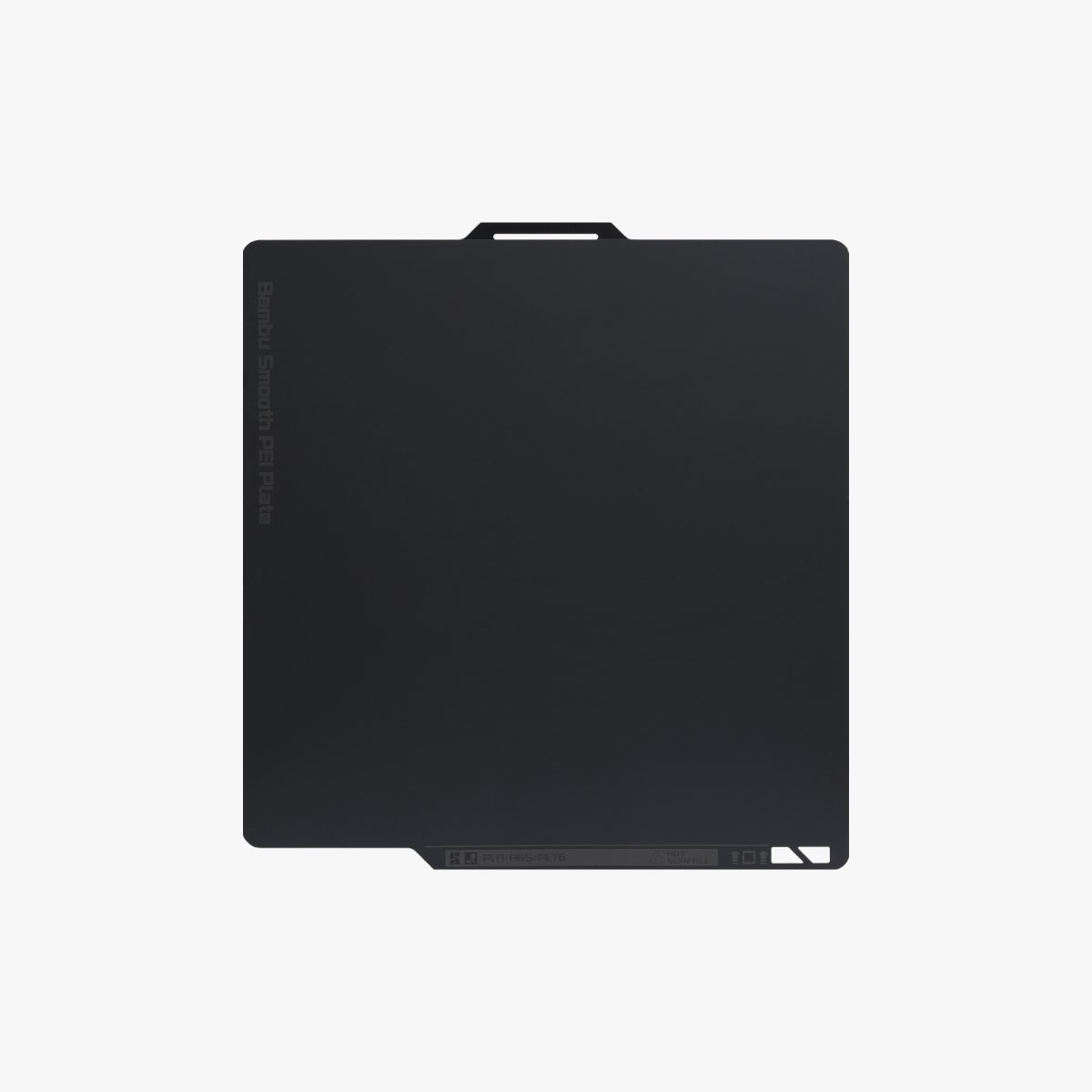
The Smooth PEI Plate (sold by Bambu as the Smooth PEI / High Temperature Plate) swaps the powder coating for a carefully selected PEI sheet bonded to the spring steel with a heat-resistant 3M adhesive. One nuance that confuses buyers: Bambu’s smooth plate produces a smooth but matte bottom surface, not the mirror-gloss finish some aftermarket smooth sheets give. Forum threads are full of owners surprised by this — it is by design, from the matte PEI sheet Bambu selected.
Where the smooth plate earns its price is precision and appearance. The perfectly flat sheet contributes to better Z-axis consistency, which matters for parts with tight tolerances or large flat bases. Community reports on PLA adhesion are strong — several long-time users describe first-layer grip on the smooth plate as the best they have experienced, even with budget PLA brands.
Filament Compatibility: Textured vs Smooth PEI Plate
| Filament | Textured PEI | Smooth PEI |
|---|---|---|
| PLA / PLA+ / Silk | Excellent, no glue | Excellent, no glue |
| PETG / PETG-HF | Good — cooled removal, glue optional | Glue stick mandatory as release agent |
| TPU | Good | Very good — strong grip, easy flex-release |
| ABS / ASA | Good with glue stick | Good with glue stick |
| PC / PA (nylon) | Glue recommended | Glue recommended |
| CF-filled (PLA-CF, PETG-CF) | Good — watch aggressive PETG-CF grip | Use glue; removal can damage sheet |
The PETG Problem on Smooth PEI
This is the single most important thing to know in the textured vs smooth PEI plate decision. PETG bonds chemically to bare smooth PEI so aggressively that forum users report tearing the PEI sheet off the steel while removing prints. The fix is counterintuitive: a thin layer of glue stick acts as a release agent, not an adhesive — it sits between the PETG and the PEI so the part peels away cleanly.
On the textured plate, the powder-coated surface releases PETG far more gracefully; letting the bed cool fully (or a few minutes in the freezer for stubborn parts) is usually enough. If PETG is your main material, pair the textured plate with our Bambu Lab PETG print settings guide, and if you see wisps on travel moves, the PETG-HF stringing fix walks through the fan and retraction tweaks.
What About the Dual-Texture and Cool Plate SuperTack?
Bambu’s lineup does not stop at two plates. The Dual-Texture PEI Plate puts a textured PEI surface on one side and a smooth PEI sheet on the other — the practical answer for anyone who wants both finishes without buying two plates. Note the compatibility fine print: the dual-texture plate is listed for X1, P1, and A1 series printers, so P2S and X2D owners should check plate generation before ordering (more on that below).
The Cool Plate 2 (SuperTack) is a different animal: a low-temperature surface aimed squarely at PLA, designed for strong first-layer grip on a cooler bed. It is the beginner-friendly option if PLA is all you print, but it does not replace a PEI plate for PETG, ABS, or engineering materials. For PLA-heavy workflows, see our roundup of the best PLA filaments for Bambu Lab.
Gen 1 vs Gen 2 Plates: P2S and X2D Owners, Read This
As of 2026, the 256×256 mm Textured PEI, Smooth PEI, and Cool Plate SuperTack all exist in two generations. Per Bambu’s documentation, the second-generation plates carry an updated QR code that enables automatic build-plate recognition on the P2S and X2D. First-generation plates still print fine on the new machines, but the printer will not auto-detect them — you must select the plate type manually in Bambu Studio, and a mismatch is an easy way to ruin a first layer.
If you just upgraded, this pairs with our Bambu X2D filament compatibility guide and the best filament picks for the P2S — the plate and the filament profile need to agree with each other.
Plate Care: Making Either Surface Last
Both plates are consumables and both fail the same way: grease. Fingerprint oils kill adhesion faster than wear does, so wash the plate regularly with dish detergent and warm water, handle it by the edges, and never clean PEI with acetone — it attacks the surface. Two surface-specific tricks from Bambu’s own guidance: a tired textured plate can be revived by light sanding with 600-grit paper, and bubbles under a smooth PEI sheet can often be healed by leaving the plate on the heatbed at 80°C or higher for a few hours. And always let prints cool before prying — forcing a hot part off is how sheets get gouged. Damp filament also sabotages first layers no matter which plate you use; our filament storage guide covers keeping spools dry.
Verdict: Which PEI Plate Should You Buy?
Buy the Textured PEI Plate first. It covers 80% of real-world printing, forgives more mistakes, and never welds a PETG print to itself. Add the Smooth PEI Plate when the bottom of your prints becomes a visible, cosmetic surface — or skip the second purchase and get the Dual-Texture plate if your printer supports it. Whatever you choose, keep a glue stick in the drawer: on the smooth plate it is non-negotiable for PETG, and on the textured plate it tames ABS, ASA, PC, and nylon.
Where to Buy
- Bambu Textured PEI Plate — Bambu Lab Store | Amazon
- Bambu Smooth PEI Plate — Bambu Lab Store | Amazon
- Bambu Dual-Texture PEI Plate — Bambu Lab Store | Amazon
FAQ
Does the smooth PEI plate give a glossy bottom?
Not on Bambu’s plate. The official Smooth PEI Plate uses a matte PEI sheet, so bottoms come out flat and smooth but with a satin-matte look, not a mirror gloss.
Can I use gen 1 plates on a P2S or X2D?
Yes, they print normally — but the automatic build-plate recognition only works with second-generation plates, so set the plate type manually in the slicer.
Do I need glue for PLA on either plate?
No. Both surfaces hold PLA without adhesives on a clean plate. Glue enters the picture for PETG on smooth PEI (as a release agent) and for ABS/ASA/PC/PA on either plate.
How long does a PEI plate last?
Bambu classifies both as consumables. With regular detergent washes, cool-before-removal habits, and occasional 600-grit refresh on the textured side, users commonly report a year or more of heavy use.
FilamentPicks is reader-supported. Some links above are affiliate links — as an Amazon Associate we earn from qualifying purchases, at no extra cost to you. This guide is based on manufacturer documentation and community-verified reports, not independent lab testing.