

The best heat-resistant filament for Bambu Lab printers in 2026 is polycarbonate (PC) for most users, with Bambu PPA-CF as the extreme-heat option — it withstands prolonged exposure up to 227°C according to Bambu Lab’s own specs. For easier printing with solid heat resistance, ASA (~98°C Vicat) and PA6-CF (~150°C continuous for PAHT-class nylons) round out the top picks.
Choosing the best heat-resistant filament for Bambu Lab printers comes down to real numbers: every figure below comes from manufacturer technical data sheets and community-verified reports, not marketing copy. We compare materials by Heat Deflection Temperature (HDT) — the metric that actually predicts whether your part will sag in a hot car or an engine bay.
👉 See also: check what your printer can run in our free Bambu filament compatibility checker.
The Best Heat-Resistant Filament for Bambu Lab, by Use Case
| Use case | Pick | Realistic heat ceiling |
|---|---|---|
| Best overall (enclosed printers) | Polycarbonate (Bambu PC / Polymaker PC blends) | ~110–130°C HDT |
| Extreme heat / engineering | Bambu PPA-CF | up to 227°C prolonged |
| Strong + hot (annealed) | PA6-CF / PAHT-CF nylons | ~150°C continuous |
| Outdoor + heat, easier print | ASA | ~98°C Vicat softening |
| Budget, open printers (A-series) | PETG | ~70–80°C |

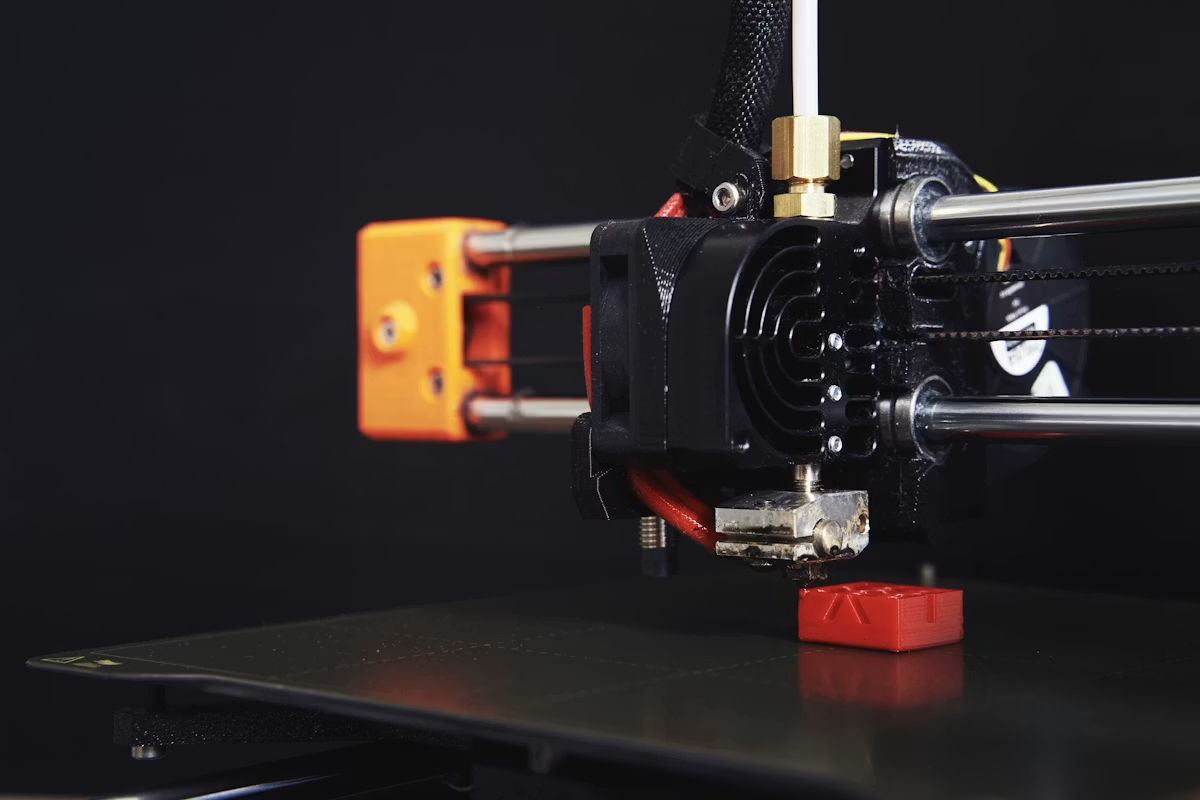
Photo: Christian Englmeier / Unsplash
Why HDT Matters More Than Glass Transition
Glass transition temperature (Tg) tells you when a plastic starts to soften; Heat Deflection Temperature tells you when a loaded part actually deforms. A PLA bracket warps in a parked summer car because cabin temps exceed its ~60°C Tg. For functional parts near heat, match the material’s HDT to your worst-case environment, with margin.
- PLA: ~60°C Tg — fails in hot cars. Not a heat-resistant option (see our PLA vs PLA+ comparison).
- PETG: usable to roughly 70–80°C — good for warm, not hot, environments.
- ABS/ASA: Vicat around 97–98°C — the entry point for genuinely heat-resistant parts (full breakdown in ABS vs ASA).
- PC: HDT typically 110–130°C depending on blend — the sweet spot for Bambu enclosed printers.
- PAHT-CF class nylons: ~150°C continuous, ~180°C short bursts — engineering territory.
- Bambu PPA-CF: prolonged use up to 227°C per Bambu’s spec — the ceiling on desktop Bambu hardware.
The Rankings, Explained
1. Polycarbonate (PC) — Best Overall
As the best heat-resistant filament for Bambu Lab overall, PC combines exceptional impact strength with HDT in the 110–130°C band, and Bambu’s enclosed printers (X1C, P1S, X2D, H2S, H2D) handle it natively with the stock hardened nozzle. Use minimal cooling (0–20% fan), a PEI plate with glue stick, and always dry it first — PC is aggressively hygroscopic. Start with our full PC printing guide and the best PC filament picks.
2. Bambu PPA-CF — Extreme Heat Champion
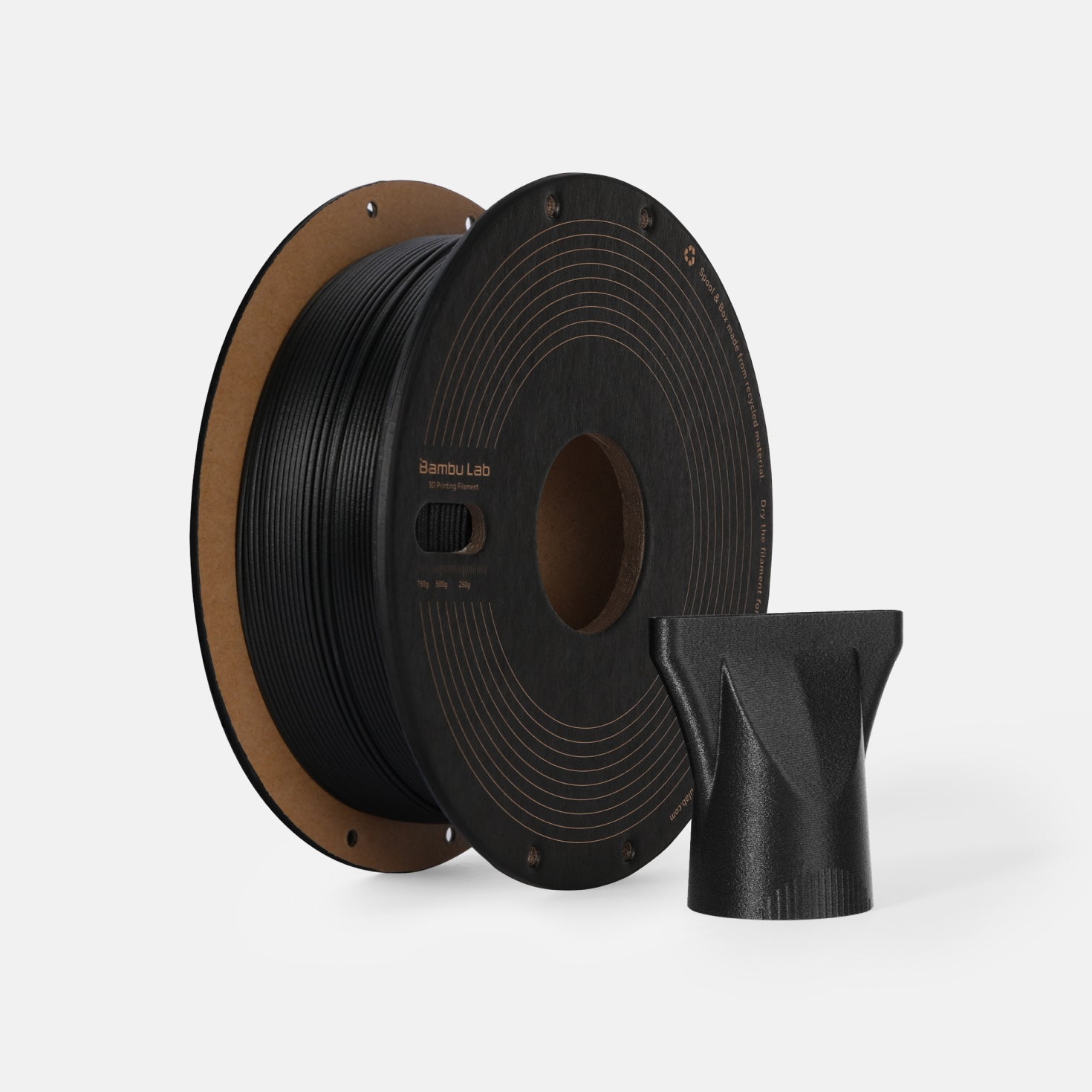
Image: Bambu Lab
Bambu’s PPA-CF is rated for prolonged exposure up to 227°C without losing structural integrity, prints at 280–310°C nozzle temps, and needs only an enclosure plus a hardened steel nozzle (P1S / X1C / X1E). Per Bambu’s data it is 48% stronger and 102% stiffer than standard PA6-CF, with 66% lower moisture absorption. It is also the most expensive pick here — reserve it for parts that truly live in extreme heat.
3. PA6-CF / PAHT-CF — Strength Plus Heat
Carbon-fiber nylons hold ~150°C continuously (up to ~180°C briefly, per PAHT CF15 specs) and print on enclosed Bambu machines with a hardened nozzle. Annealing after printing raises effective HDT further. The catch: nylon drinks moisture — dry at 80–95°C before every session and print from a dry box. See our nylon printing guide and best nylon filament roundup.
4. ASA — Outdoor Heat Workhorse
For outdoor parts, the best heat-resistant filament for Bambu Lab is ASA: it matches ABS’s ~98°C Vicat softening point while adding UV resistance, making it the default for car exterior parts and outdoor fixtures. It prints more easily than PC or nylon and costs less; enclosure strongly recommended. Current picks in our ASA roundup.
5. PETG — The Honest Budget Option
PETG is not a high-temp material, but at a ~70–80°C serviceable range it beats PLA decisively, prints on open-frame A1 machines, and costs the least. For enclosures around warm (not hot) electronics, it’s often all you need.
Printer Compatibility at a Glance
| Material | A1 / A1 mini / A2L | P1S / X1C / X2D / H2S / H2D | Hardware notes |
|---|---|---|---|
| PETG | Yes | Yes | Stock setup |
| ASA | Not recommended | Yes | Enclosure needed |
| PC | No | Yes | Dry first, low fan, glue stick |
| PA6-CF / PAHT-CF | No | Yes | Hardened nozzle, dry box |
| PPA-CF | No | P1S / X1C / X1E | Hardened steel nozzle, 280–310°C |
Drying Is Non-Negotiable

Photo: Jakub Żerdzicki / Unsplash
Every material on this list except ASA is strongly hygroscopic. Wet PC or nylon steams in the nozzle, weakening parts by 20–50%. Dry PC at 80°C for 6–8 hours and nylons at 80–95°C before printing — our complete filament drying guide covers exact times and methods for every material, and our settings database has per-filament profiles.
Where to Buy
- Bambu PC, PPA-CF and PA6-CF — Bambu Lab official store
- Polymaker PC and PA blends — polymaker.com, code BALUTAVLAD for 15% off
- ASA — see the current picks in our best ASA filament guide
Best Heat-Resistant Filament for Bambu Lab: FAQ
What is the most heat-resistant filament a Bambu printer can run?
The most heat-resistant filament for Bambu Lab printers is Bambu PPA-CF, rated for prolonged exposure up to 227°C on P1S, X1C and X1E with a hardened steel nozzle. Below that, PAHT-class carbon-fiber nylons hold ~150°C continuously and polycarbonate covers the 110–130°C band.
Is PETG heat resistant enough for a car?
For interior parts in direct summer sun, no — cabin temperatures can pass 80°C. Use ASA for exterior and sun-exposed parts, or PC/nylon for anything near the engine.
Can the A1 or A1 mini print heat-resistant filament?
Realistically only PETG. ASA, PC, nylon and PPA-CF all need an enclosure, which the open-frame A1 series lacks — check our compatibility checker for the full matrix.
Does annealing improve heat resistance?
Yes, especially for nylons and HT-PLA blends: baking printed parts relieves internal stress and raises effective HDT. Follow the manufacturer’s TDS temperatures to avoid warping the part.
Affiliate disclosure: FilamentPicks may earn a commission from qualifying purchases made through links on this page, at no extra cost to you. All recommendations are based on manufacturer specifications and community-verified data.