

Research-based guide. The settings below draw on Bambu Lab’s official material documentation, manufacturer spec sheets, and widely reported community experience — not a single hands-on lab test.
FilamentPicks is reader-supported. Some links on this page are affiliate links — as an Amazon Associate we earn from qualifying purchases, at no extra cost to you.
This guide covers exactly how to print nylon on Bambu Lab printers, from drying to slicer settings. Nylon (polyamide, PA) is the most capable material most Bambu owners never print successfully — stronger than ABS, tougher than PETG, and genuinely fit for load-bearing mechanical parts. The catch: nylon is the most moisture-sensitive filament in the ecosystem, and almost every failed nylon print traces back to a wet spool. Get drying right and the rest is closer to routine than its reputation suggests.
This guide covers pure nylon and carbon-fiber blends (PA-CF, PAHT-CF). For brand rankings, see our best nylon filament for Bambu Lab guide.
How to Print Nylon on Bambu Lab: Quick Settings
| Parameter | Recommended | Why |
|---|---|---|
| Drying (before every job) | 80°C for 8–12 h | PA is extremely hygroscopic |
| Nozzle temp | 250–290°C (per brand spec) | Varies by PA blend |
| Bed temp | 80–100°C | Adhesion + chamber heat |
| Chamber | 45–60°C, door closed | Bambu PAHT-CF spec |
| Nozzle hardware | Hardened steel for CF; 0.6 mm ideal | CF destroys soft nozzles, clogs less at 0.6 |
| Speed | ≤100 mm/s | Layer bonding needs heat soak |
| Plate | Textured PEI + glue stick | Adhesion + clean release |
| Brim | 8–10 mm, always | Non-negotiable with nylon |
These ranges align with Bambu’s PAHT-CF technical data sheet and community-verified starting points. Bambu Studio’s brand profiles preset the temperatures — follow your spool’s spec sheet over generic numbers.
Which Bambu Printers Can Print Nylon?
How to print nylon on Bambu Lab machines depends first on which printer you own — chamber temperature and enclosure make the difference.
| Printer | Nylon? | Notes |
|---|---|---|
| X1 Carbon / X1E | ✅ Yes | Enclosed; hardened extruder/nozzle stock on X1C |
| P1S / P2S | ✅ Yes | Enclosed; check nozzle before CF blends |
| H2S / H2D | ✅ Yes | Heated chamber — best case for PA |
| A1 / A1 Mini / A2L | ❌ Not recommended | Open-frame; warping and weak layers |
Open-frame A-series owners wanting engineering strength are better served by PETG — see where each material lands in our Bambu filament tier list.
Step 1: Dry the Spool — Not Optional
If you remember one thing about how to print nylon on Bambu Lab printers, make it this: drying comes before everything else.
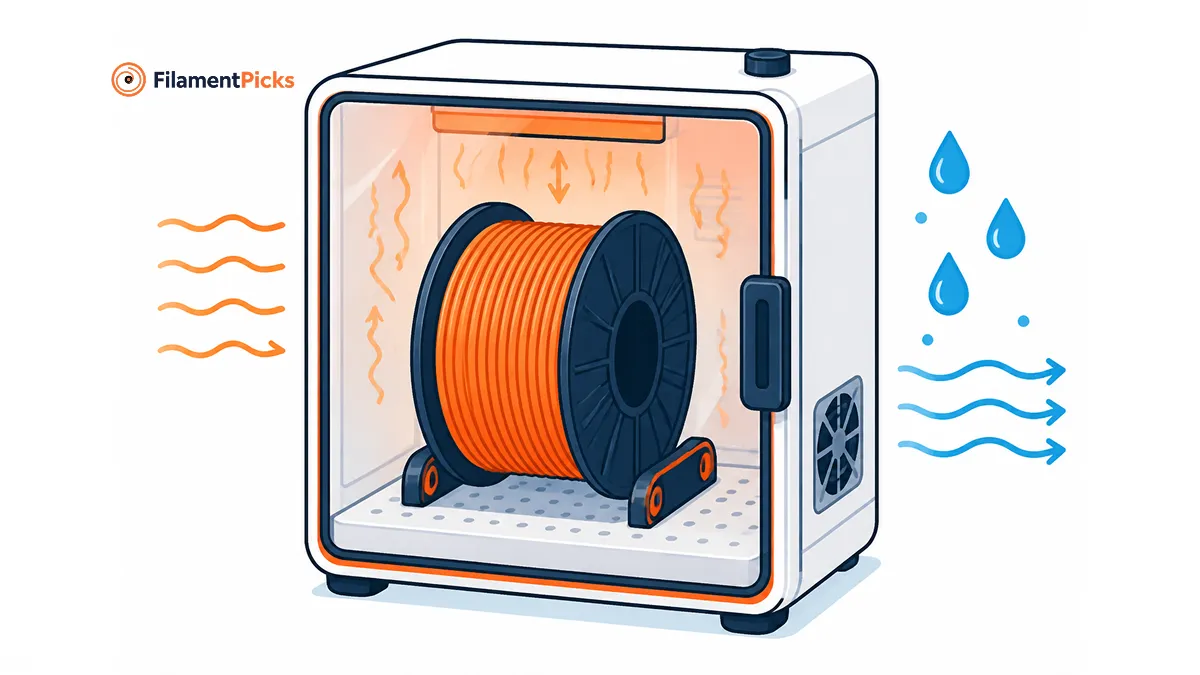
This is 80% of nylon success. Polyamide pulls moisture from the air within hours of unsealing, and wet nylon prints with a rough, foamy surface, aggressive stringing, and layers weak enough to snap by hand. Bambu’s own drying guidance for PA and PA-CF: 80°C for 8–12 hours in a blast/convection dryer, or 90–100°C for ~12 hours using the printer’s own heatbed with the door closed.
- Dry before every job unless the spool went straight from dryer to a sealed box or AMS with fresh desiccant.
- A spool left in open air for ~3 months may be beyond rescue — Bambu’s wiki notes heavily saturated PA becomes very difficult to dry at spool-safe temperatures. Store sealed from day one (see our filament storage guide).
- A dedicated dryer that can hold 80°C is the one accessory nylon genuinely requires — most budget dryers top out at 55–70°C. Our picks: best filament dryers for Bambu Lab.
Step 2: Check Your Nozzle (PA-CF Users, Especially)
Pure nylon is gentle on hardware, but carbon-fiber blends are abrasive enough to destroy a soft nozzle within a few spools. Rules of thumb:
- PA-CF / PAHT-CF: hardened steel nozzle is mandatory — see our hardened vs stainless nozzle guide for what ships on each printer.
- 0.6 mm is the community-preferred size for CF nylon: fibers clog a 0.4 mm bore far more often, and the strength-focused parts nylon is used for rarely need 0.4 mm detail.
- More on fiber-filled materials in our carbon fiber filament guide.
Step 3: Chamber and Bed Prep
Nylon shrinks as it cools, so treat the chamber like you would for ABS: door and lid closed, and on X1C/P1S/P2S preheat the bed at maximum for ~15 minutes before starting in a cool room. Bambu’s PAHT-CF sheet targets a 45–60°C chamber; the X1E, H2S and H2D can set it directly. On the plate: textured PEI, cleaned with dish soap, plus a thin glue-stick layer as both adhesion promoter and release agent — nylon can bond to bare PEI hard enough to damage the coating. Then add the 8–10 mm brim. Every time.
Step 4: Slicer Settings That Matter
The slicer side of how to print nylon on Bambu Lab machines is mostly handled by the stock PA profiles — you only need to adjust a few values.
- Temperature: follow the brand profile — pure PA typically runs 250–270°C, high-temp CF blends higher. If layers delaminate, step up 10°C before touching anything else.
- Speed: keep outer walls and critical features at or below ~100 mm/s. Nylon rewards heat-soak time per layer; this is not the material for speed benchmarks.
- Structure: Bambu’s guidance caps infill around 50% and walls around 6 to limit shrinkage stress — the default 2 walls + 15% is fine for non-structural parts.
- Retraction: modest (0.8–1.4 mm per Bambu’s PAHT-CF sheet). Excessive retraction with wet-ish nylon grinds the filament.
- Cooling: low. Like other high-shrink materials, drafts cause cracking; only bridges need real airflow.
Troubleshooting Nylon Prints
Even when you know how to print nylon on Bambu Lab printers, a few classic failure modes still show up. Here is how to read them.
| Symptom | Likely cause | Fix |
|---|---|---|
| Foamy, rough surface + popping | Wet filament | Dry 80°C / 8–12 h; store sealed |
| Heavy stringing | Moisture (first), temp (second) | Dry first; then −5–10°C nozzle |
| Corners lift / warping | Cold chamber, weak first layer | Preheat 15 min, glue + brim, +5°C bed |
| Layers snap apart | Too cold or too fast | +10°C nozzle, slow to ≤80 mm/s |
| Clogs mid-print (CF blends) | Fiber residue in 0.4 mm bore | Switch to 0.6 mm hardened nozzle |
Nylon vs the Alternatives
Before committing to learning how to print nylon on Bambu Lab printers, it is worth checking whether a simpler material already covers your use case.
Nylon’s niche is toughness plus wear resistance: gears, hinges, brackets, clips that flex, anything that takes impact. If the part mainly needs stiffness and heat resistance rather than impact toughness, polycarbonate is often the easier print. If it just needs to be “strong enough” indoors, PETG gets you most of the way with none of the drying ceremony.
Best Nylon Brands for Bambu Lab (Quick Picks)
Brand choice matters less than drying, but it still shapes how to print nylon on Bambu Lab hardware successfully.
| Use case | Pick | Approx. price |
|---|---|---|
| Best plug-and-play CF nylon | Bambu PAHT-CF | ~$65–75/kg, RFID auto-settings |
| Best pure nylon | Polymaker PolyMide CoPA | ~$40–50/kg |
| Best budget | eSUN ePA / ePA-CF | ~$30–40/kg |
Bambu PAHT-CF — easiest serious nylon
A carbon-fiber blend on a nylon-12 base, engineered for roughly half the moisture uptake of standard PA-CF, with strong Z-axis bonding and a heat-resistant spool that survives the dryer. RFID loads the full profile automatically. Check on Amazon →
Polymaker PolyMide CoPA — best pure nylon
Polymaker’s warp-resistant copolymer nylon is the community’s default unfilled PA: tough, machinable, and more forgiving of chamber dips than classic PA6. Get 15% off at Polymaker with code BALUTAVLAD → · Check on Amazon →
eSUN ePA — best budget entry
A standard formulation at the category’s friendliest price. Follow every drying step in this guide religiously and it delivers genuine nylon toughness for prototypes and workshop parts. Check on Amazon →
Full rankings with pros and cons: best nylon filament for Bambu Lab.
FAQ
Can beginners learn how to print nylon on Bambu Lab printers?
Yes — as long as the spool is properly dried and you start with a standard PA profile in Bambu Studio, learning how to print nylon on Bambu Lab machines is very achievable for a first-timer.
Can I print nylon straight from the AMS?
The AMS stores filament but doesn’t dry it. Dry the spool first, then run it from the AMS with fresh desiccant — for long prints in humid climates, many users feed from a heated drybox instead.
Do I really need to dry a brand-new spool?
Usually yes. Vacuum packaging slows but doesn’t stop moisture uptake, and spools can sit in warehouses for months. A pre-print dry is cheap insurance on a material this sensitive.
Is PA-CF stronger than PAHT-CF?
They trade blows: standard PA-CF (often PA6-based) can edge out on raw stiffness when bone-dry, while PAHT-CF (PA12-based) holds its properties far better in humidity and bonds better between layers. For real-world parts that live outside a lab, that stability usually wins.
Does nylon smell when printing?
Far less than ABS or ASA, but ventilation is still sensible — run enclosed, keep the room aired, and let the carbon filter do its job.
Once your spool is dry and your profile is dialed in, learning how to print nylon on Bambu Lab machines stops being intimidating — it becomes just another material in your rotation.
Related Guides
- Best Nylon Filament for Bambu Lab
- Best Filament Dryers for Bambu Lab
- Best Carbon Fiber Filament for Bambu Lab
- Hardened vs Stainless Steel Nozzles
- How to Store Filament Properly
- Best PC Filament for Bambu Lab
- Bambu Lab Filament Tier List
Affiliate disclosure: FilamentPicks is reader-supported. When you buy through links on this page, we may earn a commission at no extra cost to you. Recommendations reflect manufacturer specs, community testing, and widely reported user experience.