

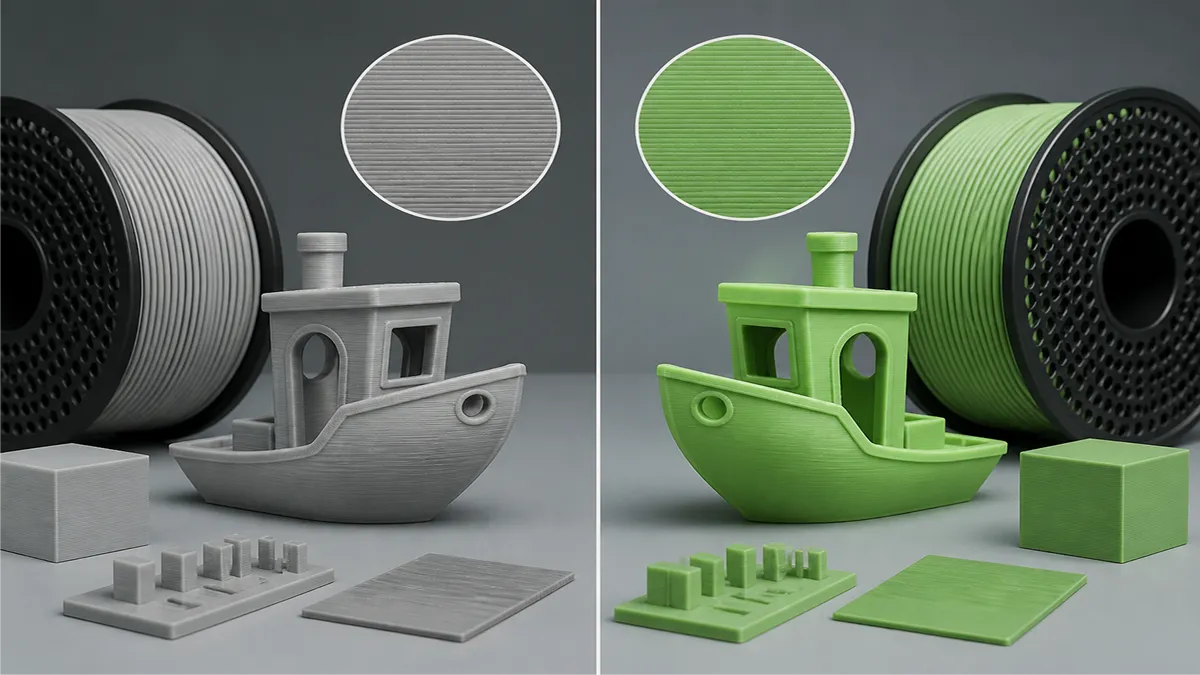
Every filament shop lists both “PLA” and “PLA+,” usually for a dollar or two apart, and it’s not obvious what the plus actually buys you. On a Bambu Lab printer the difference is real but narrow: PLA+ trades a little printing convenience for meaningfully better toughness. This research-based guide breaks down what changes, when it’s worth paying for, and when plain PLA is the smarter spool — drawn from manufacturer data sheets and widely reported community results.
Quick verdict
Display models, minis, quick prototypes → standard PLA (cheaper, easiest first layer)
Functional parts, brackets, cosplay, anything that gets handled or stressed → PLA+
On Bambu hardware both print easily; PLA+ just wants a slightly hotter nozzle
In this guide
What “PLA+” actually means
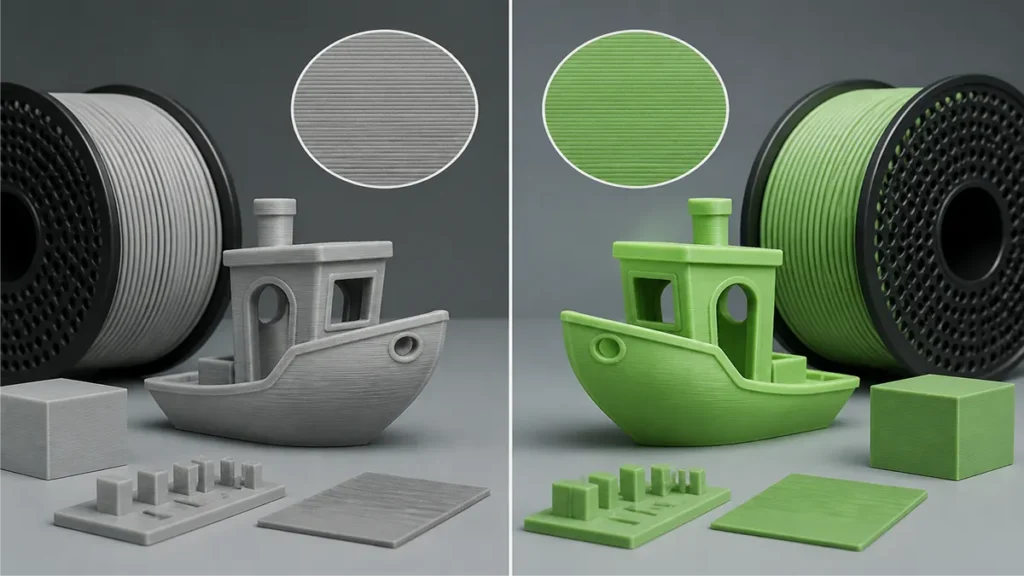
There is no single industry standard for “PLA+.” It’s a marketing label each manufacturer applies to a PLA base blended with additives and impact modifiers that improve toughness, layer adhesion and surface finish. The widely reported result is a filament that’s noticeably less brittle than basic PLA and bonds better between layers, while keeping most of PLA’s famous ease of printing. Brands like eSUN PLA+ and SUNLU PLA+ are the community reference points.
Side-by-side
Property | Standard PLA | PLA+ |
|---|---|---|
Toughness / impact | Brittle, can snap | Notably tougher, more ductile |
Layer adhesion | Good | Better |
Surface finish | Good | Often slightly cleaner |
Nozzle temp | 190–220°C | 200–240°C (a touch higher) |
First-layer bed adhesion | Excellent | Slightly fussier (higher temp) |
Warping risk | Very low | Low, marginally higher than PLA |
Price /kg | ~$14–18 | ~$18–22 |
Best for | Looks, minis, prototypes | Functional & handled parts |
Figures are typical ranges from manufacturer data and community reports; exact numbers vary by brand and color.
Where PLA+ pulls ahead
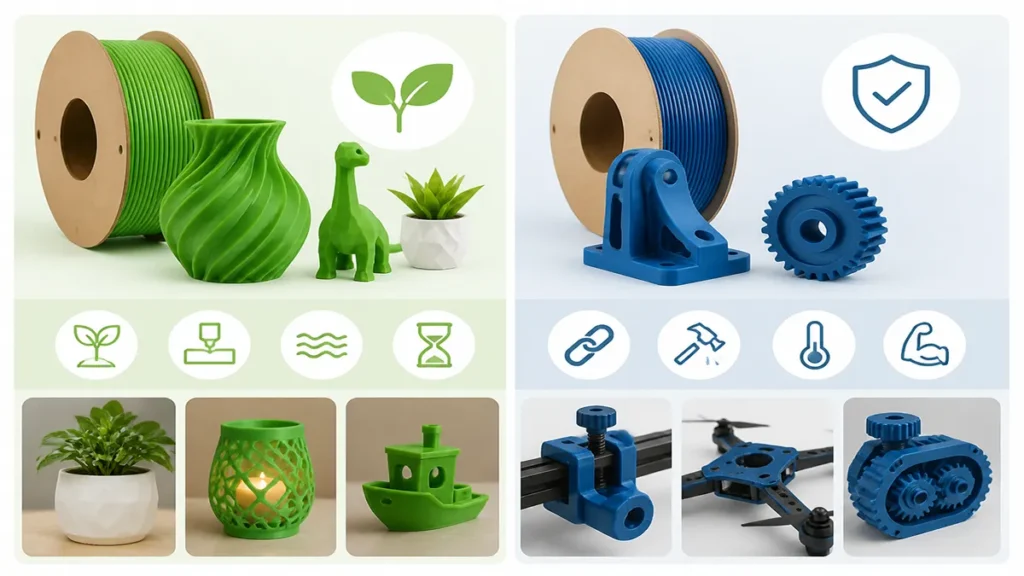
- Toughness. The headline benefit. Standard PLA is stiff but brittle and snaps under impact; PLA+ flexes a little before it fails, which is why it’s the go-to for cosplay props, armor, RC parts and brackets that get dropped or levered.
- Layer adhesion. The added modifiers help layers fuse, so parts are stronger in the weak Z direction — useful for any load that pulls across layer lines.
- Finish. Many users report a slightly smoother, more uniform surface, helped by the marginally higher print temperature.
Where standard PLA still wins
- Easiest first layer. PLA’s lower print temperature gives it slightly better bed adhesion out of the gate — handy for big flat first layers.
- Price. For display pieces, minis and throwaway prototypes you simply don’t need the extra toughness, so the cheaper spool is the rational choice.
- Lowest warping. PLA’s very low shrinkage makes it the most forgiving filament there is — PLA+ is close, but its higher temp adds a hair more warp risk on large parts.
Does PLA+ change anything on a Bambu printer?
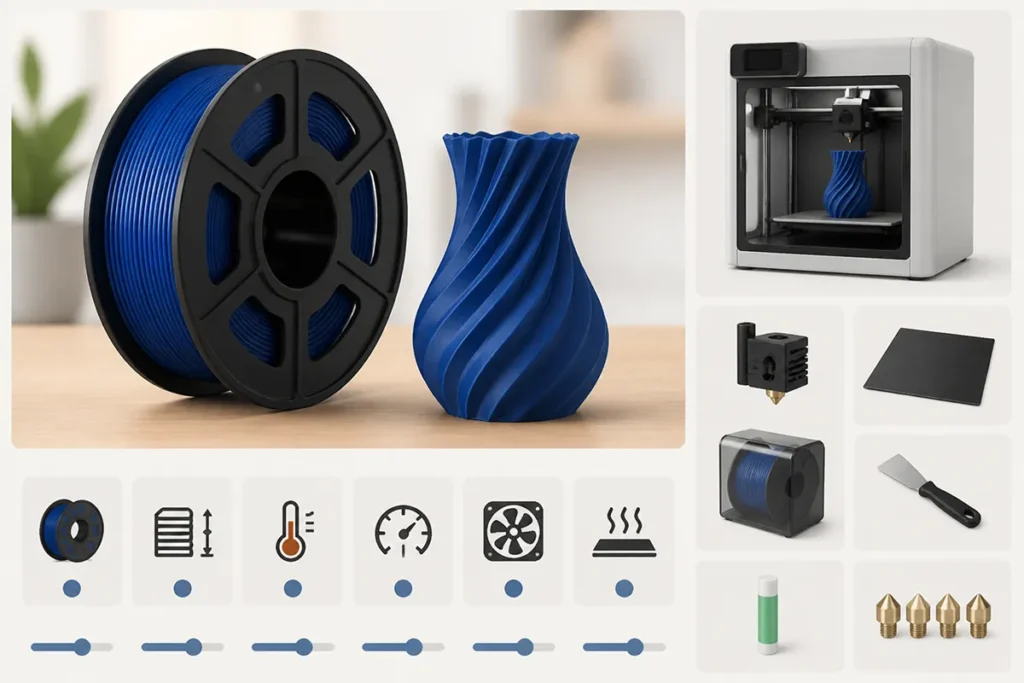
Not much — both run cleanly on Bambu hardware with the stock stainless-steel nozzle and feed through the AMS without issue. The only practical adjustments for PLA+:
- Nudge the nozzle up. Run PLA+ a touch hotter than PLA (toward the 215–230°C range) and confirm with a temperature tower for your spool.
- Keep the first layer dialed. Clean plate, correct Z-offset, first layer squished — PLA+’s higher temp is slightly less sticky, so don’t skip bed prep.
- Don’t over-cool. Excess part-cooling fan can weaken PLA+’s improved layer bonding; the Bambu PLA profile fan settings are a fine starting point.
Neither needs an enclosure, and neither is abrasive, so a stainless nozzle is perfect — see our hardened vs stainless nozzle guide for when that changes.
So which should you buy?
If you mostly print models, minis, terrain or quick prototypes, standard PLA is all you need and saves money. The moment a part has a job to do — a bracket, an enclosure, a cosplay piece, anything that gets handled — step up to PLA+ for the toughness and layer strength. Many makers simply keep a spool of each: cheap PLA for looks, PLA+ for function. For where both sit against tougher materials, see our PLA vs PETG vs PETG-HF comparison.
Where to buy
As an Amazon Associate we earn from qualifying purchases. Click through for current pricing.
- eSUN PLA+ on Amazon — the community-favorite tough PLA
- SUNLU PLA+ on Amazon — strong value, wide colors
- Standard PLA on Amazon — for display & prototype prints
Frequently asked questions
Is PLA+ stronger than PETG?
Not really. PLA+ is tougher than basic PLA, but PETG still beats it on heat resistance, UV stability and impact for outdoor or higher-stress parts. PLA+ is the upgrade within the PLA family, not a PETG replacement.
Can I print PLA+ with my standard Bambu profile?
Yes — the generic PLA profile works as a baseline. Just consider raising the nozzle temperature slightly and running a quick temp tower for the best layer adhesion.
Does PLA+ need drying?
Like all PLA it absorbs moisture over time. Fresh, sealed spools print fine; opened spools left out can string or sound crackly — dry them and store with desiccant. See our how to store filament guide.
Is PLA+ more heat resistant?
Marginally, thanks to the higher print temperature, but don’t count on it for hot environments — a part in a hot car will still soften. For heat resistance, move to PETG, ASA or ABS.
The bottom line
PLA+ is the same easy-printing material as PLA with the brittleness engineered out — tougher, better layer adhesion, slightly cleaner finish, for a small price bump and a marginally fussier first layer. Buy standard PLA for anything decorative and PLA+ for anything functional. On Bambu hardware both are effortless; PLA+ just likes a few extra degrees on the nozzle.
Related reading: Best PLA filament for Bambu Lab • PLA vs PETG vs PETG-HF • Bambu filament tier list
Affiliate disclosure: FilamentPicks is reader-supported. When you buy through links on this page we may earn a small commission at no extra cost to you. We only recommend filaments based on manufacturer specifications, published technical data sheets and community reports — this is a research-based guide, not a hands-on lab test.