

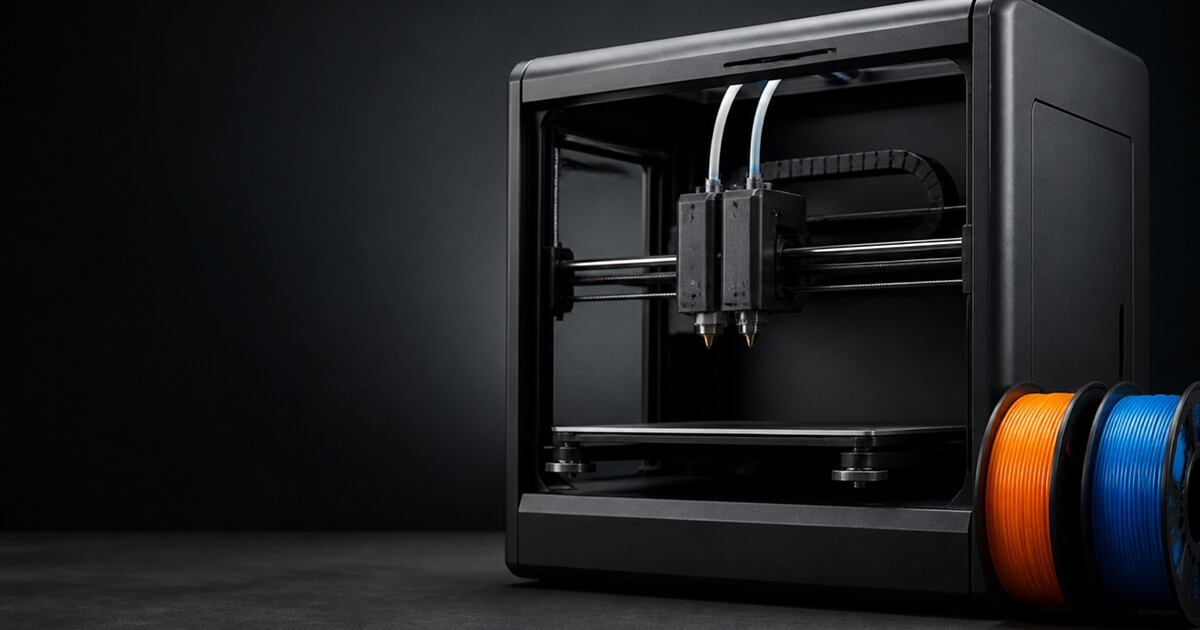
Choosing the best filament for Bambu H2D owners comes down to matching the spool to the job — because the Bambu Lab H2D is not just another fast printer — it is a large-format, dual-nozzle machine that can push its hotends up to 350°C inside a heated, air-managed chamber. That changes the filament conversation completely. On an A1 Mini you mostly think about PLA and PETG; on the H2D you can realistically run carbon-fiber nylons, polycarbonate blends and engineering composites that would warp or clog on lighter machines.
This is a research-based guide. We don’t claim to have printed every spool on an H2D ourselves — the picks below are drawn from official Bambu Lab specifications, the Bambu Wiki filament documentation, and widely reported community experience. Where a material needs special handling, we say so.
Quick answer
- Everyday & prototyping: Bambu PLA Basic or PLA-CF — cheap, fast, reliable.
- Functional & outdoor: a current, documented PETG, ASA or ABS — select by the exact application and product data.
- Maximum strength: Bambu PAHT-CF, PET-CF or PPA-CF — what the H2D was built for.
- Flexible parts: Bambu TPU 95A HF — right hotend only, must be dried first.
See also: Bambu H2D Filament Compatibility: What It Can Print
Quick Picks: Best Filament for the Bambu H2D by Use Case
These are our quick picks for the best filament for Bambu H2D owners, grouped by what you are actually printing. Prices are approximate (per kg unless noted) and move with sales — always check the live listing before buying.
| Use case | Recommended filament | Why it fits the H2D | Approx. price |
|---|---|---|---|
| Everyday / prototyping | Bambu PLA Basic | Fast, forgiving, dirt-cheap | ~$14–18 |
| Stiff light parts | Bambu PLA-CF | Stiffer than PLA, low clog risk | ~$30 |
| Functional / lower-warp | Current Bambu PETG product | Verify regional listing, TDS and matching profile | Check regional store |
| Outdoor / UV exposure | Bambu ASA | Heated chamber helps manage warping; verify the application | Check regional store |
| High strength / heat | Bambu PAHT-CF | Engineering-grade, low moisture | ~$60 / 0.5kg |
| Stiffest / load-bearing | Bambu PET-CF | High heat & dimensional stability | ~$60–70 / 0.5kg |
| Flexible | Bambu TPU 95A HF | H2D soft+hard multi-material | ~$30 |
What Makes the H2D Different for Filament Choice
Four hardware facts drive almost every recommendation when picking the best filament for Bambu H2D printing.
1. A 350°C hotend
The H2D reaches nozzle temperatures up to 350°C. That headroom makes high-temperature engineering composites — PET-CF, PPA-CF, PPS-CF and PA-based filaments — realistically printable, not just technically loadable.
2. A heated, air-managed chamber
The H2D’s heated chamber supports the temperature control required by materials such as ABS, ASA and some engineering composites, but it does not guarantee warp-free printing. Follow the exact material profile, build-surface and drying guidance. The enclosure and built-in filtration also do not remove the need for exposure control: NIOSH recommends appropriate ventilation and effective source filtration for 3D-printing emissions, together with the material safety data sheet.
3. A dual-nozzle, soft+hard workflow
The H2D prints rigid filament on the left hotend and flexible TPU on the right. Per the Bambu Wiki, soft+hard multi-material currently supports TPU 95A HF on the right hotend, with a “Beam Interlocking” option in Bambu Studio. Flexible filament must be fed from an external spool and dried first.
4. AMS 2 Pro and AMS HT drying
The H2D can pair with AMS 2 Pro and AMS HT accessories, but drying temperature, duration and feed compatibility remain product-specific. The AMS HT reaches a higher drying temperature than AMS 2 Pro, and some abrasive or flexible filaments must use a bypass or external path. Match the exact filament to the current AMS compatibility table and its technical data sheet; a dryer does not make every spool safe to keep loaded or feed through an AMS channel.
Best Everyday Filament for the H2D: PLA and PLA-CF
When people ask about the best filament for Bambu H2D everyday printing, the honest answer is usually PLA. Most H2D owners still spend the bulk of their time in PLA — fast, cheap, and the H2D rips through it. Bambu PLA Basic remains the default for prototypes, drafts and display pieces, and it is the friendliest material to learn the machine on.
For stiffer parts without a full engineering material, Bambu PLA-CF is the easy middle ground — chopped carbon fiber for rigidity while keeping PLA’s low clog risk, and it prints fine on a 0.4 mm nozzle. See our Bambu Lab PETG compatibility guide for how these materials compare across the lineup.
Best Functional Filament: PETG, ASA and ABS
For functional work, the best filament for Bambu H2D parts that need to survive heat, sunlight or rough handling is usually PETG, ASA or ABS — and the H2D’s chamber unlocks materials that struggle on open printers.
- Current Bambu PETG — Bambu lists PETG Basic in some regions and PETG HF in others. Choose the exact current product whose TDS, profile, drying guidance and mechanical properties fit the part; do not transfer claims between formulas.
- Bambu ASA — intended for better UV and weather resistance than ABS. Suitability still depends on the exact load, temperature, exposure and part design; the heated chamber helps process control but does not guarantee success.
- Bambu ABS — classic strong, machinable, heat-tolerant plastic, minus most of the warping pain.
If PETG is your main material, our best PETG filament for Bambu Lab roundup goes deeper on brand-by-brand picks.
✅ Recommended Filament
Current PETG — Verify the Exact Product for the H2D
Start with a current PETG product supported by the H2D and its matching profile. Confirm regional availability, drying guidance, mechanical data and AMS compatibility for that exact formula.
Compare Current PETG Products →Best Engineering Filament: CF-Nylon, PET-CF and PPA-CF
The H2D supports a broad range of fiber-reinforced and high-temperature materials, but support at printer level is not a universal recipe. The printer supplies a hardened hotend and heated chamber; drying may require a compatible AMS HT or separate equipment, and each material has its own nozzle, feed, build-surface, drying and annealing requirements.
- Bambu PAHT-CF — Bambu describes this as a low-moisture-absorption PA12/carbon-fiber material, but the page does not support a blanket “50% lower” comparison. Current official guidance specifies 80°C for 8–12 hours in a blast drying oven and humidity below 20% RH during printing/storage; follow the exact regional product page.
- Bambu PET-CF — excellent heat resistance and dimensional stability for load-bearing parts. High crystallinity makes it warp-prone, so use a clean plate plus Bambu liquid glue.
- Bambu PPA-CF — a premium fiber-reinforced nylon for industrial use: mechanical prototypes, fixtures and automotive-grade parts.
Nozzle note for abrasive filaments
- CF/GF filaments are abrasive and require a hardened nozzle. Permitted and recommended diameter is product-specific; check the exact H2D hotend/filament compatibility table instead of treating 0.6 mm as a universal requirement.
- Bambu’s current H2D compatibility tables mark the 0.2 mm nozzle unsupported for the listed CF/GF materials. Follow the exact product table rather than an uncited clog-probability claim.
- Many CF and PA filaments are too brittle or abrasive for the AMS channel — feed them from an external spool / the rear port instead.
Best Flexible Filament: TPU 95A HF
For flexible work, the best filament for Bambu H2D soft-and-hard prints is TPU. The H2D’s headline trick is printing rigid and flexible material in the same part. For that workflow, Bambu TPU 95A HF on the right hotend is the supported choice. The Bambu Wiki is explicit that the TPU must be fully dried first — AMS HT at 75°C for 18 hours is recommended — otherwise clogging risk is high. Feed it from an external spool, not the AMS channel.
H2D Filament Compatibility at a Glance
| Material | Nozzle | AMS / feed | Drying | Chamber |
|---|---|---|---|---|
| PLA / PLA Basic | 0.4 mm any | AMS 2 Pro OK | Optional | Not needed |
| PETG (exact current product) | Use matching product/profile guidance | Verify exact AMS compatibility | Follow exact product | Usually not required; follow profile |
| ASA / ABS | 0.4 mm any | AMS 2 Pro OK | Recommended | Yes |
| PLA-CF / PETG-CF | 0.4 mm hardened | AMS 2 Pro OK | Recommended | Helps |
| PAHT-CF | Hardened; verify diameter | Verify current AMS HT / bypass guidance | 80°C / 8–12h (official blast-oven guidance) | Yes |
| PET-CF / PPA-CF | 0.6 mm hardened | External / rear port | Aggressive | Yes |
| TPU 95A HF | Right hotend | External spool | 75°C / 18h | Helps |
Drying and storage still matter most
Moisture sensitivity differs by material and formulation. Use the exact manufacturer drying temperature, duration and target humidity; do not substitute a generic schedule. AMS 2 Pro and AMS HT have different temperature limits and feed compatibility, so confirm whether the accessory is intended to dry, store and/or feed the exact spool. Our storage guide provides general orientation, while the product TDS remains authoritative.
Where to Buy Filament for the Bambu H2D
Ready to buy the best filament for Bambu H2D projects? The picks below link to current listings. As an Amazon Associate we may earn from qualifying purchases at no extra cost to you.
- Bambu PLA Basic — everyday workhorse.
- Current PETG comparison — verify the exact regional product, profile and TDS.
- Bambu ASA — outdoor and UV-stable parts.
- Bambu PAHT-CF — practical first engineering filament.
- Bambu TPU 95A HF — for soft+hard multi-material prints.
Final verdict: the best filament for Bambu H2D
Match the exact current filament to the job and to Bambu’s H2D compatibility data. PLA is a straightforward baseline; PETG, ASA and ABS require product- and application-specific comparison; engineering composites add strict drying, feed, nozzle and chamber requirements. The printer is capable, but this research-only guide cannot rank one universal limiting factor or guarantee suitability for a safety-critical or load-bearing part.
Frequently Asked Questions
What is the best all-round filament for the Bambu H2D?
There is no evidence here for one best filament for most H2D owners. PLA is usually the simplest baseline for prototypes and display models. For functional parts, compare the exact current PETG, ASA or other product using its TDS, regional availability, profile support and the part’s real load, temperature and exposure requirements.
Can the Bambu H2D print carbon fiber filament?
Yes — a core strength of the H2D. With a 350°C hotend, heated chamber and a 0.6 mm hardened steel nozzle, it handles PLA-CF, PET-CF, PAHT-CF and PPA-CF. Use external-spool feeding and aggressive drying for the nylon-based composites.
Do I need a hardened nozzle for the H2D?
Only for abrasive filaments. CF and GF materials wear brass nozzles quickly, so a hardened steel nozzle (0.6 mm recommended) is essential for those. Plain PLA, PETG and ASA are fine on a standard 0.4 mm nozzle.
Can I print flexible TPU on the H2D?
Yes, on the right hotend. The H2D supports TPU 95A HF for soft+hard multi-material printing, fed from an external spool and dried first (75°C for 18 hours is the recommended start).
Related Guides
- Best Filament for Bambu X1 Carbon
- Best Filament for Bambu P2S
- Best Filament for Bambu X2D
- Bambu Filament vs Third-Party
- How to Store Filament Properly