

Research-based guide. Recommendations below draw on manufacturer specifications, community testing, and widely reported user experience across the Bambu Lab ecosystem — not a single hands-on lab test.
Choosing the best ABS filament for Bambu Lab printers comes down to two things most PLA buyers never think about: a sealed enclosure and warp control. ABS and its weather-resistant cousin ASA are the materials you reach for when a part needs to survive heat, sunlight, or mechanical stress — think automotive brackets, outdoor mounts, and functional tooling. This guide ranks the brands that print these materials cleanly on Bambu hardware, and flags which printers can actually handle them.
Quick reality check on hardware: ABS and ASA want an enclosed chamber. That means the X1 Carbon, X2D, H2D, P1S, and P2S are the right tools. The open-frame A1 and A1 mini can technically run ABS but will fight warping the whole way — for those, stick with PETG.
IN THIS GUIDE
- ABS vs ASA: which one do you need?
- Best ABS filament for Bambu Lab
- Best ASA filament for Bambu Lab
- Which Bambu printers can run ABS & ASA?
- Print settings that actually work
- Price guide 2026
- How we ranked these brands
- FAQ
ABS vs ASA: Which One Do You Need?
They’re chemically close, and on a Bambu printer they behave almost identically — same enclosure requirement, similar temperatures, similar warp tendency. The difference is the outer layer of the part.
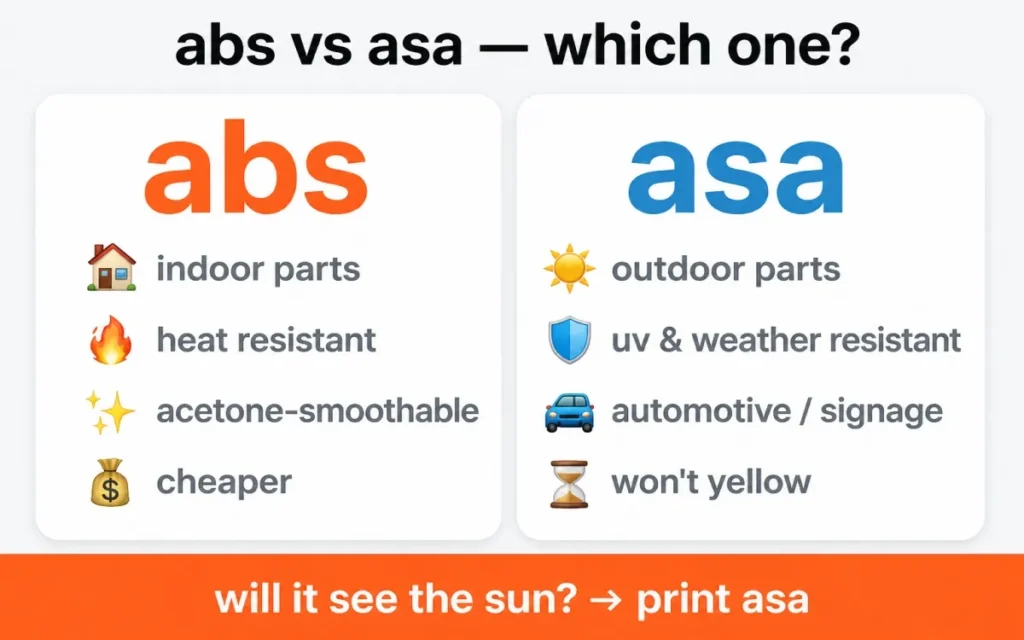
| Pick | When |
|---|---|
| ABS | Indoor functional parts, enclosures, tooling, anything that needs heat resistance and easy post-processing (acetone smoothing). |
| ASA | Anything that lives outdoors. ASA resists UV and weathering far better — ABS yellows and goes brittle in sunlight within months. |
Simple rule: if the part will ever see the sun, print ASA. Otherwise ABS is cheaper and just as strong. For a fuller material breakdown, see our PLA vs PETG vs PETG HF comparison.
Best ABS Filament for Bambu Lab
eSUN ABS+ — the community default
If you ask an enclosed-Bambu owner which ABS to buy, the answer is almost always eSUN ABS+. The “plus” formulation lowers the warp and odour of traditional ABS while keeping the strength, and at roughly $20/kg it’s the value benchmark. It feeds cleanly through the AMS and has presets in Bambu Studio. For most people printing functional indoor parts, this is the one to start with.
Best for: brackets, enclosures, general functional printing. Check eSUN ABS+ on Amazon →
Polymaker ABS (PolyLite / ABS Pro / ABS Max) — the low-warp specialist
Polymaker’s ABS lineup is engineered specifically to tame warping, the single biggest reason ABS prints fail. The newer ABS Pro and ABS Max formulations push impact strength and dimensional stability further, and the whole range has dedicated Bambu Studio profiles. It costs a little more than eSUN but earns it on large, flat parts that would otherwise lift off the plate.
Bambu Lab ABS — the zero-config option
First-party ABS ships AMS-ready with automatic, fully-tuned settings — load it and print, no profile hunting. Quality is excellent and it integrates flawlessly with the AMS, including RFID auto-detection. You pay a premium over third-party, but for multi-colour ABS or hands-off reliability it’s the safe choice.
Best for: beginners to ABS, multi-colour prints, RFID convenience. Check Bambu Lab ABS on Amazon →
Best ASA Filament for Bambu Lab
Polymaker ASA — the outdoor benchmark
Polymaker ASA is the most consistently recommended weather-resistant filament for Bambu printers. UV stability is excellent, warping is well-controlled for an ASA, and the Bambu Studio profile gets you a clean first layer without much fuss. If you’re printing parts for a garden, a car, or anything mounted outside, this is the default.
Best for: outdoor mounts, automotive, signage. Get 15% Off at Polymaker → Check on Amazon
Use code BALUTAVLAD for 15% off your first Polymaker order.
Prusament ASA — the precision pick
When dimensional accuracy matters as much as weather resistance, Prusament ASA brings the same tight tolerances the brand is known for. It’s a premium choice and the spool isn’t AMS-optimised, but for precision outdoor parts it’s hard to beat.
Best for: precision outdoor and functional parts. Check Prusament ASA on Amazon →
Bambu Lab ASA — AMS-native convenience
Like its ABS sibling, Bambu’s own ASA is the plug-and-play option with automatic settings and RFID. A strong pick if you want weather resistance without touching a slicer profile.
Best for: hands-off outdoor printing. Check Bambu Lab ASA on Amazon →
Which Bambu Printers Can Run ABS & ASA?
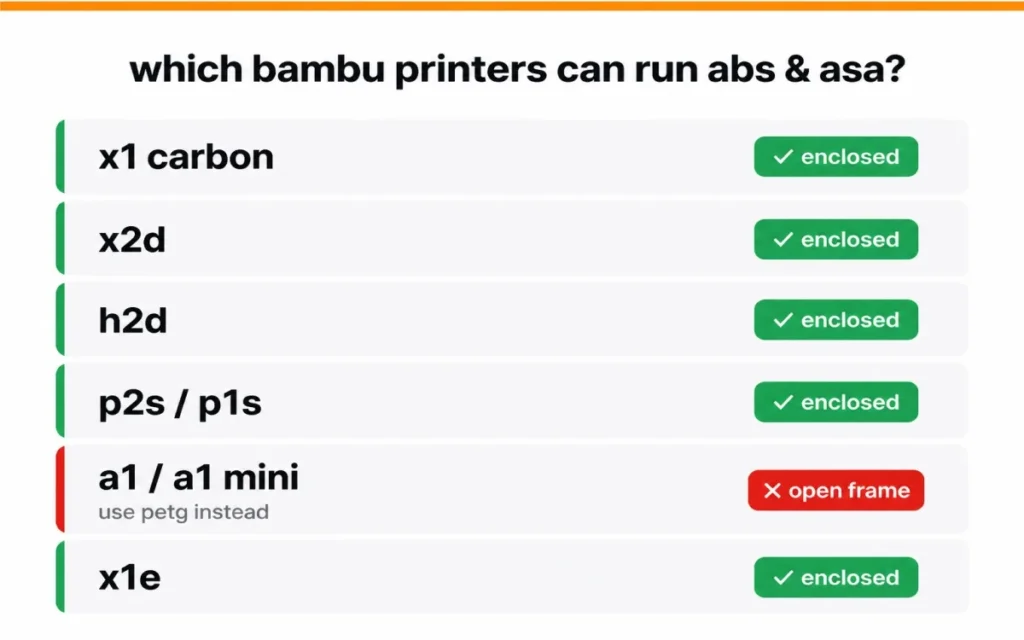
Both materials need a stable, warm chamber. Here’s how the current lineup stacks up.
| Printer | Rating | Notes |
|---|---|---|
| X1 Carbon | Excellent | Enclosed, heated chamber-friendly. The reference machine for ABS/ASA. |
| X2D / H2D | Excellent | Enclosed and high-temp capable; handle large ABS parts well. |
| P2S / P1S | Very good | Enclosed; reliable for ABS/ASA with a few setting tweaks. |
| A1 / A1 mini | Not recommended | Open frame — expect heavy warping. Use PETG instead. |
For the full material rundown per machine, see our guides to the Bambu X1 Carbon, X2D, H2D, and P2S.
Print Settings That Actually Work
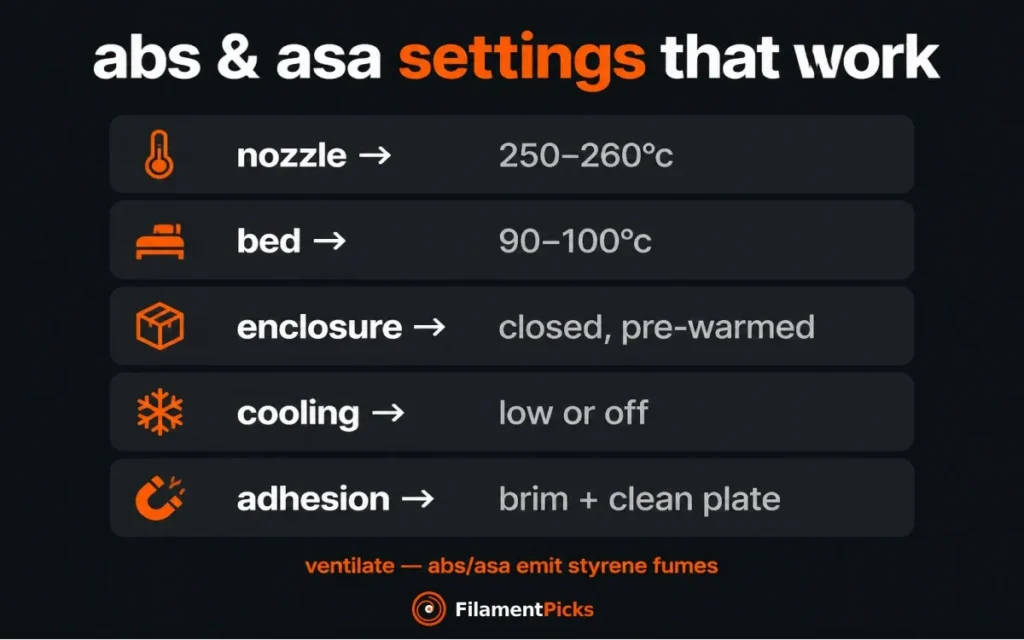
ABS and ASA succeed or fail on warp control. These starting points work across most enclosed Bambu machines — fine-tune from there.
- Nozzle: 250–260°C | Bed: 90–100°C
- Enclosure: keep it closed and let the chamber warm up before printing — ambient heat is what stops warping.
- Cooling: part fan low or off; aggressive cooling causes layer splitting and warp.
- Adhesion: brim for large parts, clean plate, and a glue stick on glass/PEI.
- Ventilation: ABS/ASA emit styrene fumes — print in a ventilated space or use the enclosure’s filtration.
Keep filament dry, too — both materials absorb moisture. Our filament storage guide covers cheap, effective options.
Price Guide 2026
| Brand | Typical price | Notes |
|---|---|---|
| eSUN ABS+ | ~$20 / kg | Best value; the community default |
| Polymaker ABS / ASA | ~$22–28 / kg | Low-warp engineering; ABS Pro/Max at the top |
| Prusament ASA | ~$30+ / kg | Premium tolerance, precision parts |
| Bambu Lab ABS / ASA | ~$25–30 / kg | RFID + auto settings, AMS-native |
How We Ranked These Brands
Three factors drive every placement:
- Warp & print reliability — the make-or-break factor for ABS/ASA on enclosed Bambu machines.
- AMS compatibility — spool shape, feeding, and whether a Bambu Studio preset exists.
- Value for money — true cost per gram against the quality delivered.
Rankings reflect manufacturer specs, community testing, and widely reported experience as of 2026. For the bigger picture across all materials, see our Bambu Lab filament tier list.
Frequently Asked Questions
What is the best ABS filament for Bambu Lab?
For most users, eSUN ABS+ is the best balance of price, low warp, and reliability. Polymaker ABS is the upgrade for large parts, and Bambu’s own ABS is the easiest plug-and-play option.
Can the Bambu A1 or A1 mini print ABS?
Technically yes, but they’re open-frame and will warp badly without a stable warm chamber. For these printers, PETG is the better high-strength choice.
Is ABS or ASA better for outdoor parts?
ASA. It resists UV and weathering far better than ABS, which yellows and grows brittle in sunlight. Print ASA for anything that lives outside.
Affiliate disclosure: FilamentPicks is reader-supported. As an Amazon Associate we earn from qualifying purchases. Product links may be affiliate links at no extra cost to you. Rankings are based on independent research and community data, not paid placement.