

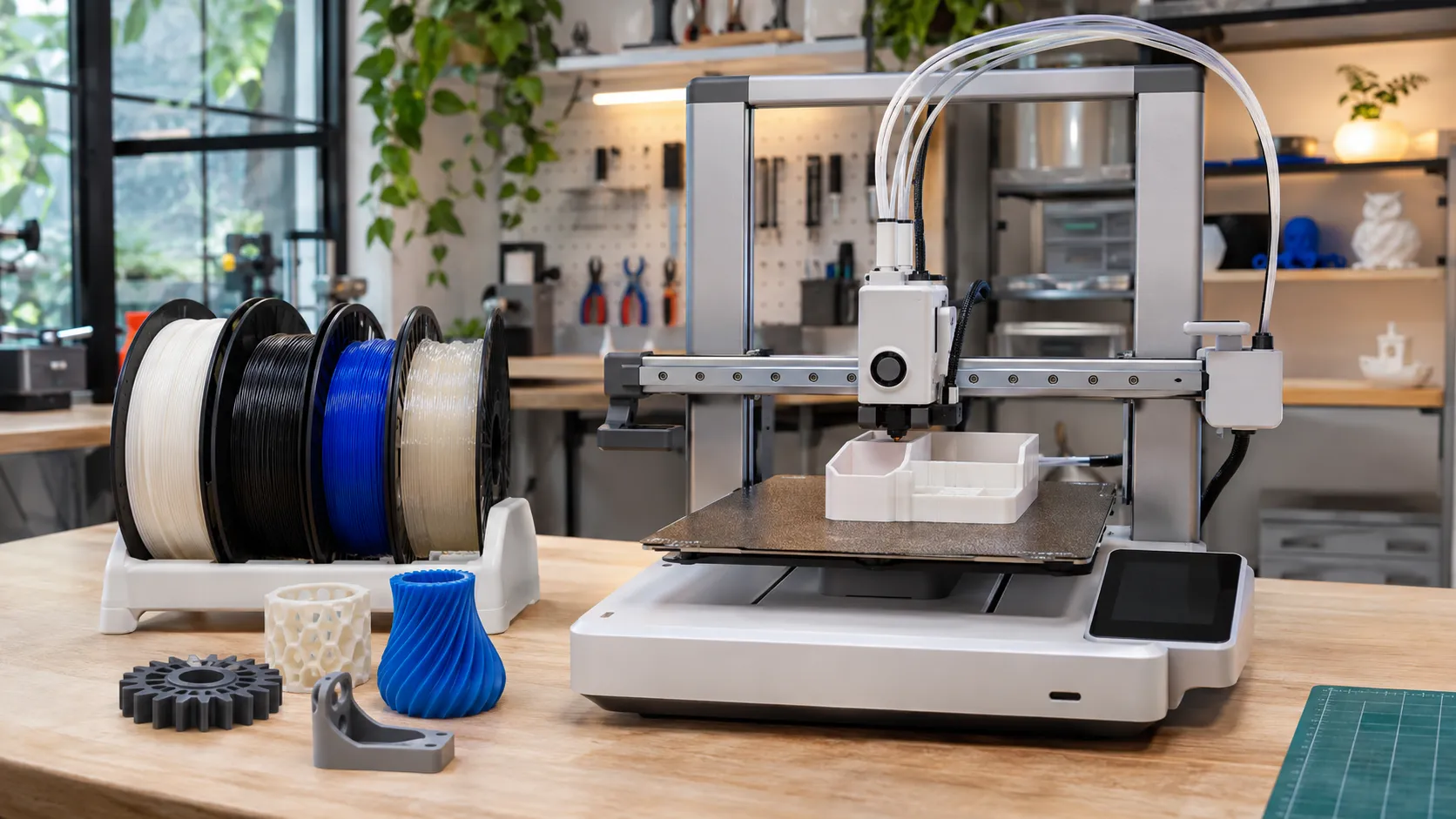
Bambu A1 filament compatibility is straightforward when you separate what the printer can heat from what it can print reliably. Bambu officially classifies PLA, PETG, TPU and PVA as ideal. ABS, ASA, PC, PA, PET and carbon- or glass-fiber reinforced polymers are listed as not recommended.
Research-based guide, updated November 2026. This guide follows Bambu Lab’s current A1 documentation and explains the practical reason behind each recommendation. Some links are affiliate links; eligible purchases may support FilamentPicks at no extra cost to you. See our Affiliate Disclosure.
Bambu A1 Filament Compatibility Chart
This Bambu A1 filament compatibility chart starts with the hardware. The A1 combines an all-metal hotend, hardened-steel extruder gears, a standard stainless-steel 0.4 mm nozzle, a 300°C maximum hotend temperature and a 100°C maximum build plate temperature. Those numbers look capable, but temperature is only one part of material compatibility. The open frame cannot hold a stable warm chamber, and the standard nozzle is not the best long-term choice for abrasive composites.
| Material | A1 rating | Best feeding method | Practical note |
|---|---|---|---|
| PLA / PLA+ | Excellent | AMS Lite or external spool | The easiest and most reliable family for the A1 |
| PETG | Excellent | AMS Lite or external spool | Dry it first and tune flow for clean surfaces |
| TPU | Good with conditions | External spool, direct path | Ordinary flexible TPU should not be forced through AMS Lite |
| PVA / support | Good with conditions | Dry spool; AMS only if explicitly compatible | Moisture sensitivity is the main failure risk |
| ABS / ASA | Not recommended | — | Open-frame drafts and shrinkage increase warping |
| PC / PA nylon | Not recommended | — | Usually needs controlled chamber heat and rigorous drying |
| CF / GF composites | Not recommended | External only if attempted | Abrasive and often based on materials the A1 is not designed around |
The Best Filaments for Bambu A1
PLA and PLA+
For everyday use, Bambu A1 filament compatibility is strongest with cool-running materials. PLA is the A1’s natural home territory. The open frame provides the cooling that PLA likes, while automatic calibration and the 256 × 256 × 256 mm build volume make it suitable for everyday models, prototypes, organizers and decorative parts. Standard, matte and many tough PLA formulas are reasonable starting points. Silk and filled decorative blends may need slower outer walls and more conservative volumetric flow.
If you are selecting a brand rather than a material family, see our best filament for Bambu A1 guide. Polymaker PLA is especially easy to integrate because matching profiles can be checked through our Polymaker LayerHub profile guide.
PETG
PETG is the practical step up when you need better temperature resistance, toughness and outdoor durability than basic PLA. It is officially ideal for the A1, but it is less forgiving of moisture and excessive speed. A dry spool, a clean plate and a validated flow limit matter more than copying one aggressive profile from the internet.
Start with a manufacturer preset when available, then inspect first-layer behavior and stringing. Our Bambu PETG settings chart and PETG drying guide cover those two variables in detail.
TPU
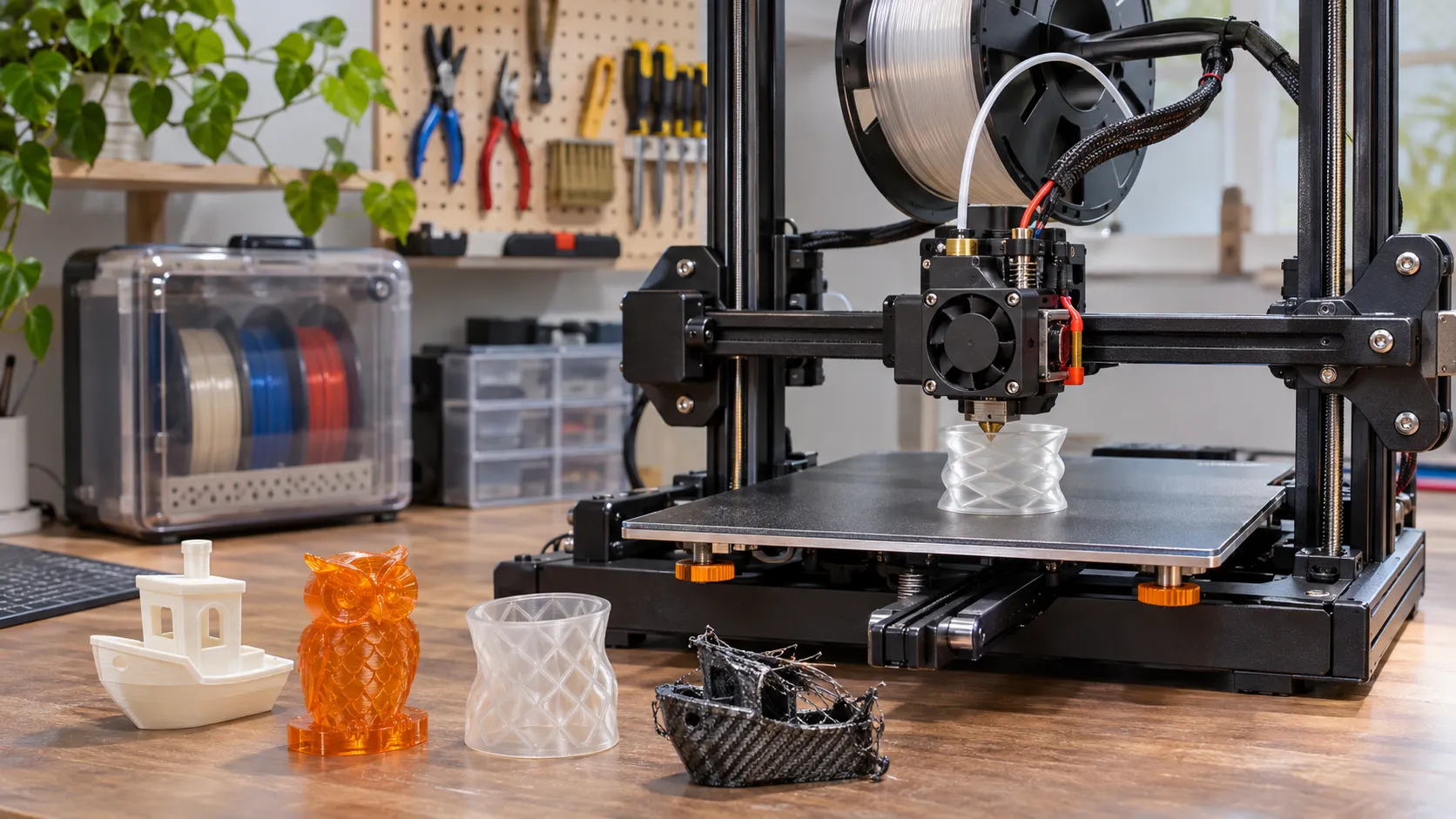
The short direct-drive path makes the A1 capable with common flexible filaments, especially 95A TPU. Feed it from an external spool with a smooth, low-friction path. Reduce speed, avoid sharp bends in the tube and keep retraction conservative. Softer grades become progressively harder to push consistently.
Do not assume that printer compatibility equals automatic material-system compatibility. For most ordinary TPU, external feeding is the reliable route. The step-by-step settings are covered in our TPU printing guide for Bambu Lab.
PVA and soluble support
Bambu lists PVA among the ideal material families, but PVA can absorb moisture quickly enough to ruin a print even when the profile is correct. Store it in a sealed dry box and print from a controlled environment when possible. Before combining support and model material, verify that their temperature ranges overlap and that the specific spool is approved for your feed path.
Why ABS, ASA, PC and Nylon Are Not Recommended
The limits in Bambu A1 filament compatibility are not arbitrary. The common thread is not simply nozzle temperature. ABS and ASA shrink as they cool, while polycarbonate and many nylons benefit from stable chamber conditions. The open A1 is exposed to room drafts and temperature swings, so large functional parts can warp, split between layers or release from the plate.
Small experiments sometimes succeed, but that is different from an officially supported, repeatable workflow. Enclosing the A1 yourself can also interfere with electronics cooling and should not be treated as a casual fix. If engineering materials are central to your work, an enclosed P-series, X-series or H-series machine is the more appropriate platform.
What about carbon-fiber filament?
The A1 has hardened-steel extruder gears, but the standard nozzle is stainless steel. Abrasive fibers can accelerate nozzle wear, and many CF/GF blends use nylon, polycarbonate, PET or another base polymer that already sits outside Bambu’s recommended A1 list. A hardened nozzle addresses abrasion; it does not create a heated chamber or solve the base material’s moisture and warping requirements.
For a broader explanation, compare hardened and stainless Bambu nozzles before buying composite filament.
Bambu A1 and AMS Lite Filament Compatibility
Bambu A1 filament compatibility and AMS Lite compatibility are related but not identical. AMS Lite is excellent for rigid, consistently wound PLA and PETG spools. It provides automatic switching and reduces manual loading, but it cannot make every filament feed safely. Flexible TPU can buckle or stretch inside a longer multi-stage path, while brittle or unusually rough materials can shed particles or break.
| Spool type | AMS Lite | External spool |
|---|---|---|
| PLA / PLA+ | Recommended | Also works |
| PETG | Recommended when dry | Also works |
| TPU | Usually avoid unless specifically approved | Preferred |
| PVA | Spool-specific; keep extremely dry | Possible from a dry box |
Check spool diameter, width and edge condition as well as material. Our complete AMS Lite filament compatibility guide explains feeding and spool-fit limits.
A Safe Setup Workflow for a New Filament
Use the following Bambu A1 filament compatibility workflow whenever a spool is new to you.
Check the base polymer
Read the full material name, not only the marketing label. A “carbon” product may be PLA-CF, PETG-CF, PA-CF or PC-CF, with very different requirements.
Confirm the feed path
Use AMS Lite for rigid, approved spools. Use a direct external path for flexible or questionable materials.
Dry hygroscopic filament
Moist PETG, TPU, PVA and nylon can create bubbles, stringing and weak layers before any slicer setting is tested.
Select the closest safe profile
Use an exact manufacturer profile or a conservative generic profile, then verify temperatures against the spool label.
Run a compact validation print
Check first layer, bridges, corners, seams and surface consistency before committing to a large model.
Adjust one variable at a time
Stabilize temperature and flow before using retraction to chase stringing.
Amazon links use tag filamentpicks-20. Use Polymaker code BALUTAVLAD for 15% off your first order. Eligible purchases may support FilamentPicks at no extra cost to you.
FilamentPicks Verdict
Bambu A1 filament compatibility is broad enough for the materials most owners actually use. PLA, PETG and direct-fed TPU cover prototypes, household parts, outdoor pieces and flexible components. PVA can add soluble support when kept dry. For ABS, ASA, PC, nylon and serious fiber composites, the smartest upgrade is not a riskier profile—it is an enclosed printer built around those materials.
Frequently Asked Questions
Can the Bambu A1 print ABS?
The hotend can reach ABS temperatures, but Bambu lists ABS as not recommended. The open frame makes warping and layer separation harder to control, especially on larger parts.
Can the Bambu A1 print carbon-fiber filament?
Bambu lists carbon- and glass-fiber reinforced polymers as not recommended for the A1. The standard stainless nozzle is also less wear-resistant than a hardened nozzle. Even after a nozzle change, the base polymer may still require chamber conditions the A1 does not provide.
Does any 1.75 mm PLA work in the Bambu A1?
Most reputable 1.75 mm PLA can work, but spool fit, winding quality, recommended temperature and maximum flow still vary. Add a matching third-party profile in Bambu Studio and validate it with a small print.
Can TPU go through AMS Lite?
Ordinary flexible TPU is safer from the external spool holder with a direct path. Only use AMS Lite when the exact filament is explicitly approved for that system.
Is PETG safe for the Bambu A1?
Yes. PETG is one of the four material families Bambu officially rates as ideal for the A1. Dry the spool and tune flow if you see stringing or rough surfaces.