

AMS Lite makes four-color printing on the A1 and A1 mini approachable, but it is not a sealed dryer and it is not a universal filament transport system. Its exposed frame, rotary spool holders, long feed path, and automatic retraction favor materials that are stiff enough to push, flexible enough to bend without snapping, and clean enough not to shed particles into the feeders.
This guide combines Bambu’s official store specifications and A1 Combo quick-start guidance. Bambu’s compatibility list describes what the feeder can load and unload; it does not override the printer’s material limits. Always check both the AMS Lite and the A1/A1 mini profile for the exact spool.
Bambu AMS Lite filament compatibility matrix
The Bambu AMS Lite filament compatibility list includes PLA, PETG, ASA, PET, PA, PC, dry PVA/BVOH, PP, POM, HIPS, and selected first-party reinforced products from a loading and unloading perspective. It separately marks several glow, CF/GF, and flexible products as not recommended or unsupported. The exact list can change, so treat the official AMS Lite page as the live reference.
| Material / type | AMS Lite status | Preferred route | Reason |
|---|---|---|---|
| PLA, PLA Matte, most standard PLA | Generally suitable | AMS Lite | Rigid, predictable feeding; monitor brittle old PLA |
| PETG | Generally suitable | AMS Lite | Good stiffness; dry if stringing or roughness appears |
| ASA, PET, PA, PC and other listed rigid polymers | Feeder may support them | Only if the A1 profile/environment also supports the exact filament | AMS loading compatibility is not printer/process compatibility |
| Dry PVA / BVOH | Conditional | AMS Lite only while genuinely dry and feeding cleanly | Rapid moisture uptake causes swelling and brittleness |
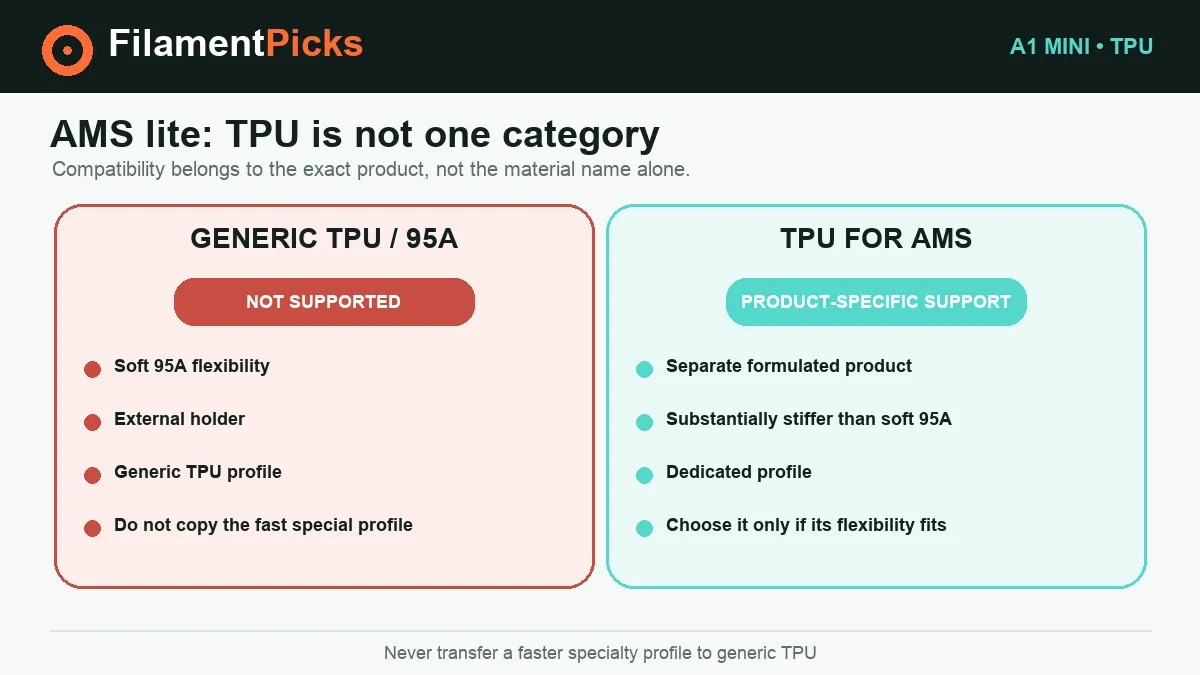
| TPU / TPE | Unsupported or formulation-dependent | External spool when permitted by the printer/material guide | Soft strand can buckle during pushing and retraction |
| Glow, wood, glitter, generic CF/GF | Not recommended / unsupported | External route with correct nozzle, if printer supports it | Abrasion, particles, brittleness, and feeder wear |
| Bambu products explicitly listed as AMS Lite compatible | Supported as specified | AMS Lite with matching profile | Product-specific guidance takes priority over family labels |
Spool dimensions and holder fit
Spool fit is the physical foundation of Bambu AMS Lite filament compatibility. AMS Lite uses four spring-loaded rotary holders rather than the enclosed roller bays of the full-size AMS. Bambu specifies 40–68 mm spool width and a 53–58 mm inner diameter. The system is designed for 1.75 mm filament. A spool that is technically within range can still feed poorly if its hub is damaged, the winding is crossed, the rim rubs another object, or an adapter runs off-center.
Check free rotation
Match tube path
Set material
Secure filament
| Fit check | Official range / goal | Failure if ignored |
|---|---|---|
| Filament diameter | 1.75 mm | Incompatible feeding and slicing assumptions |
| Spool width | 40–68 mm | Poor seating, rubbing, or unstable rotation |
| Hub inner diameter | 53–58 mm | Holder cannot grip or center the spool correctly |
| Winding | Free, untangled, no crossed free end | Intermittent resistance and load/retract failures |
| Rim and adapter | Round, stable, not rubbing | Pulsed tension and inconsistent extrusion |
Cardboard spools and adapters
Unlike roller-driven enclosed AMS bays, AMS Lite grips the hub. Cardboard can work when the hub fits, stays round, and does not shed or collapse. If an adapter is necessary, use one that remains concentric and does not expand the assembly into another spool or tube. Rewinding is a last resort because poor tension can create tangles that automatic retraction cannot correct.
Why TPU and other flexibles are difficult
Flexible materials mark the most important limit in Bambu AMS Lite filament compatibility. Automatic material systems must push as well as pull. A rigid filament transmits that push over a long curved path. Soft TPU behaves more like a rope: compression makes it bow, buckle, or coil at a small gap. Friction rises as the material rubs the tube, and repeated retractions can deform the strand. Hardness, surface finish, and “high-flow” formulation all change the result, so the word TPU alone is not enough.
Bambu’s A1 Combo quick-start guidance advises avoiding flexible TPU/TPE in AMS Lite and using the external spool. Some current product-specific profiles can define exceptions, but the exact official listing should control—not an anecdote that a different hardness loaded once. Our dedicated A1 mini TPU and AMS Lite guide explains safe routing in more detail.
Glow, carbon fiber, glass fiber, and brittle blends
Abrasive behavior is another Bambu AMS Lite filament compatibility boundary. A filament can harm the feed system before it reaches the nozzle. Glow pigments, chopped carbon or glass fiber, and mineral or wood particles can be abrasive, rough, or brittle. Bambu specifically lists several such products as not recommended or unsupported in AMS Lite, even when a printer equipped with appropriate nozzle hardware could melt them.
Do not generalize from one compatible Bambu product to every generic blend. Bambu’s list has included selected first-party products such as PLA-CF or PAHT-CF while excluding other CF formulations. Formulation, particle size, strand stiffness, and brittleness differ. Use the current product row, not only the family name, and check whether your Bambu nozzle is wear-resistant.
Why a hardened nozzle is not enough
A hardened nozzle protects the melt outlet. AMS Lite adds gears, guides, funnels, and tubing upstream. An abrasive strand can wear or shed debris along that entire path. External feeding reduces automatic-system exposure but does not make the A1’s extruder, nozzle, temperature range, or open-frame environment suitable for every engineering polymer.
AMS Lite is not a dryer or dry box
Moisture control remains part of Bambu AMS Lite filament compatibility because the open frame does not seal filament from room humidity and does not actively remove water. This matters most for PVA/BVOH, nylon, PC, TPU, and other hygroscopic materials, but even PETG can show increased stringing and roughness after poor storage. Dry the spool with a method and temperature appropriate to that exact filament, then keep it protected during long prints.
A heated dryer must not pull against AMS Lite while the spool is mechanically constrained on its holder. Plan a supported path with low drag. If a job needs four moisture-sensitive spools exposed for many hours, an enclosed and actively controlled feeding strategy may be more appropriate than AMS Lite.
Use our filament drying guide to separate drying temperature from printing temperature and learn why a warm enclosure is not necessarily removing moisture.
Plan material combinations before loading four slots
Four individually compatible spools do not automatically make one compatible print. Materials used in the same model must tolerate the selected bed condition, cooling strategy, and purge temperatures, and they must bond—or separate—as the design requires. PLA with a purpose-made support interface is a different problem from mixing PLA and ABS inside one structural wall. Test the interface on a small coupon before trusting a long multicolor job.
Color order also matters. Dark pigment carried into a light material may require more purge than the reverse transition, while a high-temperature material can leave residue when the next slot runs cooler. Review the slicer’s material mapping and purge preview, not only the rendered colors. If the job exists only to change colors, keep all four spools in the same polymer family when possible. That removes a large set of temperature, adhesion, and shrinkage variables and makes a failed swap much easier to diagnose.
A reliable four-slot setup workflow
A practical Bambu AMS Lite filament compatibility check covers the spool, material profile, physical slot, purge behavior, and expected room exposure before slicing.
- Inspect each spool. Confirm dimensions, round hub, free rotation, secure winding, and dry material.
- Mount by path, not color order alone. Avoid awkward tube crossings and make sure each tube is fully seated.
- Configure material and color. Bambu RFID can identify compatible Bambu spools; third-party spools require manual material/color selection.
- Confirm the slicer mapping. Match model colors/materials to physical slots and check purge strategy.
- Load one slot at a time. Watch for smooth rotation and stop on repeated clicking or retraction.
- Run a small material-change test. Validate loading, unloading, purge, adhesion, and color order before a multi-hour model.
| Before slicing | Question | Good answer |
|---|---|---|
| Material pairing | Do the model and support materials bond or separate as intended? | Confirmed by manufacturer data or a small interface test |
| Temperature overlap | Can one plate/chamber strategy serve all loaded materials? | All materials stay within safe, compatible conditions |
| Purge | Is dark-to-light contamination acceptable? | Volumes are validated without excessive waste |
| Moisture | Will exposed spools remain dry for the entire job? | Yes, or the workflow is changed |
| Spare path | Can a failed slot unload without tangling adjacent spools? | All spools and tubes have clearance |
Fix loading, retraction, and slot errors
When loading fails, troubleshoot the Bambu AMS Lite filament compatibility chain one section at a time instead of repeating the same motor cycle.
The spool turns, but filament does not reach the printer
Check the filament tip, first-stage feeder, tube seating, and tube bends. A blunt mushroomed tip can catch at a connector. Cut only as directed for the loading procedure, keep the tube route smooth, and do not add force while the motor is already slipping.
The same slot repeatedly retracts
Swap only one variable at a time. Try a known-good rigid spool in that slot; then try the suspect spool in a known-good slot if its material is supported. This separates a spool/material issue from a slot/tube issue. Our AMS jamming guide offers a complete isolation sequence.
Filament reaches the toolhead but does not extrude
Stop treating the feeder as the only suspect. Verify the selected material temperature, extruder grip, and nozzle condition. A clog or ground section can make AMS Lite repeat a load cycle even though the upstream path is clear. Follow the safe nozzle-clog diagnostic.
Bambu AMS Lite filament compatibility FAQ
Which printers work with AMS Lite?
Bambu specifies AMS Lite for the A1 series. An A1 or A1 mini connects to one AMS Lite for up to four colors. It is not the feeder for X1/P1 or H2-series printers.
Can AMS Lite use TPU?
Standard guidance directs flexible TPU/TPE to the external spool because the soft strand can buckle in automatic feeding. Use an exception only when Bambu explicitly lists the exact product and route as supported.
Does AMS Lite dry filament?
No. It is an open feeder, not a sealed dry box or active dryer. Dry hygroscopic material separately and protect it during storage and long prints.
What spool sizes fit AMS Lite?
Bambu specifies 40–68 mm width and a 53–58 mm inner hub diameter, using 1.75 mm filament. Condition and free rotation matter in addition to dimensions.
Can I use generic carbon-fiber filament in AMS Lite?
Do not assume so. Generic CF/GF materials are commonly excluded because of abrasion and brittleness, while only selected product-specific formulations may be listed. Check the current official row and use correct printer/nozzle hardware.
Official sources
- Bambu Lab AMS Lite: compatibility, spool dimensions, and specifications
- Bambu Lab A1 Combo quick-start guide