

Research-based guide. Our picks are built from manufacturer specifications and community-verified user reports across the Bambu Lab ecosystem — not paid placements.
The best filament for Bambu A1 plays to the printer’s strengths: it’s a fast, beautifully calibrated open-frame bedslinger with AMS Lite support. What it does not have is an enclosure — so the smart move is to lean into PLA, PETG, TPU and specialty PLAs, and leave the high-warp engineering materials to enclosed machines.
Below are the top A1 filament picks by use case, drawn from manufacturer specs and community-verified reports, plus a clear note on what to avoid so you don’t waste a spool fighting warping.
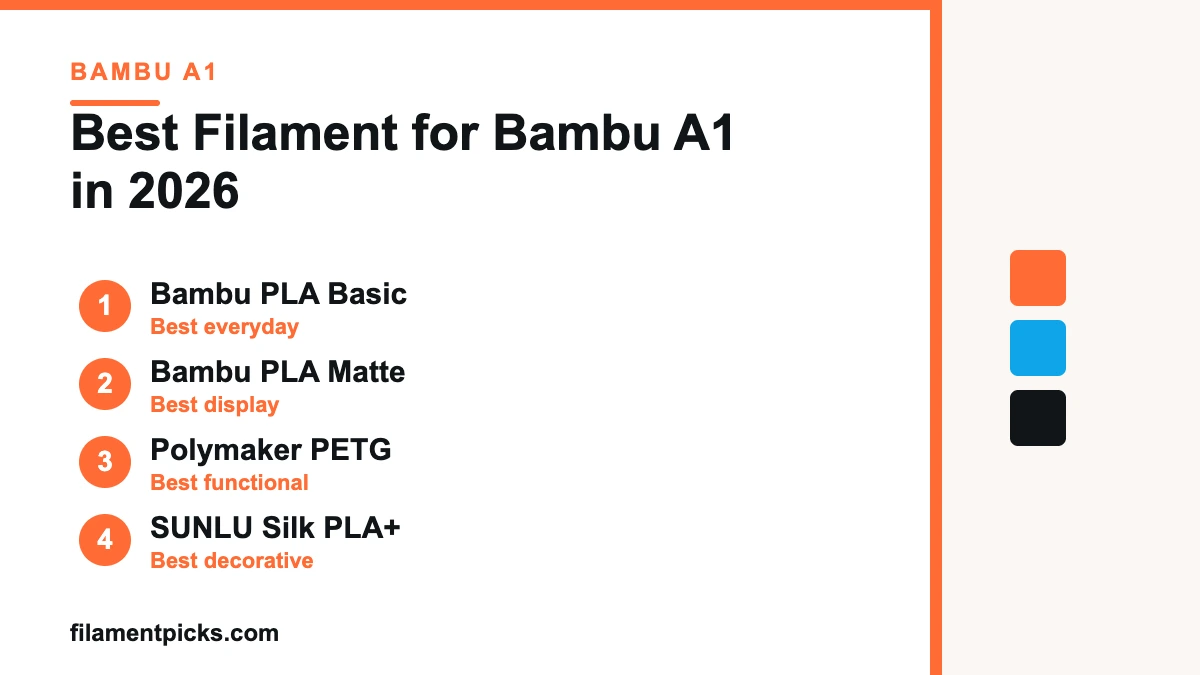
Best Filament for Bambu A1 at a Glance
| Use case | Top pick | Why |
|---|---|---|
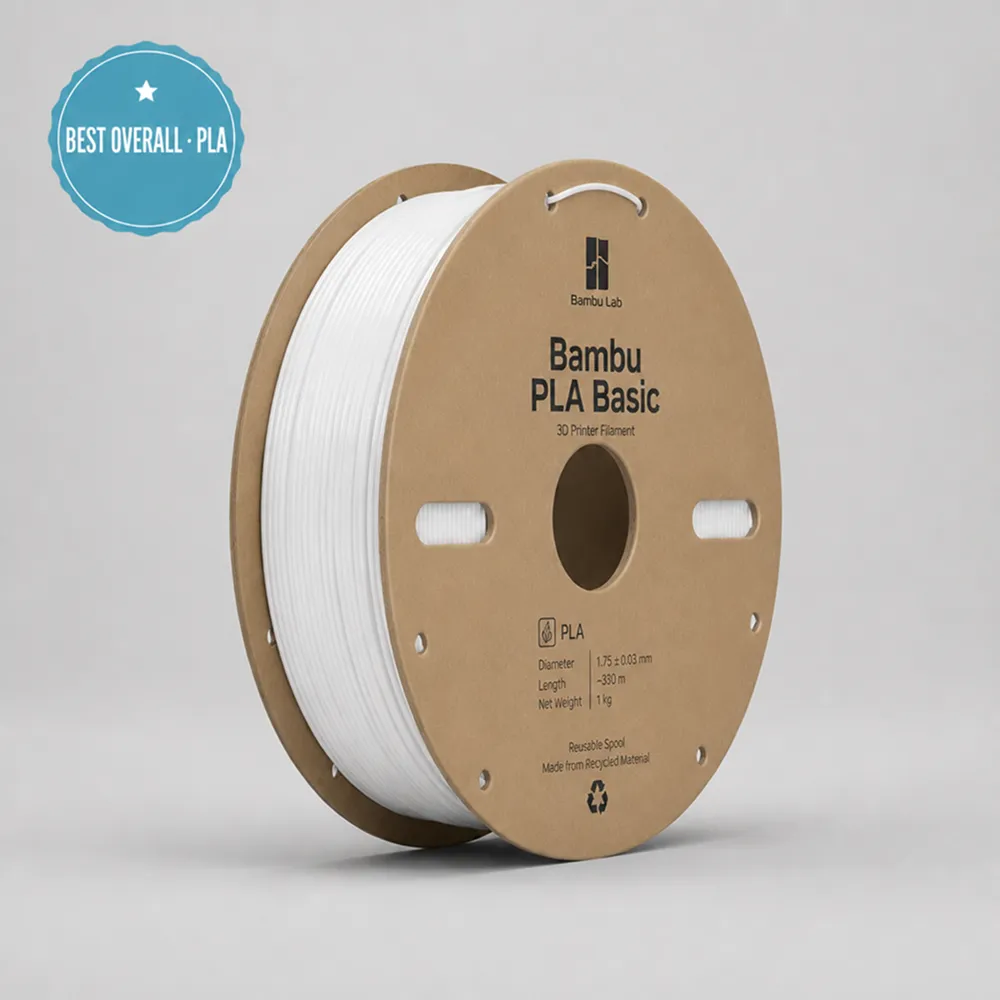
| Everyday printing | Bambu PLA Basic | Calibrated RFID profile, flawless on the A1 |
| Display models | Bambu PLA Matte | Hides layer lines, vibrant colors |
| Functional parts | Polymaker PETG | Tougher and more heat-tolerant than PLA |
| Shiny / decorative | SUNLU Silk PLA+ | Glossy metallic look, budget price |
| Flexible parts | Bambu TPU 95A HF | Direct-extruder friendly on the A1 |
| Budget bulk | eSUN PLA+ / Overture PLA | Reliable AMS Lite results for less |
What the A1’s Open Frame Means for Filament
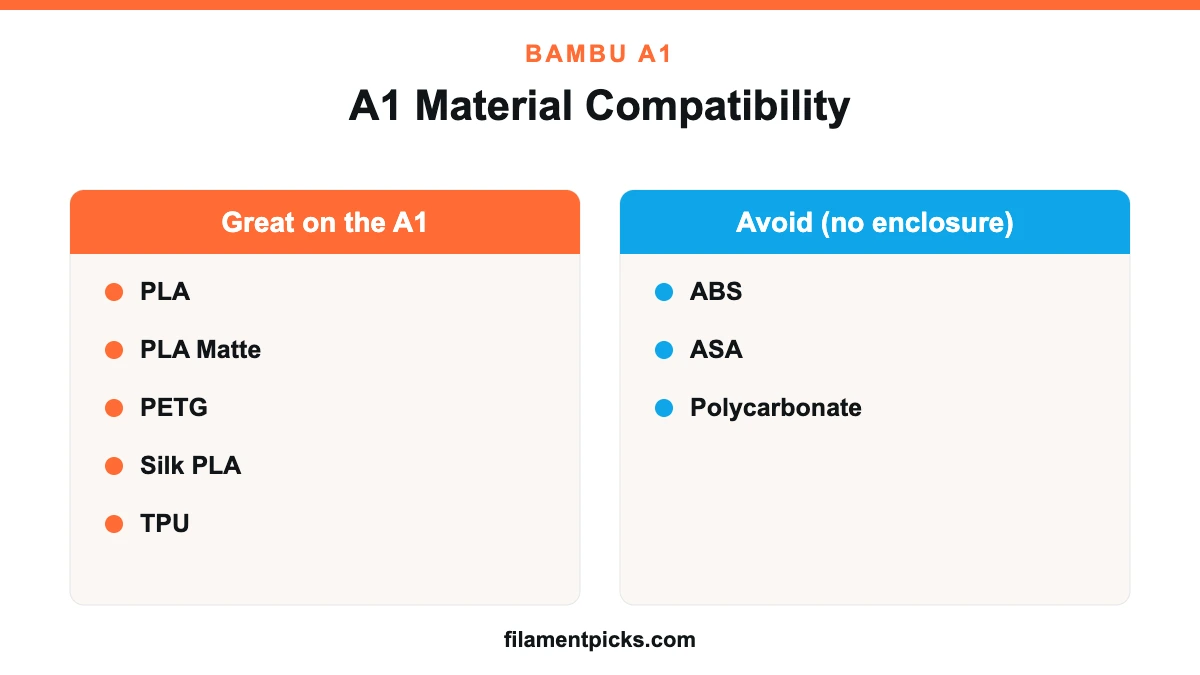
The A1 is an open-frame printer, so the chamber stays near room temperature. That’s perfect for PLA and fine for PETG and TPU, but it’s the reason ABS and ASA warp and delaminate badly on the A1. Stick to materials that don’t need a heated chamber and the A1 is genuinely hard to beat.
Its AMS Lite is not fully sealed, so for moisture-sensitive materials store spools in a dry box and dry them when needed. Our filament storage guide walks through it.
Best PLA for the Bambu A1
If you buy one filament for the A1, make it PLA. Bambu PLA Basic is the most reliable, with a calibrated profile the AMS Lite reads automatically. For display work, Bambu PLA Matte and Polymaker’s matte line (now branded Panchroma) give a premium, layer-hiding finish.
For everyday bulk printing, eSUN PLA+ and Overture PLA deliver excellent results on the generic profile at a lower price — just print a cardboard-spool adapter for the AMS Lite if the spool edges are rough. See the full best PLA ranking.
Best PETG for the Bambu A1
PETG steps up durability, temperature tolerance and chemical resistance for functional parts. Polymaker PETG and Sunlu PETG both run well on the A1; keep print speeds reasonable and the filament dry. With HF discontinued, Bambu PETG Basic is the current Bambu-branded option.
Best Specialty & Flexible Filaments
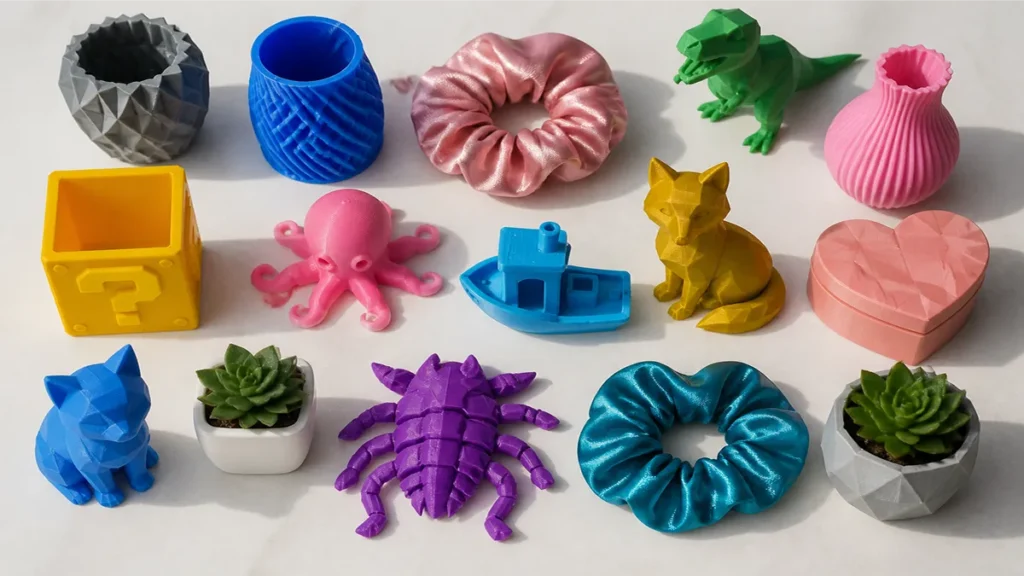
The A1 shines with aesthetic PLAs. Silk PLA (SUNLU Silk PLA+, Bambu PLA Silk) adds a glossy, metallic sheen — print a touch hotter, around 225–230°C. For flexibles, the A1’s extruder handles TPU 95A nicely at moderate speeds.
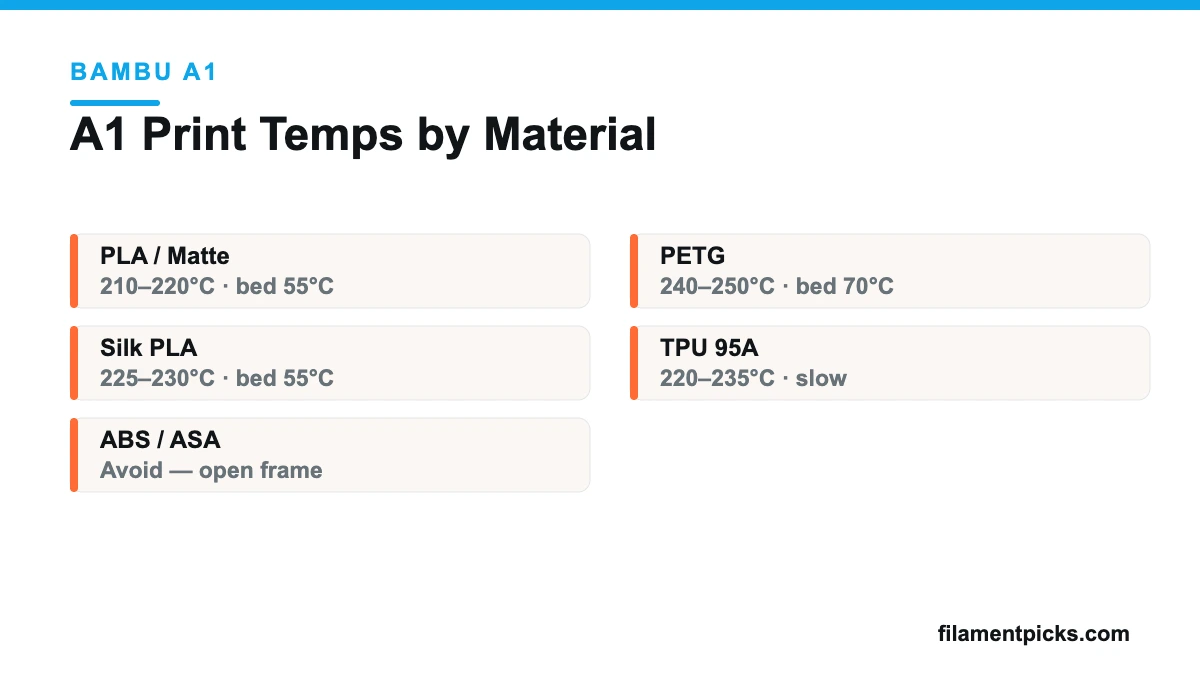
| Material | Nozzle temp | A1 verdict |
|---|---|---|
| PLA / PLA Matte | 210–220°C | Ideal — the A1’s sweet spot |
| PETG | 240–250°C | Great for functional parts |
| Silk PLA | 225–230°C | Excellent for decorative prints |
| TPU 95A | 220–235°C | Works well; keep speeds moderate |
| ABS / ASA | — | Avoid — open frame causes warping |
What to Avoid on the A1
Skip ABS, ASA and pure polycarbonate on the A1 — without an enclosure they warp, crack and delaminate. If you need those materials, an enclosed printer like the P2S or P1S is the right tool. The A1 is about fast, clean PLA/PETG/TPU work, and it does that exceptionally well.
Where to Buy
The community-verified picks that consistently perform on the open-frame A1. Check current pricing before you buy.
Use code BALUTAVLAD for 15% off your first Polymaker order.
 Frequently Asked Questions
Can the Bambu A1 print ABS or ASA?
Not reliably. The A1 is open-frame with no heated chamber, so ABS and ASA warp and delaminate. Use PLA, PETG, TPU and specialty PLAs instead, or move those materials to an enclosed printer.
Does third-party filament work in the AMS Lite?
Yes. Filament without RFID shows a ‘?’ and you select the material type once. Brands like eSUN, Overture, Polymaker and Sunlu all run well on the A1.
What’s the single best filament for the A1?
Bambu PLA Basic for reliability, or Bambu PLA Matte if you mostly print display pieces. Both are calibrated for Bambu hardware out of the box.
The Bottom Line
The best filament for Bambu A1 plays to an open-frame printer’s strengths: fast, clean PLA, PETG, silk and TPU. Keep ABS, ASA and PC for an enclosed machine, and the A1 will reward you with some of the nicest prints in its class.
FilamentPicks is reader-supported. When you buy through links on our site we may earn an affiliate commission at no extra cost to you. As an Amazon Associate we earn from qualifying purchases.