

Research-based guide. Our picks are built from manufacturer specifications and community-verified user reports across the Bambu Lab ecosystem — not paid placements.
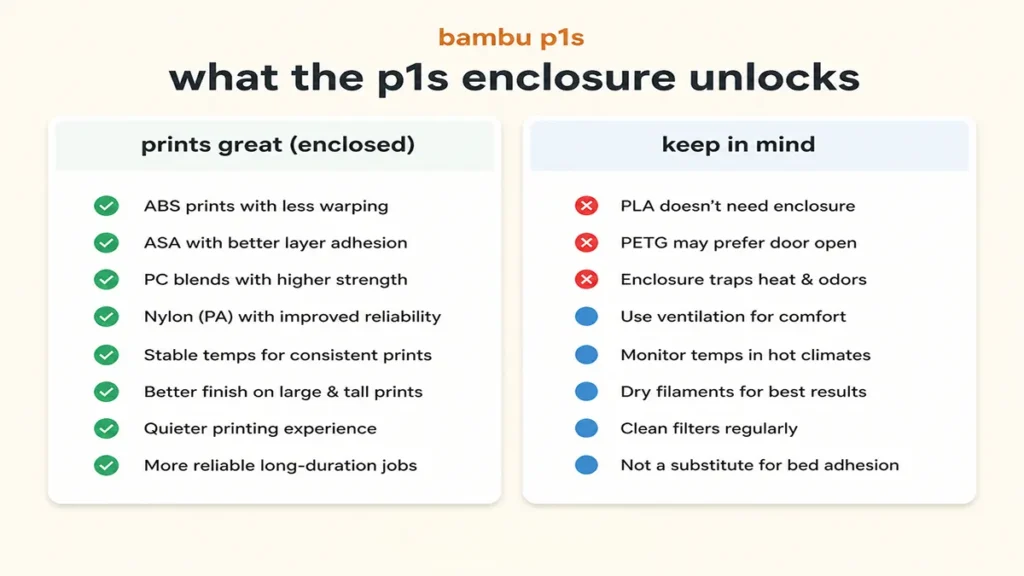
Choosing the best filament for Bambu P1S comes down to one thing the cheaper open-frame printers can’t match: the enclosure. That sealed, passively heated chamber is what lets the P1S print warp-prone engineering materials like ABS, ASA and polycarbonate reliably — not just easy PLA.
Below we rank the best P1S filament for each material class, based on manufacturer specifications and community-verified user reports. Whether you want effortless display prints or heat-resistant functional parts, there’s a clear pick for your use case.
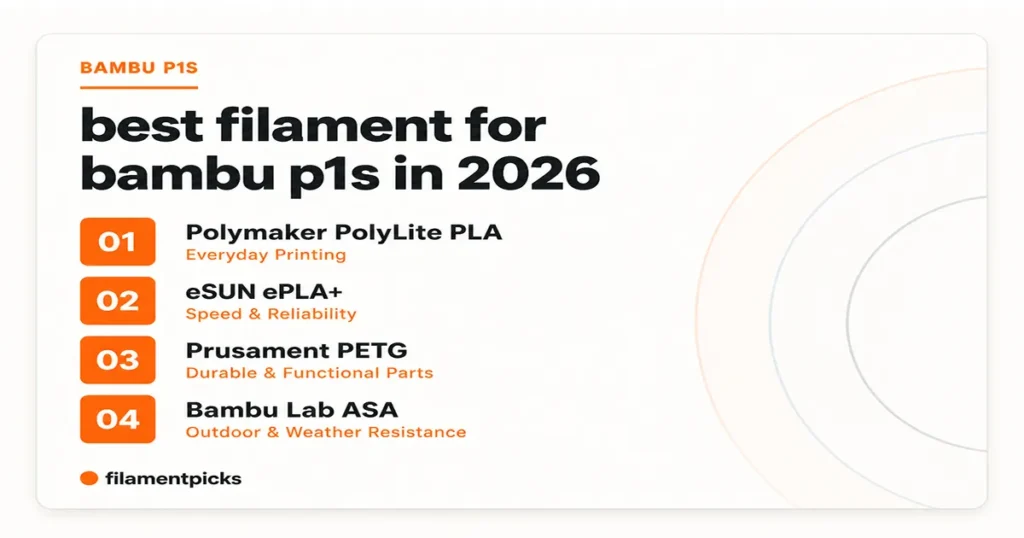
Best Filament for Bambu P1S at a Glance
| Use case | Top pick | Why |
|---|---|---|
| Everyday / beginners | Bambu PLA Basic | Pre-tuned RFID profile, dialed in out of the box |
| Functional parts | Polymaker PETG / Bambu PETG Basic | Tough, chemical-resistant, easy on an enclosed bed |
| Heat & impact | Bambu ABS | Minimal warping inside the P1S enclosure |
| Outdoor / UV | Bambu ASA | UV-stable, perfect built-in profile |
| Maximum strength | Polymaker PolyMax PC | Polycarbonate toughness the enclosure makes printable |
| Flexible parts | Bambu TPU 95A HF | Direct-drive-friendly, prints cleanly on the P1S |
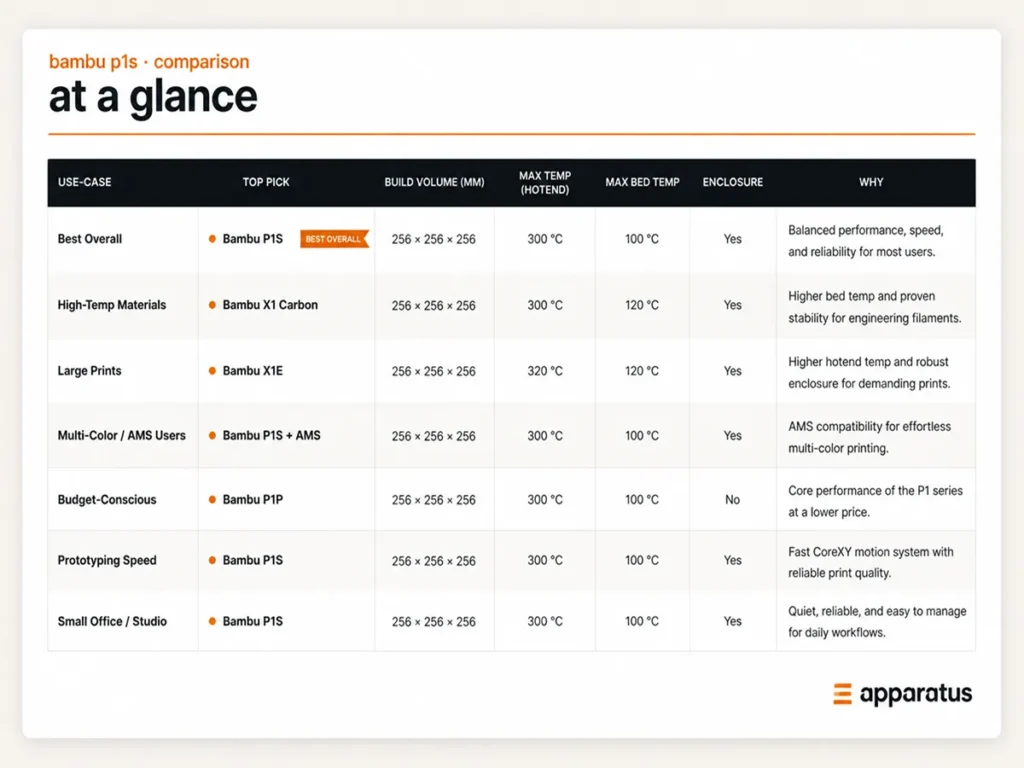
Why the P1S Enclosure Changes Your Filament Choices
On an open-frame printer, drafts and uneven cooling cause ABS and ASA to curl off the plate. The P1S enclosure traps heat around the part, dramatically reducing that thermal shrinkage. That single feature is why the best filament for Bambu P1S includes materials most A1-class machines simply can’t handle.
It also means you should keep the enclosure door (and the top glass) closed for high-temp materials, and leave the part cooling fan low or off for ABS, ASA and PC. For PLA and PETG, normal cooling applies.
Best PLA for the Bambu P1S
For the vast majority of prints, PLA is still the workhorse. Bambu PLA Basic is the safest start — the RFID profile is calibrated and the AMS reads it automatically. For matte display pieces, Bambu PLA Matte and Polymaker’s matte line (formerly PolyTerra, now Panchroma) hide layer lines beautifully.
Budget-conscious? eSUN PLA+ and Overture PLA both run well on the generic profile and cost noticeably less per kilo. See our dedicated best PLA filament guide for the full ranking.
Best PETG for the Bambu P1S
PETG is the go-to for tougher, slightly flexible, water- and chemical-resistant parts. Note that Bambu PETG HF has been discontinued and is being replaced by the reformulated Bambu PETG Basic — so if you’ve relied on HF, plan to re-tune. Polymaker PETG and Siraya Tech’s high-flow PETG are excellent AMS-compatible third-party options.
Keep PETG dry; it absorbs moisture quickly. Our PETG drying guide covers temperatures and times.
Best ABS & ASA for the Bambu P1S
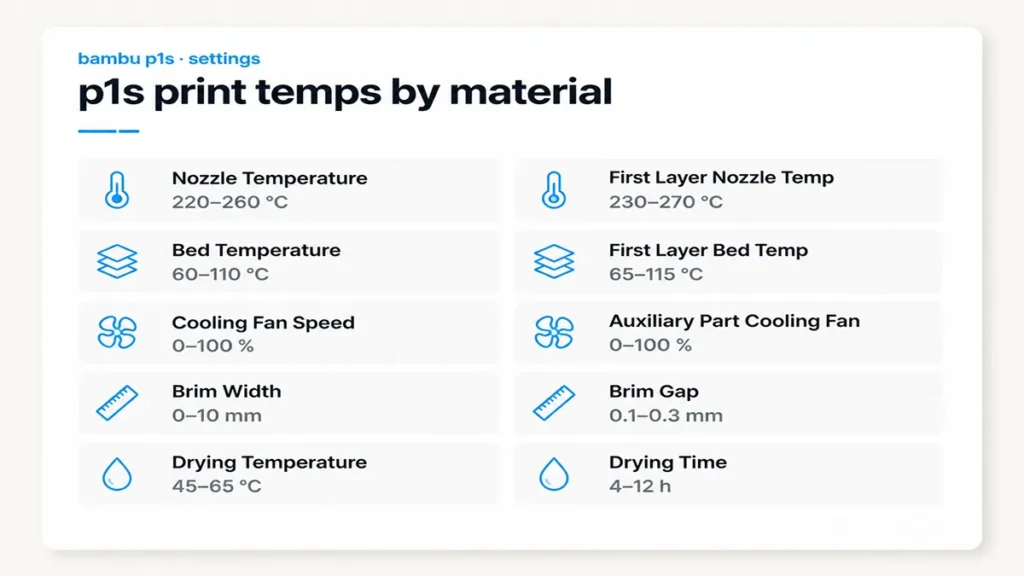
This is where the P1S earns its money. Bambu ABS prints with minimal warping inside the enclosure and its RFID profile manages temperatures automatically — run roughly 240°C nozzle / 100°C bed with the door closed. For outdoor or UV-exposed parts, ASA is the upgrade: Bambu ASA has excellent UV stability and a perfectly dialed profile, while Polymaker ASA offers a wider color range.
Always ventilate — ABS and ASA fumes are real. A brim helps the first layer hold on large footprints.
| Material | Nozzle | Bed | Notes |
|---|---|---|---|
| Bambu ABS | 240°C | 100°C | Door closed, fan low |
| Bambu ASA | 240–260°C | 100°C | Best UV resistance, use a brim |
| Polymaker ASA | 240–260°C | 90–100°C | Wider colors, outdoor-rated |
Best Polycarbonate (PC) for the Bambu P1S
PC is the strongest, most heat-resistant material the P1S can realistically run. A consumer PC blend like Polymaker PolyMax PC prints around 250–270°C with the part fan off and a 90–105°C bed; the passive enclosure is usually enough for small-to-medium parts. Bambu PC is the most plug-and-play option on Bambu hardware.
Dry PC before printing (80–90°C for 6+ hours), use a 10 mm brim, and let parts cool slowly inside the closed chamber. Full detail in our best PC filament guide.
Best TPU (Flexible) for the Bambu P1S
The P1S’s direct-drive extruder handles flexibles better than most people expect. Bambu TPU 95A HF and Polymaker’s TPU run cleanly at moderate speeds. Keep retraction modest and speeds reasonable. See our best TPU filament guide for specifics.
Where to Buy
These are the community-verified picks for each material on the P1S. Prices fluctuate, so check the current listing before buying.
Use code BALUTAVLAD for 15% off your first Polymaker order.
Use code BALUTAVLAD for 15% off your first Polymaker order.
Frequently Asked Questions
Can the Bambu P1S print ABS and ASA?
Yes. The P1S enclosure is exactly what makes ABS and ASA practical — keep the door closed, ventilate the room, and use a brim on large parts.
Do I need a hardened nozzle for the P1S?
Only for abrasive filaments like carbon-fiber or glass-filled blends. Standard PLA, PETG, ABS, ASA and plain PC are fine on the stock nozzle.
Is Bambu PETG HF still available?
No — Bambu has discontinued PETG HF and won’t restock it once sold out. The reformulated Bambu PETG Basic is the official successor, and Polymaker PETG is a strong third-party alternative.
The Bottom Line
For the Bambu P1S, the enclosure is the whole story: start with Bambu PLA Basic for everyday work, move to PETG and ABS/ASA for function and durability, and reach for polycarbonate when you need maximum strength. Keep the door closed for high-temp materials and the best filament for Bambu P1S becomes whichever one matches the job.
FilamentPicks is reader-supported. When you buy through links on our site we may earn an affiliate commission at no extra cost to you. As an Amazon Associate we earn from qualifying purchases.