

Carbon fiber filament Bambu Lab users choose for real parts — engineering grades — is where Bambu printers stop being toy-makers and start producing real functional parts — brackets, jigs, fixtures, drone frames. But they are also the category where a wrong move costs you a nozzle or a whole spool. This guide ranks what to buy and, just as importantly, how to run it without damaging your printer.
IN THIS GUIDE
Quick Picks by Use Case
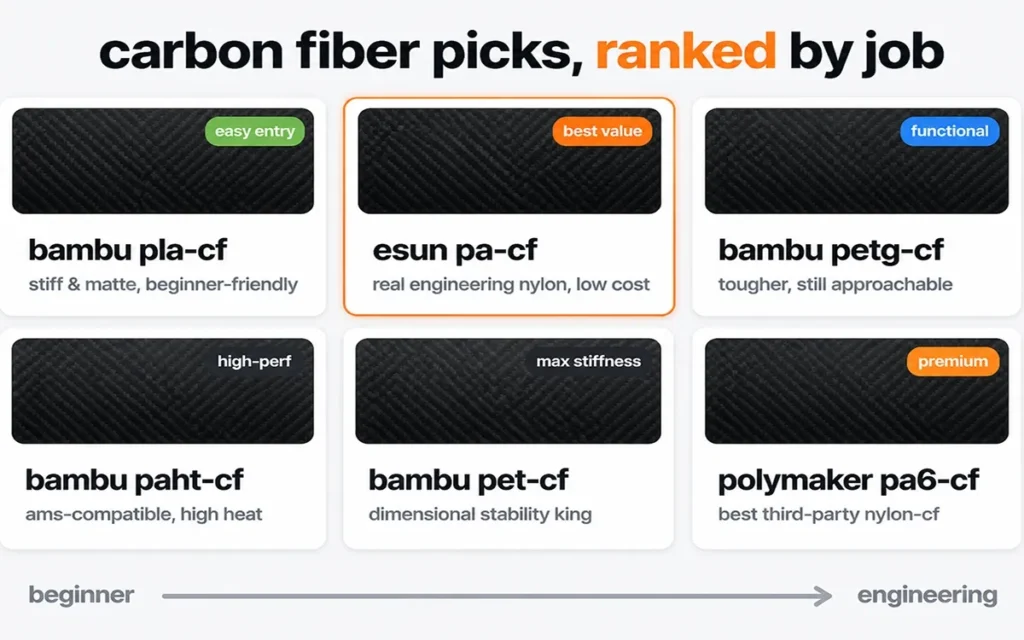
| Use case | Pick | Approx. $/kg |
|---|---|---|
| Stiff, good-looking parts (easiest) | Bambu PLA-CF | $30–35 |
| Functional parts, more rigidity than PETG | Bambu PETG-CF | $35–40 |
| Best value real engineering CF | eSUN PA-CF | ~$45 |
| High-performance + AMS compatible | Bambu PAHT-CF | $55–65 |
| Maximum stiffness / dimensional stability | Bambu PET-CF | $55–70 |
| Premium nylon-CF balance | Polymaker PA6-CF | $45–60 |
What Carbon Fiber Actually Does (and What It Doesn’t)
Most desktop CF filament is chopped carbon fiber — short strands (typically 0.1–0.2 mm) mixed into a base polymer like PLA, PETG or nylon. That is very different from the continuous fiber used in systems like Markforged, where long fibers run the length of the part.
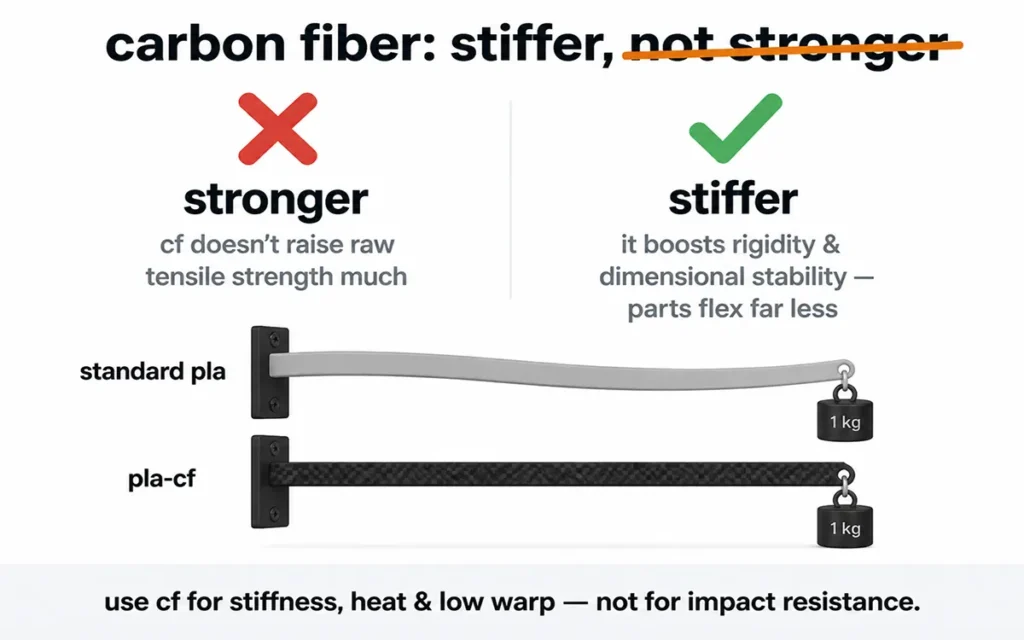
Here is the part most listings won’t tell you: adding chopped CF mainly raises stiffness (flexural modulus) and improves surface finish and stiffness-to-weight. It does not reliably increase raw tensile strength — some PLA-CF products actually test lower than plain PLA, because the short fibers act as stress concentrators. Chopped CF also makes parts more brittle (lower elongation at break). For genuine load-bearing strength you need continuous fiber, not a chopped-CF spool.
The Hardened Nozzle Rule (Non-Negotiable)
Every CF (and GF) filament is abrasive and will wear out a brass nozzle within hours. Per the Bambu Lab engineering materials wiki, a hardened steel nozzle (0.4 mm or larger) is mandatory for any sustained CF printing. For nylon-CF, a 0.6 mm hardened nozzle is the sweet spot — Bambu lists 0.2 mm as not compatible.
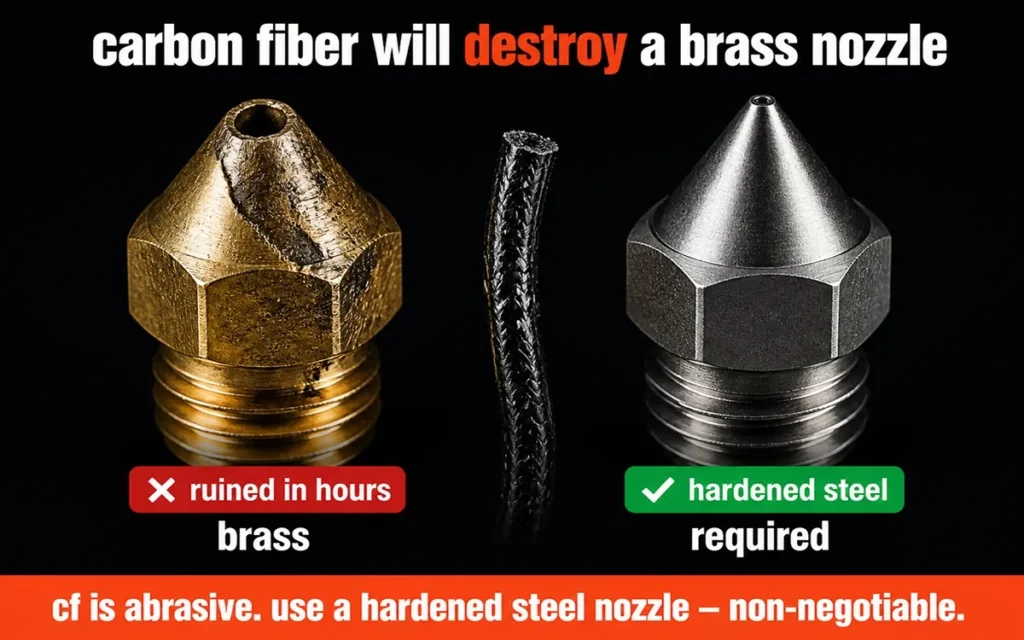
On Bambu hardware specifically: the X1E and X2D ship with hardened steel as standard, but on the X1 Carbon you must manually swap to a hardened nozzle before running any CF filament. Forgetting that is the single most common and most preventable hardware mistake with these materials.
Best Carbon Fiber Filament Bambu Lab: Engineering Picks 2026
Bambu PLA-CF — the easy entry point
PLA-CF, the easiest carbon fiber filament Bambu Lab beginner can try, prints at near-standard PLA temperatures (around 210–230°C), needs no enclosure, and produces stiff, dimensionally accurate, matte-black parts. Carbon doesn’t dramatically change PLA’s mechanical limits, so treat this as a stiffness-and-aesthetics upgrade rather than a true engineering material — but it is the most beginner-friendly way to start with CF.
Bambu PETG-CF — functional, still approachable
PETG-CF offers a step up in rigidity — carbon fiber filament Bambu Lab owners often try after PLA-CF, PETG-CF prints around 230–260°C and needs no heated enclosure (though a draft shield reduces stringing). It is easier than the nylons — no extreme temperatures, less moisture drama — making it a good choice for functional parts that need more stiffness than PETG without the nylon hassle.
eSUN PA-CF — best value real engineering filament
At roughly $45/kg, eSUN PA-CF is the most-recommended value pick for genuine structural parts — stiff, lightweight, heat-resistant nylon-CF for brackets and fixtures. Like all nylon-CF it is moisture-hungry and demands drying and a hot all-metal hotend, but it delivers real engineering performance without first-party pricing. See where it lands overall in our Bambu filament tier list.
Bambu PAHT-CF — best high-performance, AMS-compatible
A composite of PA12 and carbon fiber, PAHT-CF combines low water absorption with excellent mechanical and thermal properties that hold up even when parts get damp. Crucially, it is AMS compatible (though not AMS Lite) and needs an enclosed printer plus a hardened 0.6 mm nozzle. If you want high-performance nylon-CF that still works with multi-material workflows, this is the pick.
Bambu PET-CF — maximum stiffness & dimensional stability
PET-CF is stiffer than PAHT-CF with ultra-low water absorption, ideal for structural components needing dimensional stability or long-term water contact. The trade-offs: weaker interlayer bonding, more brittleness, and it is not AMS compatible. Adjust the feeding angle to avoid snapping the brittle filament in the path.
Polymaker PA6-CF / PA-CF — the premium third-party balance
Polymaker’s nylon-CF lineup is widely rated for the best balance of strength, drying tolerance and price among third-party engineering filaments. PA6-CF is more flexible than PET-CF and excellent for stiff, lightweight structural brackets. A strong alternative if you want engineering performance outside the Bambu first-party ecosystem.
Carbon Fiber Material Comparison
| Material | Base | Enclosure | AMS | Dry before use | Best for |
|---|---|---|---|---|---|
| PLA-CF | PLA | No | Yes | Recommended | Stiff decorative parts |
| PETG-CF | PETG | Draft helps | Varies | Recommended | Functional parts |
| PA-CF / PA6-CF | Nylon | Yes | Varies | Mandatory (65–70°C) | Structural brackets |
| PAHT-CF | PA12 | Yes | Yes (not Lite) | Mandatory | High-perf + AMS |
| PET-CF | PET | Yes | No | Mandatory | Max stiffness / stability |
How to Print Carbon Fiber on Bambu Lab
The essentials for any carbon fiber filament Bambu Lab print: fit a hardened steel nozzle (0.6 mm for nylon-CF), dry the spool first (nylon-CF at 65–70°C for 4–6 hours) and keep it dry while printing, and use an all-metal hotend capable of 280–300°C for PA-CF. Entry CF (PLA-CF, PETG-CF) needs no enclosure; nylon-CF wants a heated chamber. For full moisture handling, see our guides on drying filament and storing filament.
Engineering filaments shrink and warp more than PLA. Reduce warping by applying glue stick to the build plate and enabling a brim to increase contact area. If you hit extrusion failures during long CF prints, carbon can solidify and accumulate in the nozzle — clear it with a clog-cleaning routine before blaming the spool.
Which Bambu Printer for Carbon Fiber?
The X1 Carbon handles CF well but needs a manual hardened-nozzle swap first. The X1E ships hardened by default. The newer X2D — successor to the discontinued X1 Carbon — adds a 65°C active heated chamber and dual hardened-steel nozzles, so it runs carbon-fiber PETG and nylon reliably, not just decorative CF-PLA. The AMS Lite on A1-series machines is not suited to high-performance CF. More detail in our X1 Carbon filament guide and X2D filament guide.
Where to Buy Carbon Fiber Filament Bambu Lab
These are affiliate links — buy the best carbon fiber filament Bambu Lab needs through them and we may earn a small commission at no extra cost to you. It never changes our rankings.
✅ Best Value Engineering CF
eSUN PA-CF — Real Structural Performance
Stiff, lightweight, heat-resistant nylon-CF for brackets and fixtures at roughly $45/kg. Dry it, run a hardened 0.6 mm nozzle, and it delivers genuine engineering parts.
Check Price on Amazon →- Bambu PLA-CF on Amazon
- Bambu PETG-CF on Amazon
- eSUN PA-CF on Amazon
- Bambu PAHT-CF on Amazon
- Get 15% Off at Polymaker → Check on Amazon
Use code BALUTAVLAD for 15% off your first Polymaker order.
Frequently Asked Questions
Does carbon fiber filament make parts stronger?
It makes them stiffer and lighter with a better surface finish, but not necessarily stronger in raw tensile terms — chopped CF can even lower tensile strength and increases brittleness. For true load-bearing strength you need continuous fiber, not a chopped-CF spool.
Do I need a special nozzle for carbon fiber?
Yes — a hardened steel nozzle is mandatory. CF is abrasive and destroys brass nozzles within hours. Use 0.4 mm or larger; 0.6 mm hardened is ideal for nylon-CF. The X1 Carbon needs a manual swap; the X1E and X2D ship hardened.
Which carbon fiber filament works with the AMS?
Bambu PAHT-CF is AMS compatible (but not AMS Lite). PET-CF is not AMS compatible because it is brittle. Entry CF like PLA-CF generally feeds fine. Always use a hardened nozzle regardless.
Do I have to dry carbon fiber filament?
For nylon-based CF (PA-CF, PAHT-CF), yes — drying is mandatory; they absorb moisture quickly, causing weak layers and stringing. PLA-CF and PETG-CF benefit from drying but it is less critical.
FilamentPicks is a research-based resource and a participant in the Amazon Services LLC Associates Program. We may earn from qualifying purchases made through links on this page, at no additional cost to you. Our rankings are based on manufacturer specifications and community data, not paid placement. We do not claim to have physically tested every product listed.