

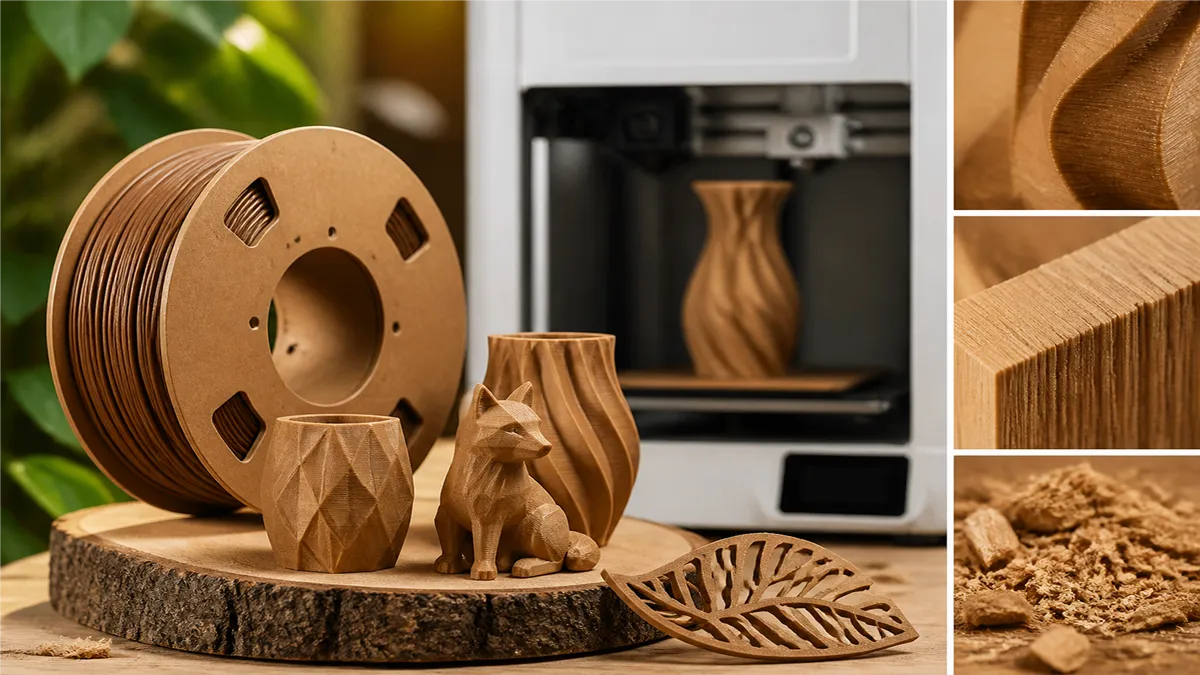
Wood filament turns ordinary PLA prints into pieces that look — and even smell — like real timber, with visible grain you can sand and stain. On a Bambu Lab printer it’s very printable, with two important caveats: the wood particles are abrasive, and they clog small nozzles. This research-based guide covers the best wood filament for Bambu Lab, ranks the brands the community rates highest, and lays out the exact settings to print them cleanly — built from manufacturer data sheets and widely reported user results, not a hands-on test.
Quick picks
Best official option: Bambu PLA Wood — tuned profile, realistic grain
Best value: SUNLU Wood PLA — real wood fiber, wide tones
Print rule #1: use a 0.4 mm (ideally 0.6 mm) hardened nozzle, not 0.2 mm
In this guide
What wood filament actually is
Wood filament is standard PLA blended with fine wood powder or fiber — anywhere from a few percent up to around 40% real wood content in some brands. That filler gives prints an authentic grainy texture and warm tones, and lets you post-process them like wood: sanding smooths them, and stain or wax deepens the color. The trade-off is that the wood particles are mildly abrasive and prone to clogging narrow nozzles, so nozzle choice and temperature matter more than with plain PLA.
The best wood filament for Bambu Lab in 2026
Bambu PLA Wood — the no-fuss official pick
Bambu’s own PLA Wood mixes high-quality PLA with fine wood powder for a realistic, handcrafted look, and it has a tuned Bambu Studio profile so there’s nothing to guess at. Its data sheet lists a nozzle range of 190–240°C, support for 0.4, 0.6 and 0.8 mm nozzles, and a pre-print drying recommendation of 55°C for 8 hours. If you want wood-look prints with the least troubleshooting, start here.
SUNLU Wood PLA — best value
SUNLU’s wood PLA uses real wood fiber for a convincing texture at a lower price, with a decent range of timber tones. Like all wood filaments it prints best on a larger nozzle and benefits from a slow, steady flow. A strong choice if you’re printing wood pieces in volume.
Other community favorites
Several specialty makers offer high-wood-content PLA (up to ~40% fiber) that sands and stains especially well for furniture-style and decorative prints. Whatever the brand, the printing rules below are the same.
Recommended Bambu settings for wood filament
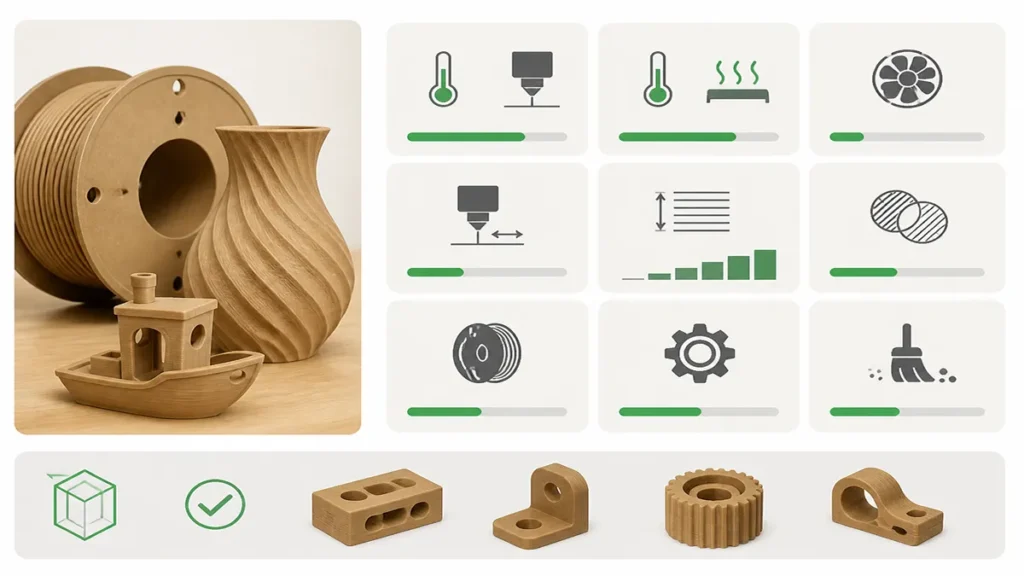
Setting | Starting value | Why |
|---|---|---|
Nozzle size | 0.4 mm min, 0.6 mm better | Wood particles clog small nozzles; 0.2 mm is a no |
Nozzle material | Hardened steel | Wood-fill is abrasive — protects the orifice |
Nozzle temp | 190–220°C | Lower end reduces darkening; tune per brand |
Bed temp | 55–65°C | Standard PLA-style adhesion |
Speed | Slower than PLA (~40–60% walls) | Reduces clogging and improves grain |
Cooling fan | Standard PLA fan | Wood is still a PLA base |
Dry before printing | 55°C / ~8 h | Damp wood-fill strings and clogs more |
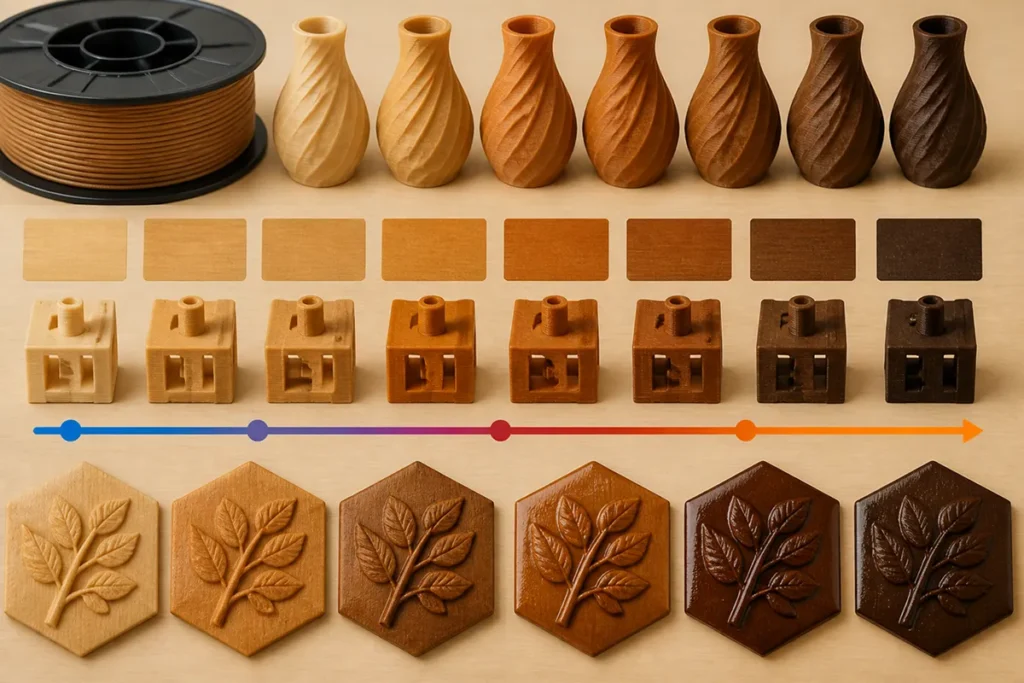
Pro tip: printing slightly cooler gives lighter wood tones, hotter gives darker, almost scorched tones — you can vary the temperature to “stain” the print as it goes.
The nozzle warning you can’t skip
Two failure modes catch people out. First, clogging: wood fibers bridge a narrow orifice, so a 0.2 mm nozzle is a non-starter and even 0.4 mm benefits from slower speeds — 0.6 mm is the safest. Second, wear: wood-fill is abrasive enough that some users report visible nozzle deformation after under a kilogram. Always print it on a hardened steel nozzle, and treat that nozzle as a consumable.
Printing and finishing tips
- Dry it first. Wood-fill absorbs moisture readily; a damp spool strings and clogs. Dry at ~55°C and store with desiccant.
- Slow down. Lower wall and infill speeds dramatically cut clog risk and bring out the grain.
- Vary temperature for tone. Cooler = lighter, hotter = darker — a free way to add realism across a model.
- Sand, then stain or wax. Wood prints take post-processing beautifully; light sanding plus stain looks remarkably like the real thing.
- Clear a clog with a cold pull. If flow drops mid-print, a cold pull usually restores it without a teardown.
Where to buy
As an Amazon Associate we earn from qualifying purchases. Click through for current pricing and tones.
- Bambu PLA Wood on Amazon — tuned profile, realistic grain
- SUNLU Wood PLA on Amazon — best value, real wood fiber
- Hardened steel nozzle on Amazon — required for wood-fill
Frequently asked questions
Do I need an enclosure for wood filament?
No. Wood filament is a PLA base, so it prints fine on open-frame Bambu machines like the A1 — no enclosure or heated chamber required.
Will wood filament wreck my nozzle?
It will wear a stainless nozzle quickly and even shortens a hardened one’s life. Use hardened steel and accept the nozzle as a consumable. Full detail in our hardened vs stainless nozzle guide.
Can I run wood filament through the AMS?
It’s a PLA base so it feeds, but abrasive fills wear the AMS path and can clog — many users prefer an external spool for wood. See our AMS 2 Pro compatibility guide.
Why are my wood prints stringing?
Usually moisture or too-high temperature. Dry the spool, lower the nozzle temp slightly, and slow travel moves. Wood-fill is less tolerant of a wet spool than plain PLA.
The bottom line
When it comes to the best wood filament for Bambu Lab, two spools stand out: Bambu PLA Wood is the easiest path to realistic wood-look prints thanks to its tuned profile, while SUNLU Wood PLA is the value pick. Whatever you choose, the rules are the same: a 0.4 mm (ideally 0.6 mm) hardened nozzle, a dried spool, slower speeds, and a willingness to treat the nozzle as a consumable. Get those right and wood filament delivers some of the most satisfying, hand-finished prints you can make.
Related reading: Best PLA filament for Bambu Lab • Hardened vs stainless nozzle • How to store filament
Affiliate disclosure: FilamentPicks is reader-supported. When you buy through links on this page we may earn a small commission at no extra cost to you. We only recommend filaments based on manufacturer specifications, published technical data sheets and community reports — this is a research-based guide, not a hands-on lab test.