

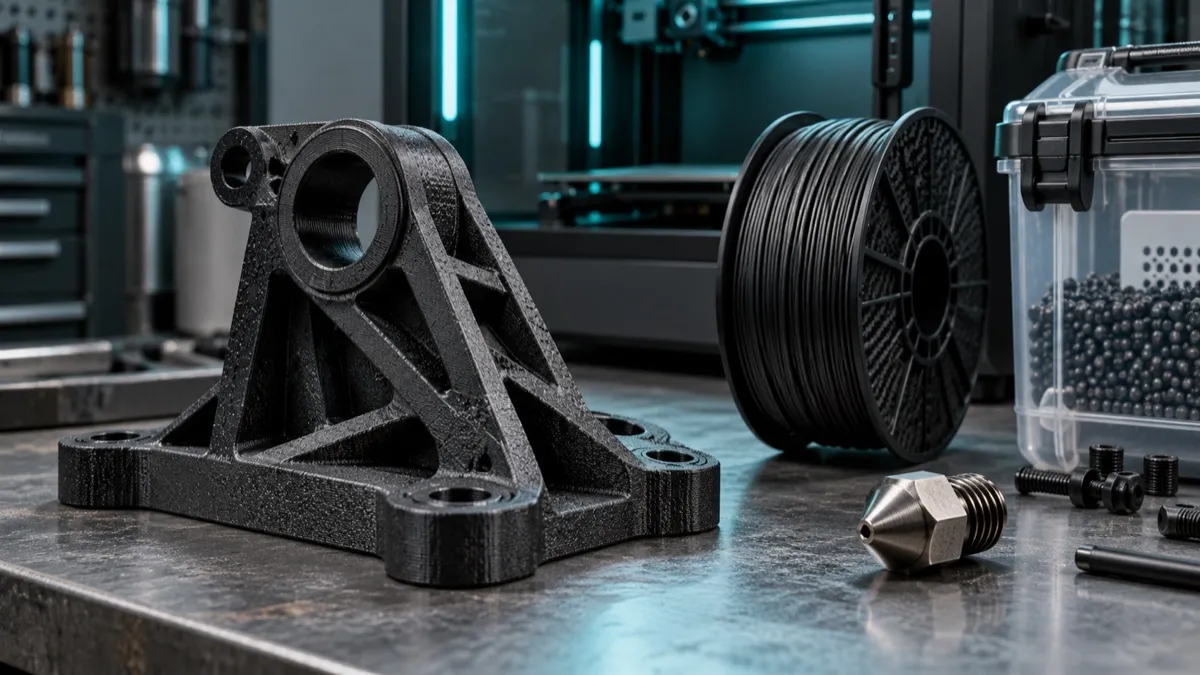
Bambu P2S nylon settings depend more on moisture control and the exact formulation than almost any other common filament. Unfilled PA, PA6-CF, PA6-GF and PAHT-CF are not interchangeable. The enclosed P2S has the temperature range and quick-swap nozzle system needed for many engineering nylons, but a generic profile cannot compensate for a wet spool or unsuitable nozzle.
Know which nylon you are printing
| Material family | Main advantage | Main setup risk |
|---|---|---|
| Unfilled PA6/PA12 | Toughness, fatigue resistance and low friction | Moisture, warping and difficult bed adhesion |
| PA-CF / PAHT-CF | Stiffness, dimensional stability and heat performance | Abrasive fibers, brittle feed path and moisture |
| PA-GF | Stiff, stable functional components | Abrasion and rougher surface |
| Easy-print copolyamide | Lower warp and simpler profiles | Properties may differ substantially from traditional PA |
The polymer name alone is not enough. A profile that works for one PA12 blend can be unsafe or mechanically poor for a high-temperature PA6-CF. Keep the manufacturer, product name, color, drying history and nozzle in the profile label.
Useful Bambu P2S nylon settings therefore describe a specific formulation and hardware path, not nylon as one interchangeable material family.
Bambu P2S nylon settings baseline
| Setting | Starting rule | Verification |
|---|---|---|
| Filament profile | Exact Bambu or manufacturer P2S profile; otherwise closest Generic PA clone | Do not transfer a P1 profile without validation |
| Nozzle temperature | Use the narrow range in the filament data sheet | High-temperature PA may approach the P2S limit |
| Nozzle material | Hardened steel for CF/GF grades | Standard unfilled nylon may not require hardened hardware |
| Nozzle diameter | 0.6 mm is a robust starting choice for filled material | Use 0.4 mm only when the maker approves it |
| Bed and adhesive | Profile-specific high-temperature plate setup | Adhesive may function as both grip and release layer |
| Part cooling | Low; increase only for bridges and small geometry | Too much fan weakens bonding and increases warp |
| Enclosure | Closed and thermally stable | Large PA parts remain sensitive to drafts |
| Volumetric speed | Conservative until melt capacity is tested | Filled polymers can under-extrude before they visibly fail |
Drying is part of the print profile
Nylon can absorb enough moisture to change extrusion, surface quality and mechanical properties. Popping, steam, excessive stringing, fuzzy walls and a rough matte surface can all indicate moisture. A spool can feel dry and still print poorly.
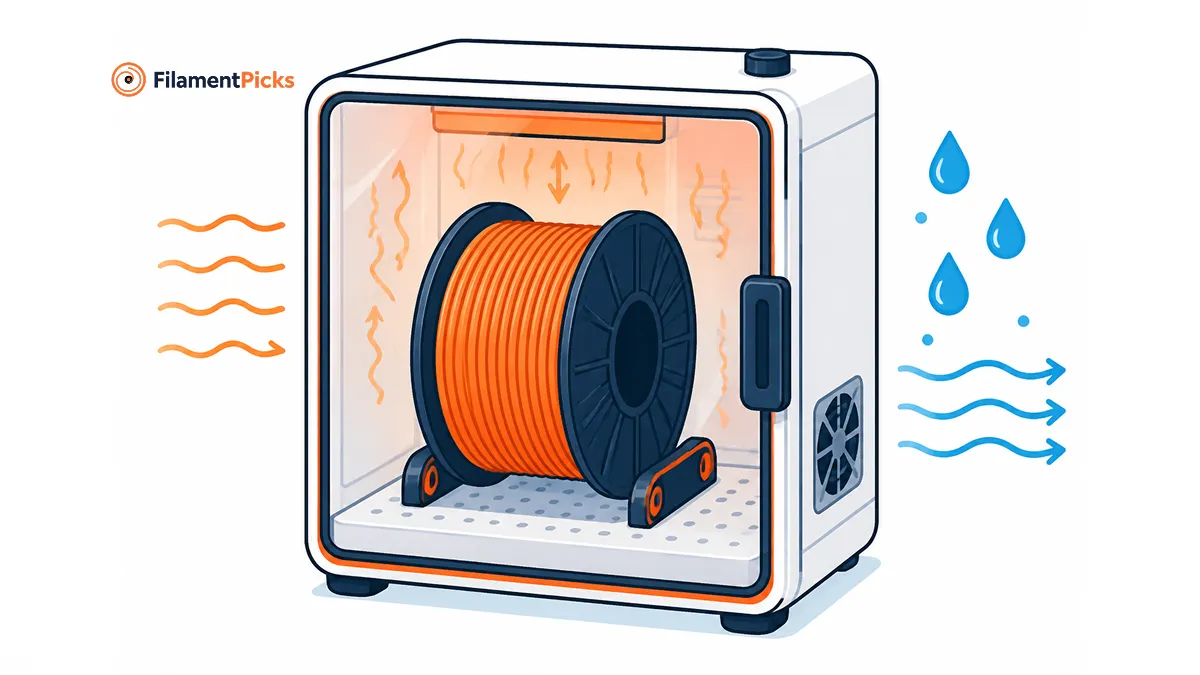
Bambu’s filament guide marks PAHT-CF, PA6-CF and PA6-GF as requiring drying and provides formulation-specific high-temperature cycles. Those values are not universal. Use a dryer that can hold the required temperature evenly, respect the spool’s limit and print from a dry box when the job is long. An AMS 2 Pro can maintain a dry environment and dry compatible material within its documented limits, but it is not a substitute for a hotter dedicated cycle when the filament maker requires one.
Use a controlled moisture comparison
When moisture is uncertain, avoid changing five slicer values at once. Dry a measured amount of filament with the documented cycle, keep the remainder in its current state and print the same short coupon from each sample. Listen for popping, compare surface texture and weigh or break the parts only after they have cooled under the same conditions. A clear improvement after drying is stronger evidence than a subjective guess based on one wall.
Store the dry sample in a sealed container while the printer is prepared. Nylon can begin absorbing moisture during a long setup or pause, particularly in a humid room. If a multi-hour print becomes progressively rougher toward the top, examine how the spool was protected during printing rather than recalibrating only the last layers.
Nozzle and feed-path choices
Use hardened hardware for abrasive blends
Carbon and glass fibers act as abrasives. Wear changes nozzle diameter and can degrade dimensional accuracy long before a casual inspection reveals a problem. Use a hardened nozzle and inspect it periodically. A 0.6 mm opening improves particle clearance and is the common conservative choice for filled nylon.
Keep the feed path gentle
Dried engineering filament can be stiff or brittle. Avoid tight bends, damaged PTFE and poorly aligned spool exits. Confirm the AMS and spool compatibility for the exact material. Some abrasive or brittle grades are better printed from an external dry box even when the polymer itself appears on a general compatibility list.
Calibration sequence for PA and PA-CF
- Dry the spool using its documented cycle.
- Install the approved nozzle material and diameter.
- Select the correct P2S, hotend and plate in Bambu Studio.
- Print a first-layer patch with the intended adhesive.
- Validate temperature with a mechanical coupon, not appearance alone.
- Calibrate flow ratio for the dried spool.
- Calibrate flow dynamics.
- Run a restrained volumetric-flow test.
- Condition test coupons consistently before comparing strength or dimensions.
Moisture invalidates calibration. If the spool absorbs water between tests, the next result is not comparable. Our Bambu flow calibration guide separates flow ratio, dynamics and volumetric capacity. For a wider material comparison, see PA-CF vs PC vs ASA on the P2S.
Save the final Bambu P2S nylon settings with the drying date and time spent outside dry storage so a later test can reproduce the same material condition.
Create an engineering acceptance test
Appearance is a poor approval standard for functional nylon. Choose a small set of checks that matches the intended use: mass, wall thickness, hole diameter, flatness, fastener pull-out, repeated bending or a simple load test. The goal is not to reproduce a laboratory data sheet; it is to confirm that this spool, profile and orientation meet the real requirement.
| Application | Coupon feature | What it reveals |
|---|---|---|
| Gear or sliding guide | Tooth/slot segment | Surface finish, clearance and wear behavior |
| Bolted bracket | Boss with the real insert or screw | Layer orientation and local cracking |
| Living hinge or clip | Full-thickness flex section | Fatigue behavior after conditioning |
| Flat fixture | Long base strip | Warp and dimensional stability |
| High-temperature mount | Loaded section in a safe simulated environment | Creep and fit at service temperature |
Print all comparative coupons in the same orientation and condition them the same way. Unfilled nylon can change stiffness as it absorbs moisture, so a dry coupon tested immediately and a conditioned coupon tested days later are not equivalent. Keep both results when the finished part will live in a humid environment.
Profile records for repeatable PA-CF printing
Record the full material name, lot, color, drying cycle, time out of dry storage, nozzle material and diameter, plate, adhesive, flow values and successful volumetric limit. Add the approximate hours already printed through the nozzle. That last entry helps explain a slow drift in dimensions caused by abrasive wear instead of blaming every change on moisture.
P2S nylon troubleshooting
| Symptom | Probable cause | First action |
|---|---|---|
| Popping or steam | Wet filament | Stop and repeat the documented drying cycle |
| Fuzzy, rough wall | Moisture or unstable flow | Verify dryness before temperature changes |
| Nozzle clicking | Partial clog, particle bridge or excess flow demand | Reduce speed and inspect the hotend/feed path |
| Weak interlayer strength | Wet filament, low temperature or too much fan | Dry, reduce cooling and validate temperature |
| Corner lift | Chamber/bed instability or poor adhesive match | Use a brim and stabilize the enclosure |
| Part changes size after printing | Moisture uptake, annealing or anisotropic shrinkage | Condition and measure parts under controlled conditions |
| Increasing over-extrusion over time | Nozzle wear from fibers | Measure or replace the nozzle and recalibrate |
Designing functional nylon parts
Nylon’s toughness can be more valuable than its absolute stiffness. Unfilled PA can flex repeatedly and resist impact, while CF/GF grades trade some ductility for stiffness and dimensional stability. Use fillets around fasteners, orient layer lines around the primary load and avoid relying on a thin Z-direction feature for safety-critical strength.
Moisture affects the finished part as well as printing. Some nylon parts become more flexible after conditioning. Measure critical fits after the part reaches its intended service environment, not immediately after it leaves a dry printer chamber.
For tight assemblies, approve the Bambu P2S nylon settings only after a conditioned test part still meets the required clearance and mechanical behavior.
The Bambu nylon printing guide covers general preparation, while the nylon filament comparison helps choose a formulation. This article stays focused on Bambu P2S nylon settings and workflow.
Moving from a test coupon to a production part
Scale gradually. A profile that passes a 20-minute coupon should next print a section with the final wall count and footprint, then one complete part. Inspect the nozzle after a long filled-nylon job, especially if line width or dimensions begin drifting. Do not compensate for suspected wear by repeatedly lowering flow without measuring the hardware.
For a batch, keep spool condition and chamber routine constant. Start each reel with the same drying process, note when it enters the dry box and avoid mixing parts printed from fresh and moisture-exposed material without labeling them. If dimensional tolerances matter, sample the first, middle and last part from the batch rather than checking only the cleanest example.
Revalidate the Bambu P2S nylon settings whenever the nozzle, material lot, drying routine or production environment changes.
Safety and process limits
Use room ventilation and follow the filament safety data sheet. Filled polymers can create fine dust during sanding or machining; use appropriate extraction and personal protective equipment. Do not touch a hot nozzle, bed or printed part, and never exceed the P2S or filament manufacturer’s rated temperatures.
Treat these Bambu P2S nylon settings as a documented starting point, then validate one change at a time with the same dried spool and nozzle.
Bambu P2S nylon settings FAQ
Can the P2S print PA-CF?
Many PA-CF formulations fit the P2S temperature and enclosure capabilities. Confirm the exact product, use hardened hardware and follow its drying and nozzle guidance.
Is a 0.4 mm nozzle safe for carbon-fiber nylon?
Some manufacturers approve it, but 0.6 mm is commonly recommended for better particle clearance. Never assume compatibility from the polymer name alone.
Can PA-CF go through the AMS 2 Pro?
Compatibility varies by formulation, spool and current AMS guidance. Abrasion and brittleness may make external dry-box feeding the safer path.
Why is nylon stringing after calibration?
Moisture is the first variable to eliminate. Retraction tuning cannot fully compensate for steam and inconsistent melt behavior.
Should I anneal nylon prints?
Only when the filament manufacturer provides a validated process and dimensional change is acceptable. Annealing can shrink or warp a finished part.