

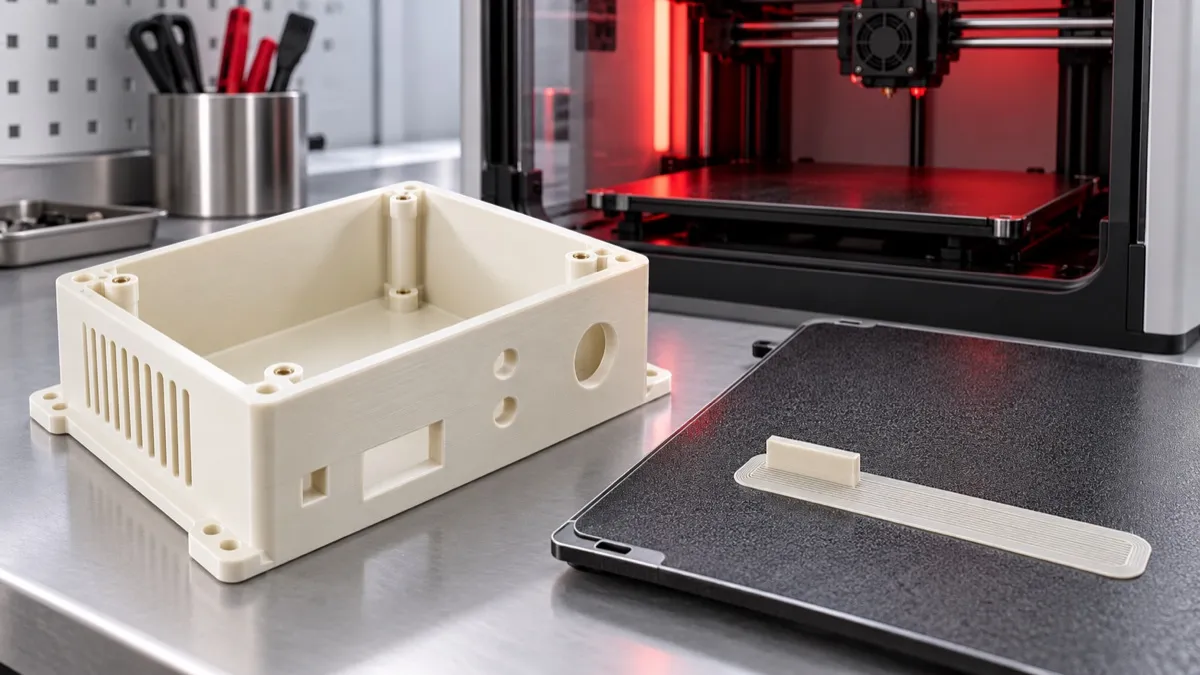
Bambu P2S ABS settings work best when the printer, plate and filament profile are treated as one thermal system. ABS can produce strong, machinable functional parts on the enclosed P2S, yet it will still curl or split if the bed is dirty, the chamber changes temperature quickly or part cooling is too aggressive.
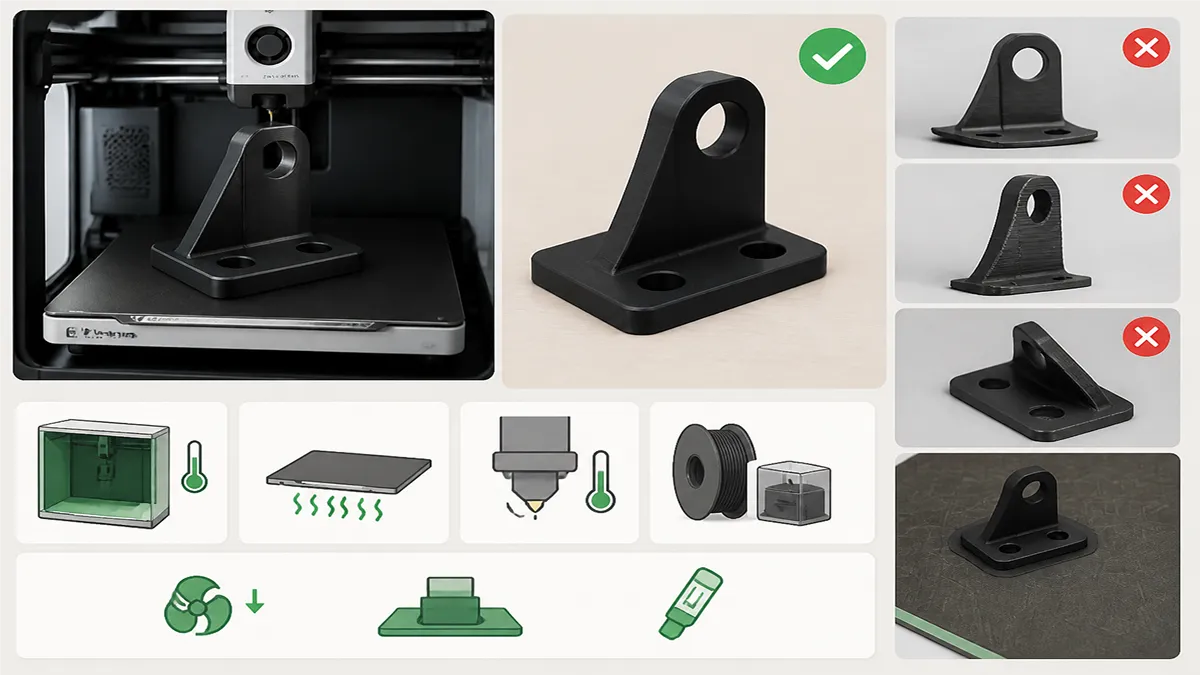
Bambu P2S ABS settings baseline
| Control | Conservative start | Why it matters |
|---|---|---|
| Profile | Bambu ABS or Generic ABS for P2S | P1/P1S third-party presets should not be copied without calibration |
| Nozzle temperature | Inside the spool maker’s range; Bambu guide: 240–280 °C | Controls flow, gloss and layer bonding |
| Bed temperature | Plate-specific profile; Bambu guide: 90–100 °C PEI | Reduces the first-layer temperature gradient |
| Part fan | Off or low for normal walls | High cooling increases shrinkage stress |
| Auxiliary fan | Off | Prevents one-sided cooling |
| Enclosure | Closed and preconditioned for large parts | Stabilizes the chamber before tall layers are built |
| First layer | Slow stock-profile value | Improves contact without hiding a contaminated plate |
| Max volumetric speed | Profile default until tested | ABS can look acceptable while under-extruding at high flow |
Numbers in a table cannot replace profile validation. A saved Bambu P2S ABS settings profile should identify the brand, product and color because ABS+ and impact-modified ABS may behave differently from standard ABS. A color change alone can alter the required temperature and flow ratio.
ABS or ASA on the P2S?
Both materials benefit from an enclosure and low cooling. ABS is widely available, easy to sand and commonly used for indoor functional parts. ASA normally provides better long-term UV and weather resistance, making it the stronger default for outdoor housings. The choice should follow the environment of the finished part rather than whichever profile prints faster.
| Requirement | ABS | ASA |
|---|---|---|
| Indoor fixtures and prototypes | Good fit | Also suitable |
| Outdoor UV exposure | Less preferred | Usually preferred |
| Post-processing | Easy to sand; solvent methods require strict safety controls | Similar considerations |
| Warping risk | High on large footprints | High; formulation-dependent |
| Ventilation | Required | Required |
For a broader comparison, see PETG vs ABS on Bambu Lab printers. PETG is easier when enclosure heat resistance is unnecessary; ABS earns its complexity when temperature resistance, machining or finishing matters.
Prepare the printer before tuning
Dry only within the material limit
Bambu lists drying as optional for standard ABS and provides an 80 °C, eight-hour blast-oven reference for its material. Dry a spool that has been stored poorly or shows popping, bubbles and rough extrusion, but follow its own data sheet. A plastic spool or cardboard core can have a lower safe temperature than the polymer.
Clean the plate and use release agent when required
Skin oil creates localized failure that resembles incorrect temperature. Clean the build surface and use the adhesive or release method recommended for that exact plate. Adhesive can protect a smooth sheet from excessive bonding as well as help a difficult material stay down.
Control room drafts
Do not place the printer below an air-conditioning vent or next to a frequently opened exterior door. The P2S enclosure limits direct airflow, but a cold room or repeated door opening can still shift chamber conditions over a long job.
Calibrate ABS in the correct order
- Confirm printer, nozzle and plate selection in Bambu Studio.
- Clone the closest safe ABS profile.
- Print a first-layer patch and solve adhesion before touching advanced settings.
- Test temperature with a part thick enough to evaluate layer bonding.
- Run flow-ratio calibration for the exact spool and color.
- Calibrate flow dynamics after ratio.
- Increase volumetric speed only after a representative flow test.
- Validate a part with the final footprint and chamber conditions.
The flow calibration guide explains why these tests should not be combined. Third-party P2S profiles can be sparse; use the custom filament workflow instead of selecting a profile made for another printer.
Match the ABS test to the final geometry
A small tower proves that the filament can extrude, but it does not reproduce the shrinkage stress of a wide enclosure or the heat accumulation inside a thick mechanical part. Challenge the Bambu P2S ABS settings with a reduced validation model that keeps the final part’s longest edges, wall thickness, corners and fastener features. A 15-minute coupon that contains the real failure point is more informative than another perfect cube.
| Final use | Test before the full print | Pass condition |
|---|---|---|
| Electronics housing | Base corner, vent and screw boss | Flat base and no split around the boss |
| Workshop jig | Loaded hole or clamping face | Fastener seats without cracking or excessive creep |
| Automotive interior trim | Clip and visible wall section | Clip survives repeated use and surface bands are acceptable |
| Large flat panel | Full-length strip with the same brim | No corner lift after gradual cooling |
| Machined or tapped part | Extra boss with the intended tool operation | Walls remain intact after drilling or tapping |
Let every comparison cool under the same conditions. Removing one sample hot and leaving another on the bed can create a larger dimensional difference than the slicer change being evaluated. Mark the profile version on the test piece or in its file name so results do not become detached from the settings that produced them.
Document the spool, not just “ABS”
Save brand, product line, color, lot when available, plate, nozzle, drying history, flow ratio and tested volumetric limit. Impact-modified ABS, recycled blends and “ABS+” products can behave differently. A profile named only “Generic ABS” is difficult to trust several months later.
Bambu P2S ABS troubleshooting table
| Problem | Diagnosis | Action |
|---|---|---|
| Corner lift | Plate contamination, draft or insufficient footprint | Clean, add a brim and stabilize the enclosure |
| Layer cracks | Part fan too high or chamber too cool | Reduce cooling and avoid opening the door |
| Elephant’s foot | Too much initial heat or compression | Verify plate profile and first-layer flow before compensation |
| Weak walls | Low nozzle temperature, wet material or excess speed | Dry if justified, slow down, then test temperature |
| Gloss changes | Speed/temperature transitions | Use a steadier outer-wall speed and sufficient minimum-layer time |
| Stringing | Moisture, temperature or travel behavior | Check dryness and temperature before aggressive retraction edits |
| Nozzle clicking | Flow demand or partial restriction exceeds delivery | Reduce volumetric speed and inspect the hotend/feed path |
Design choices that reduce warping
Rounded corners distribute shrinkage stress better than long sharp corners. Split an oversized housing into mechanically joined sections when the footprint approaches the limits of the plate. Use ribs instead of very thick solid walls, and keep wall thickness reasonably uniform so one region does not cool much more slowly than another.
Strength is directional. Orient load paths across continuous roads when possible, add walls before extreme infill and test the real fastener or temperature exposure. A material’s data-sheet strength does not automatically transfer to a printed part with layer seams and internal voids.
Recheck the Bambu P2S ABS settings after changing the nozzle, plate or room conditions. A profile that was flat in summer may need a different warm-up routine in a colder workshop.
Surface finish and dimensional control
Visible gloss bands often follow speed changes rather than random filament variation. Keep the visible outer-wall speed reasonably consistent and inspect the slicer preview for sharp slowdowns near holes, bridges and overhangs. If the band appears at the same layer on every copy, read the toolpath before changing temperature.
Measure critical features only after the part reaches room temperature. Separate systematic slicer error from physical distortion: a consistently undersized circular hole may justify calibrated compensation, while a hole that is oval on only one side points to cooling, orientation or warping. For assemblies, print both mating coupons together and test functional clearance under the expected service temperature.
ABS is popular for sanding and finishing, but post-processing can change dimensions and introduce chemical hazards. Use wet sanding or suitable dust control, eye protection and ventilation. Solvent smoothing should never be improvised near ignition sources; follow the chemical supplier’s safety data and local rules, and keep the dimensional change away from bearing seats, threads and snap fits.
ABS ventilation and fire safety
Reliable Bambu P2S ABS settings control quality, but they never replace proper ventilation, fire awareness and material-specific safety guidance.
Let large ABS prints cool gradually before removing them. Forcing a hot part from the plate can distort it, damage the surface or release accumulated stress.
Use these Bambu P2S ABS settings as a controlled baseline, then change only one variable per validation print and record the result for that exact spool.
Bambu P2S ABS settings FAQ
Can the Bambu P2S print ABS?
Yes. The enclosed printer, 300 °C maximum nozzle and 110 °C maximum bed are compatible with common ABS workflows. Use the current filament profile and ventilation.
Should the auxiliary fan run for ABS?
Usually no. Strong one-sided cooling increases warping. Use limited part cooling only where bridges or small features require it.
Can I use ABS in the AMS 2 Pro?
Standard rigid ABS is generally compatible when the spool fits and the current AMS documentation allows it. Confirm the exact spool and do not route unusually brittle, abrasive or deformed material blindly.
Why does ABS detach halfway through the print?
The first layer can remain attached while cumulative shrinkage exceeds its grip. Stabilize the chamber, reduce cooling and use a brim or geometry change for large footprints.
Is ABS stronger than PETG?
There is no universal winner. ABS may offer higher heat resistance and easier finishing; PETG often has excellent layer adhesion and easier printing. Match the material to the load, temperature, chemicals and UV exposure.