

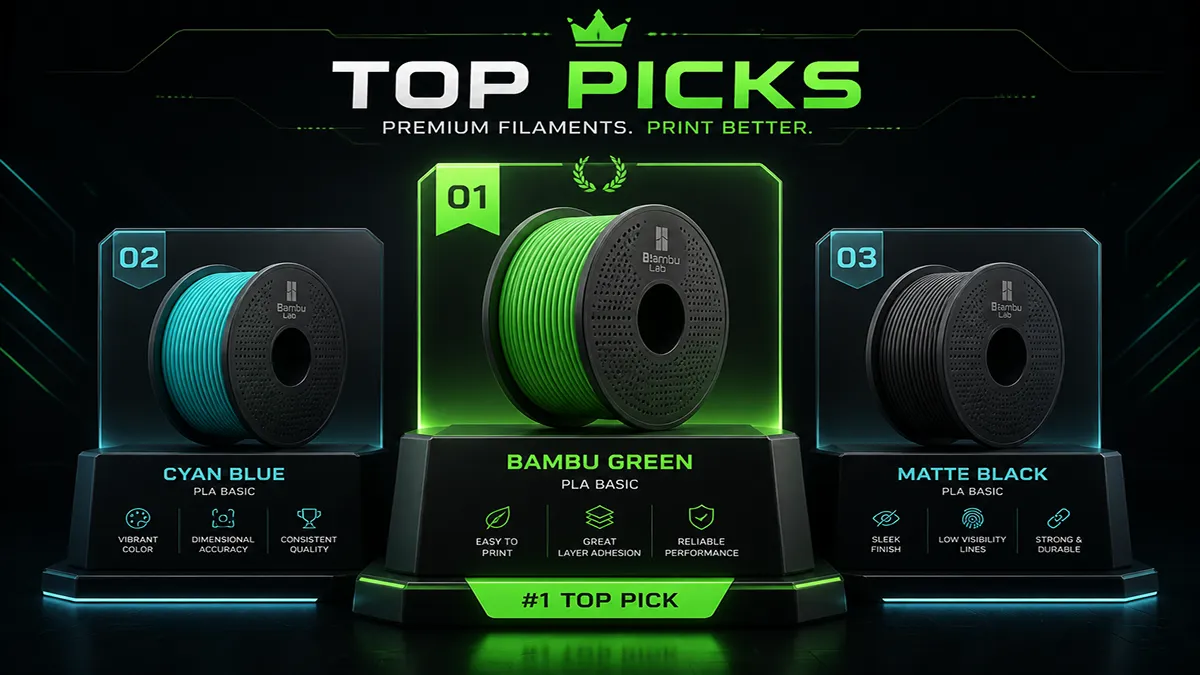
The best nylon filament for Bambu Lab is Bambu PA6-CF for most people: it’s a carbon-fiber-reinforced PA6 with a factory-tuned Bambu Studio profile, excellent stiffness, and high heat resistance for structural parts. If you want the lowest moisture sensitivity and the highest temperature performance, step up to Bambu PAHT-CF; if you want the same engineering strength for less money, eSUN PA-CF is the value pick.
Nylon (PA) is the go-to for functional, load-bearing parts — gears, brackets, fixtures, drone frames, and automotive components — because it combines toughness, fatigue resistance, and heat tolerance that PLA and PETG can’t match. The catch is that nylon is the most demanding common filament: it soaks up moisture aggressively, the carbon- and glass-filled grades need a hardened nozzle, and an enclosure helps a lot. Get those three things right and Bambu’s engineering machines handle it beautifully.
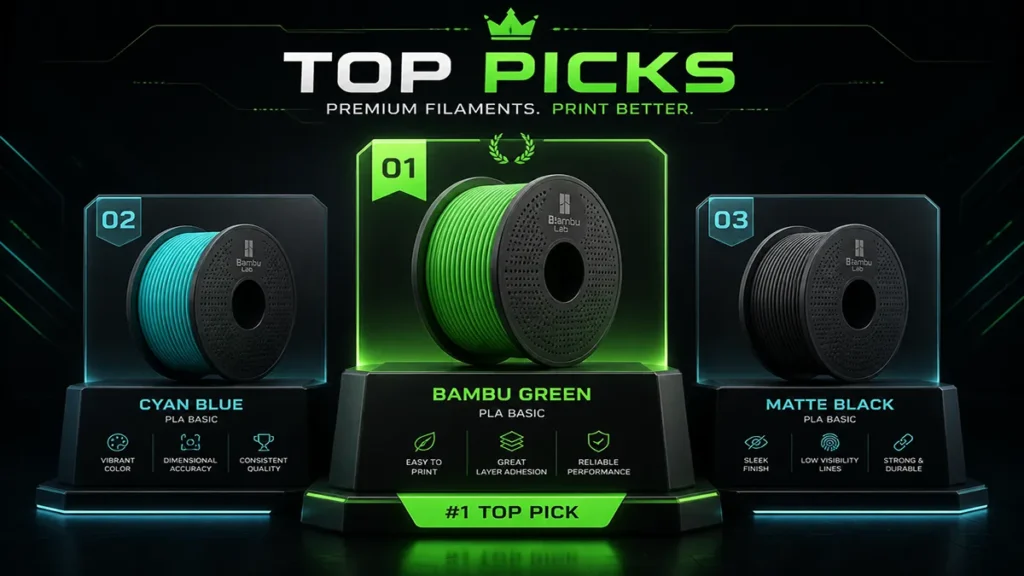
Quick picks at a glance
| Use case | Our pick | Why |
|---|---|---|
| Best overall engineering | Bambu PA6-CF | Tuned profile, high stiffness, heat & impact resistance |
| Lowest moisture / highest heat | Bambu PAHT-CF | Lower water absorption, stronger layer bonding |
| Best value structural | eSUN PA-CF | Real CF in a nylon base; survives load, vibration, heat |
| Best warp-free / flat parts | Polymaker Fiberon PA6-GF | Glass-fiber reinforced, low warp, high-speed friendly |
| Best non-CF tough nylon | Polymaker PolyMide CoPA | Warp-free, strong, heat-resistant; no hardened nozzle needed |
What makes the best nylon filament for Bambu Lab
Nylon earns its reputation on functional parts. Carbon-fiber grades like Bambu PA6-CF deliver high stiffness and strength in dry conditions and keep their properties at temperatures that would soften PLA or PETG, which is why they’re used for fixtures, clamps, automotive and mechanical components, and load-bearing structural parts. Carbon-reinforced nylon also has excellent impact and vibration resistance — ideal for drone frames and parts that take repeated knocks.
Three catches separate success from failure:
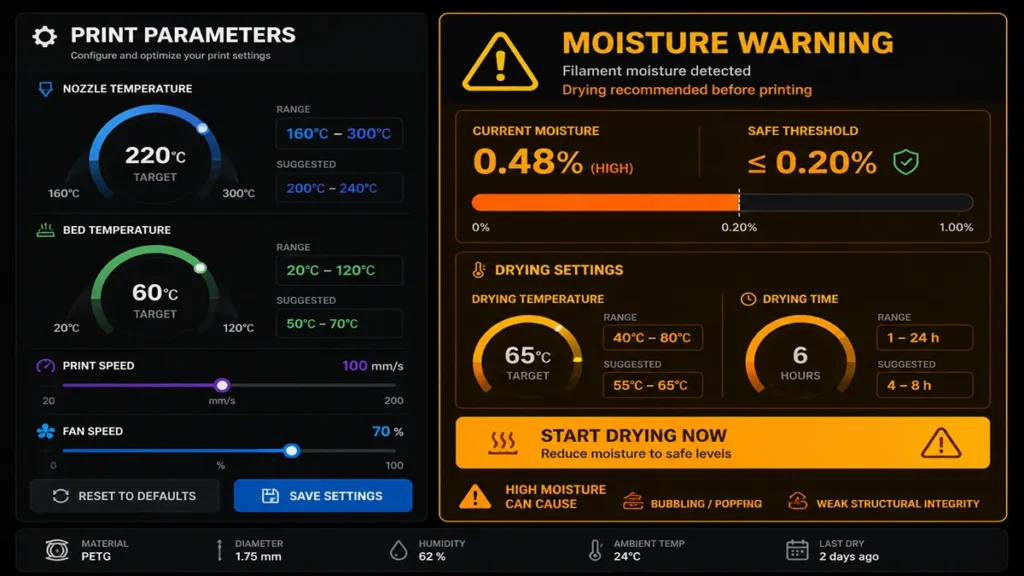
Moisture is the enemy. Nylon absorbs water from the air faster than almost any other filament, and wet nylon prints poorly and loses strength. Drying is mandatory — Bambu recommends roughly 80°C for several hours for PA6-CF, and you’ll often print straight from a dryer. Read our filament storage guide and consider a dedicated filament dryer before committing to nylon.
Filled grades are abrasive. Carbon- and glass-fiber nylon will chew through a standard brass nozzle in a single spool. A hardened steel or wear-resistant nozzle is required — the same upgrade you’d use for any carbon-fiber filament.
An enclosure helps. Nylon and its composites print best on enclosed machines like the X1C, P2S, or H2D, which hold chamber heat and reduce warping on larger parts.
The best nylon filaments for Bambu Lab
1. Bambu PA6-CF — best overall
Bambu PA6-CF is a carbon-fiber-reinforced PA6 (Nylon 6) that pairs high stiffness and strength with strong heat and impact resistance. Because it’s formulated for Bambu hardware, the Bambu Studio profile is dialed in, which removes a major variable from an otherwise tricky material. It’s ideal for fixtures, clamps, automotive parts, and structural components used in dry environments. Note that, like all nylon, it loses stiffness as it absorbs moisture — dry it well and store it sealed.
✔ Recommended
Bambu PA6-CF — best overall engineering nylon
Carbon-fiber PA6 with a factory-tuned profile, high stiffness, and excellent heat & impact resistance. Needs a hardened nozzle.
2. Bambu PAHT-CF — best for heat & low moisture
PAHT-CF is Bambu’s higher-performance carbon nylon. Compared with PA6-CF, Bambu reports a lower water-absorption rate and higher layer-bonding strength — two of nylon’s biggest pain points. If your parts see high heat or you’re tired of fighting moisture, this is the upgrade. It frequently sells out, so grab it when it’s in stock.
✔ Recommended
Bambu PAHT-CF — best high-temp / low-moisture
Lower water absorption and stronger layer bonding than PA6-CF. The pick for demanding, heat-exposed structural parts.
3. eSUN PA-CF — best value structural
eSUN PA-CF puts real carbon fiber in a nylon base at a noticeably lower price than first-party spools. It’s a proven choice for structural drone components — parts that survive flight loads, vibration, and thermal cycling. It’s genuinely harder to print than PLA, but the mechanical properties are in a different league, and for the money it’s the best value engineering nylon for Bambu owners willing to tune their own profile.
✔ Recommended
eSUN PA-CF — best value structural nylon
Real carbon-fiber nylon at a lower price. Survives load, vibration, and heat — great for drone and functional parts.
4. Polymaker Fiberon PA6-GF — best warp-free
Polymaker’s Fiberon PA6-GF is a glass-fiber-reinforced Nylon 6 built to be warp-free and optimized for high-speed printing. Glass fiber gives you stiffness and heat resistance without the brittleness that can come with some carbon grades, and it holds flat on larger parts. It’s a strong choice for stiff, durable components like brackets, pedals, and tooling. Like all filled nylon, it needs a hardened nozzle.
✔ Recommended
Polymaker Fiberon PA6-GF — best warp-free glass-fiber nylon
Glass-fiber Nylon 6, warp-free and high-speed friendly. Stiff, strong, and heat-resistant for flat functional parts.
Use code BALUTAVLAD for 15% off your first Polymaker order.
5. Polymaker PolyMide CoPA — best non-CF tough nylon
If you want nylon’s toughness without carbon fiber — and without buying a hardened nozzle — PolyMide CoPA is the answer. It’s a warp-free copolymer nylon that’s strong, tough, and heat-resistant, and it prints with a standard brass nozzle. It’s the most forgiving way into nylon for parts that need flex and impact resistance rather than maximum rigidity.
✔ Recommended
Polymaker PolyMide CoPA — best non-CF tough nylon
Warp-free copolymer nylon that’s strong and heat-resistant — and prints with a standard nozzle.
Use code BALUTAVLAD for 15% off your first Polymaker order.
CF vs GF vs neat nylon: which reinforcement?
Carbon fiber (PA-CF / PA6-CF / PAHT-CF): the stiffest and lightest option, with the best strength-to-weight ratio. Best for rigid structural parts where deflection matters. Abrasive — hardened nozzle required.
Glass fiber (PA6-GF): stiff and heat-resistant like CF but typically less brittle and more impact-tolerant, often at a lower price. Excellent for flat, warp-prone parts. Also abrasive — hardened nozzle required.
Neat / copolymer nylon (CoPA, PA6, PA12): the toughest and most flexible, with the highest elongation before breaking. Best for living hinges, clips, and impact parts. Prints with a standard nozzle but is the most moisture-sensitive of the three.
Print settings & drying
Nylon settings vary by brand — always start from the manufacturer or Bambu profile. These are representative starting points for carbon/glass nylon on Bambu hardware. Drying is the single most important step.
| Setting | Recommended | Notes |
|---|---|---|
| Nozzle temp | 260–290°C | CF/GF nylon runs hot; follow the brand profile |
| Bed temp | 90–100°C | Glue stick or engineering plate aids adhesion |
| Chamber | Enclosed preferred | X1C / P2S / H2D hold heat and reduce warp |
| Drying (before print) | ~80°C for 8–12 h | Mandatory; print from a dryer when possible |
| Part cooling | Low (0–30%) | Too much cooling weakens layer bonding |
| Nozzle | Hardened steel | Required for CF/GF; brass OK only for neat CoPA |
| Storage | Sealed + desiccant | Nylon re-absorbs moisture within hours |
Hardened nozzle & AMS compatibility
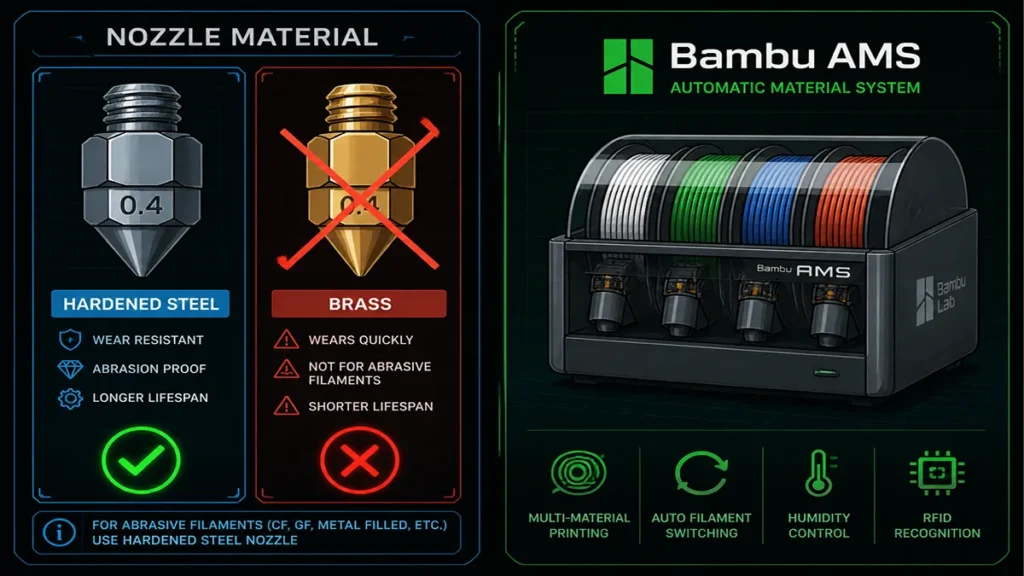
Two hardware notes decide whether your nylon prints succeed:
Hardened nozzle. Carbon- and glass-filled nylon is abrasive and will wear out a brass nozzle fast. Fit a hardened steel or wear-resistant nozzle before printing any filled grade. Only neat copolymer nylon (CoPA) is safe on brass.
AMS feeding. Bambu’s own carbon-reinforced nylons (PA6-CF, PAHT-CF) are designed to work with the AMS on enclosed machines. Third-party carbon-fiber filaments are generally not AMS-supported and are best run from an external spool to avoid jams on the tight AMS path. For more on official-versus-third-party trade-offs, see Bambu filament vs third-party.
Frequently asked questions
Can the Bambu A1 or A1 Mini print nylon?
They can print some nylon, but the open frame and lack of a heated chamber make warping and moisture harder to manage, and filled grades still need a hardened nozzle. For serious nylon work, an enclosed X1C, P2S, or H2D is strongly preferred.
Do I really have to dry nylon?
Yes — more than any other common filament. Nylon absorbs moisture within hours of being exposed to air, and wet nylon prints rough, pops, strings, and loses strength. Dry it before every print and store it sealed with desiccant.
Is carbon-fiber nylon stronger than glass-fiber nylon?
Carbon fiber is stiffer and lighter with a better strength-to-weight ratio; glass fiber is typically tougher and less brittle, often for less money. Choose CF for rigidity, GF for impact resistance.
What nylon does Bambu actually sell?
Bambu’s nylon line is carbon-reinforced — PA6-CF and the higher-performance PAHT-CF (Bambu has described its PA base as a PA6/PA12 blend). For neat nylon, third-party brands like Polymaker CoPA fill the gap.
The bottom line
Nylon is the material to reach for when a part has to do real work. For the smoothest path on a Bambu printer, Bambu PA6-CF gives you a tuned profile and strong, heat-resistant parts; PAHT-CF is the upgrade for heat and moisture resistance; and eSUN PA-CF delivers most of the performance for less. Whatever you choose, treat drying as mandatory, fit a hardened nozzle for filled grades, and print enclosed. Do that and nylon rewards you with parts no PLA or PETG can match. See where it sits against every other material in our Bambu filament tier list.
Disclosure: FilamentPicks is reader-supported. When you buy through links on our site, we may earn an affiliate commission at no extra cost to you. We are not sponsored by any filament manufacturer, and our recommendations are based on manufacturer specifications, published test data, and aggregated community reports — not paid placements. Full affiliate disclosure.