

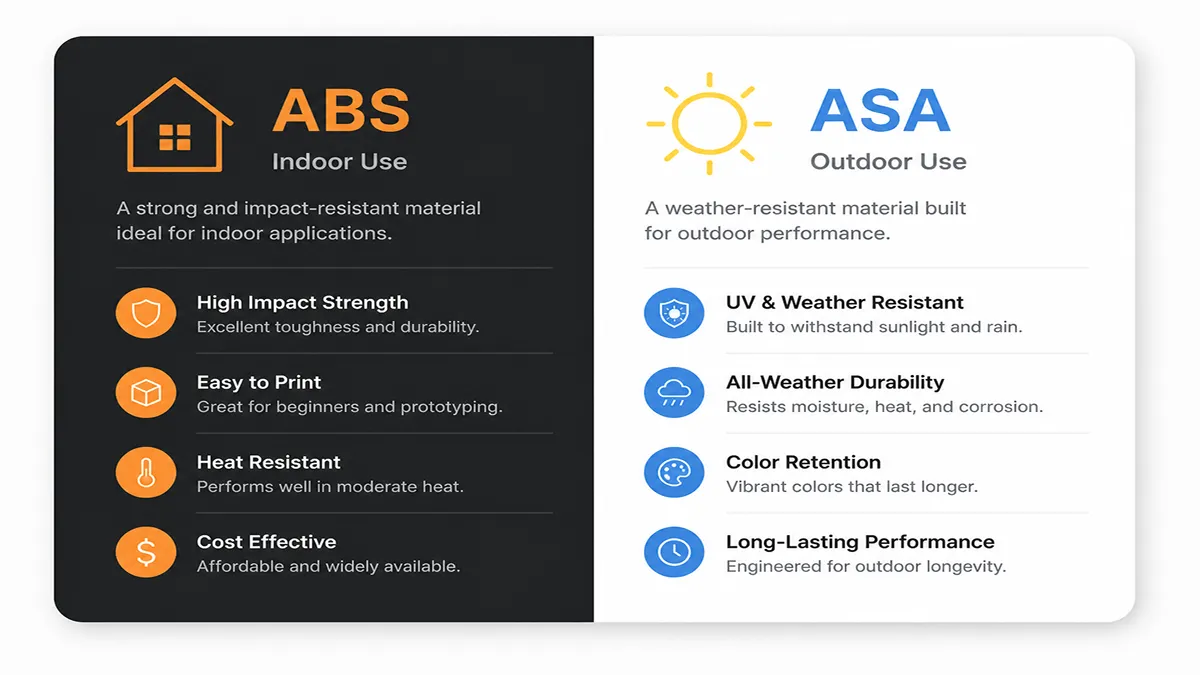
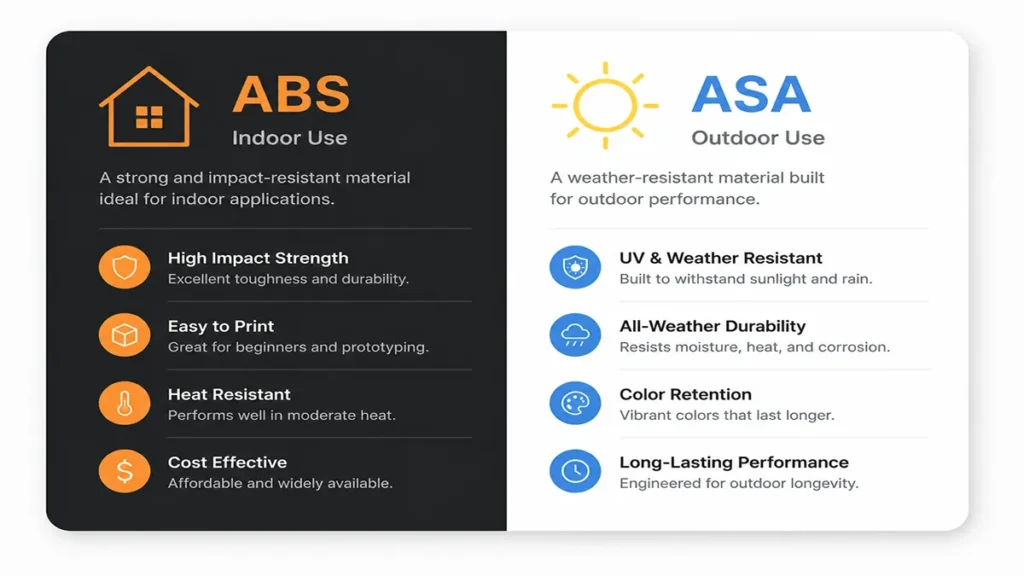
The ABS vs ASA decision on a Bambu Lab printer comes down to where the part will live: on a Bambu Lab printer, choose ASA if your part will live outdoors and ABS if it stays indoors or you want to save money. ASA is built to resist UV, so it keeps its color and impact strength in sunlight, where ABS slowly yellows and turns brittle. ABS is cheaper, just as strong indoors, and can be smoothed glass-smooth with acetone — something ASA cannot do.
Mechanically the two are close cousins. ASA is a styrene copolymer engineered from ABS, so they share comparable tensile strength, similar heat resistance, and the same need for an enclosed printer and a hot bed. The real decision comes down to four things: sun exposure, warping, post-processing, and cost. Here is how they compare on Bambu hardware, with settings for both.
Quick verdict table
| Property | ABS | ASA | Winner |
|---|---|---|---|
| UV / weather resistance | Poor — yellows, cracks | Excellent — color-stable | ASA |
| Tensile strength | Strong | Strong (comparable) | Tie |
| Heat resistance (HDT) | ~81°C | ~86°C | ASA (slight) |
| Warping tendency | Higher | Lower | ASA |
| Acetone smoothing | Yes | No | ABS |
| Odor while printing | Stronger | Milder | ASA |
| Cost per kg | Lower | Slightly higher | ABS |
| Ease on Bambu | Needs enclosure | Needs enclosure | Tie |
What ABS is good at
ABS has been the workhorse engineering plastic for decades, and it still earns its place for indoor functional parts. It’s tough, heat-resistant enough for most enclosures and electronics housings, and it’s the cheapest of the styrene materials. Its signature trick is acetone vapor smoothing: a short exposure to acetone vapor melts the surface into a glossy, watertight finish that no other common filament matches. For cosplay props, smooth enclosures, and parts you want to look injection-molded, ABS wins.
Where ABS falls down is sunlight. UV exposure makes it yellow and grow brittle within months, so it’s a poor choice for anything left outdoors. It also warps more than ASA and gives off a stronger odor while printing — ventilate your space and keep the enclosure closed. For the best indoor ABS results, see our best ABS filament for Bambu Lab guide.
What ASA is good at
ASA was developed specifically to fix ABS’s biggest weakness: weather durability. It resists UV, rain, and temperature swings without fading or cracking, which makes it the default for outdoor brackets, automotive trim, RC and drone bodies, garden hardware, and signage. It also warps slightly less than ABS and prints with a milder smell.
The trade-offs are a slightly higher price, a marginally hotter nozzle requirement (premium ASA likes 250–260°C), and no acetone smoothing. If your part will see the sun, none of that matters — ASA is simply the right material. Our full ranking lives in best ASA filament for Bambu Lab.
ABS vs ASA: the differences that matter
UV & weather resistance
This is the headline difference. ASA holds its color and impact strength after prolonged sun exposure; ABS degrades, yellows, and embrittles. If the part lives outside, ASA wins outright.
Strength & heat
Per manufacturer data, ABS and ASA have comparable tensile strength and heat deflection temperatures. ASA’s HDT is marginally higher (~86°C vs ~81°C), but for indoor structural parts the two perform almost identically. ASA is not meaningfully stronger — choosing it for strength alone is a myth.
Warping & printability
Both warp without an enclosure, but ASA is a little more forgiving on a well-calibrated Bambu machine. Either way, keep the chamber closed, run minimal part cooling, and use a brim on large parts.
Post-processing
ABS is acetone-soluble, so vapor smoothing gives a glossy finish. ASA is not soluble in acetone, so it can’t be vapor-smoothed the same way. If a mirror finish matters, ABS is your material.
Cost & odor
ABS is a few dollars cheaper per kilogram and the more economical choice for high-volume indoor parts. ASA prints with a noticeably milder odor, which is a small but real quality-of-life win in a home workshop.
Print settings on Bambu Lab
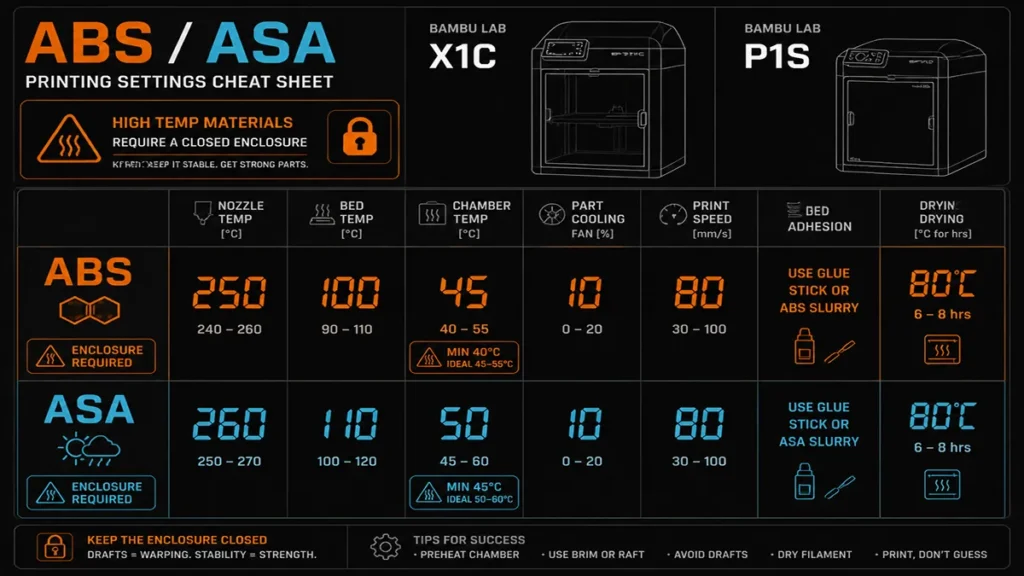
Both materials want an enclosure, a hot bed, and almost no part cooling. ASA runs slightly hotter at the nozzle. Dry either spool before printing.
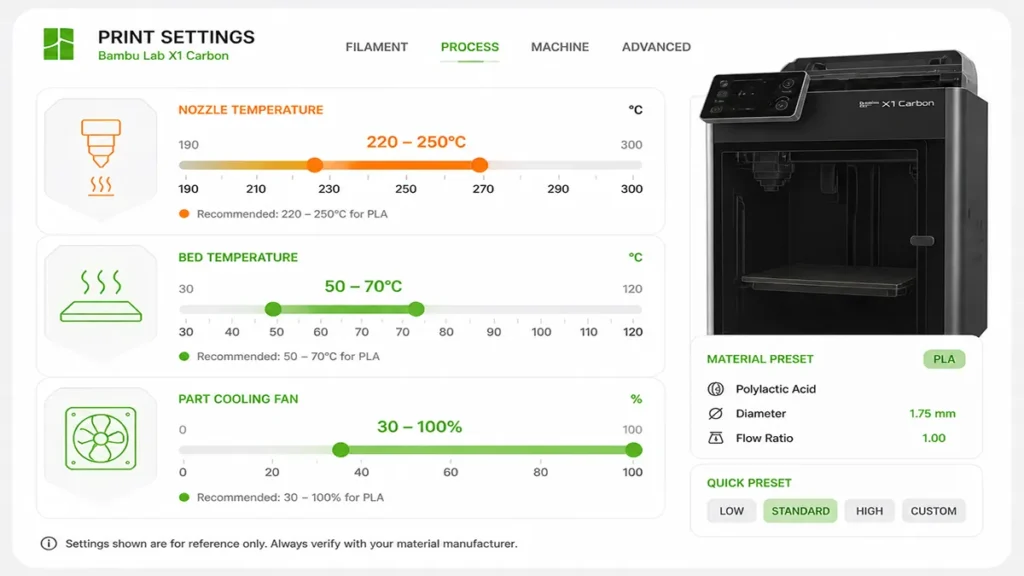
| Setting | ABS | ASA |
|---|---|---|
| Nozzle temp | 230–255°C | 240–260°C |
| Bed temp | 100–110°C | 90–110°C |
| Chamber | Enclosed | Enclosed |
| Part cooling | 0–20% | 0–20% |
| Brim | Recommended on large parts | Recommended on large parts |
| Drying | 75°C / 4 h | 65°C / 4–6 h |
| Acetone smoothing | Yes | No |
ABS vs ASA: which should you pick?
Pick ASA if: the part goes outdoors, sees sunlight, or needs long-term color stability — automotive trim, drone bodies, garden tools, antenna mounts, signage.
Pick ABS if: the part stays indoors, you want to acetone-smooth it to a glossy finish, or you’re printing in volume and want the lower cost — enclosures, brackets, cosplay props, prototypes.
Skip both if: you don’t have an enclosure and don’t want one. On an open-frame A1 or A1 Mini, PETG is a far easier functional material — see best PETG filament for Bambu Lab.
Recommended spools
Two reliable starting points, one for each material:
✔ Recommended
eSUN ABS+ — best indoor ABS
Less warping than standard ABS, great in an enclosed Bambu printer. The easy pick for indoor functional parts.
✔ Recommended
Polymaker PolyLite ASA — best outdoor ASA
Excellent UV resistance, wide color range, ~100°C heat resistance. The go-to for weather-exposed parts.
Frequently asked questions
Is ASA just better ABS?
For outdoor use, essentially yes — ASA keeps ABS’s strengths and adds UV resistance. But ABS is cheaper and can be acetone-smoothed, so it still wins for indoor and cosmetic parts.
Can I use the same Bambu Studio profile for both?
They’re close, but use the dedicated ASA profile for ASA — it nudges the nozzle temperature up. Both need the enclosure and reduced cooling.
Do ABS and ASA need an enclosure on Bambu?
For anything beyond small parts, yes. Both warp and delaminate without stable ambient heat. Enclosed P1S, X1C, P2S, and H2D machines handle them well; open-frame A1/A1 Mini struggle.
Which smells less?
ASA. Both release styrene fumes, but ASA’s odor is milder. Ventilate either way.
The bottom line
ABS and ASA are two sides of the same coin. They print almost identically on an enclosed Bambu machine and deliver comparable strength — so let the environment decide. Sun and weather call for ASA; indoor parts, glossy acetone finishes, and tight budgets call for ABS. If you’re still mapping out your material toolkit, our Bambu filament tier list puts every option in context.
Disclosure: FilamentPicks is reader-supported. When you buy through links on our site, we may earn an affiliate commission at no extra cost to you. We are not sponsored by any filament manufacturer, and our recommendations are based on manufacturer specifications, published test data, and aggregated community reports — not paid placements. Full affiliate disclosure.