

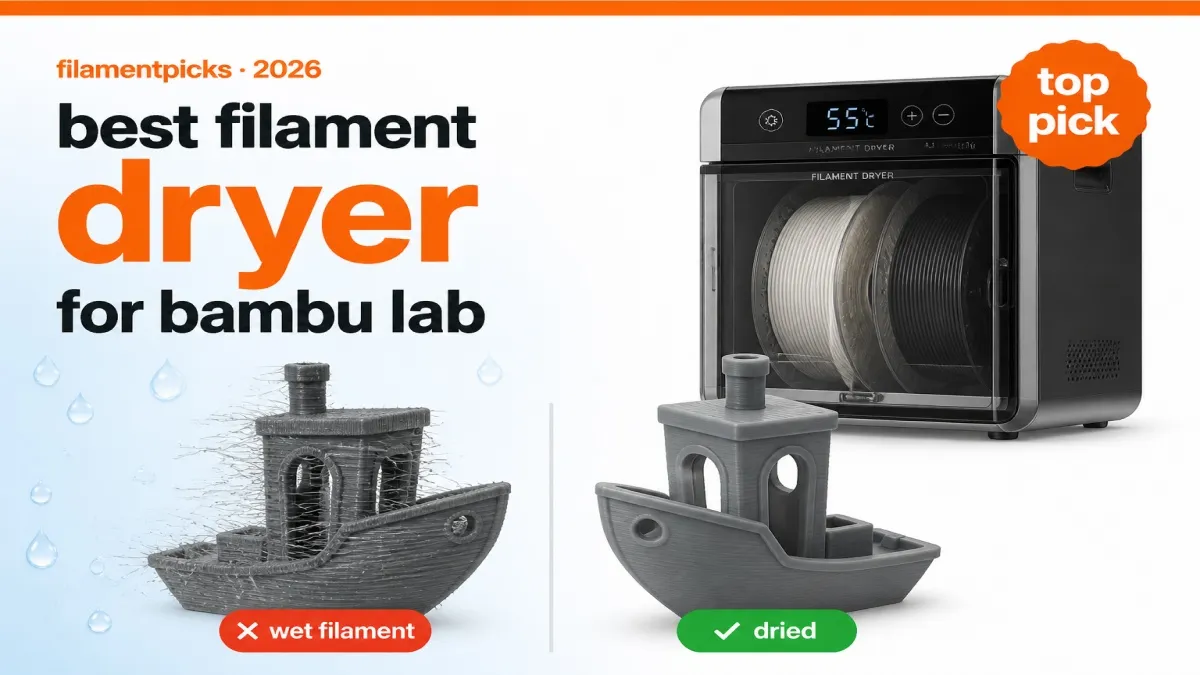
Research-based guide. Recommendations draw on manufacturer specifications, community testing, and widely reported user experience — not a single hands-on lab test.
The best filament dryer for Bambu Lab printing isn’t a luxury — it’s the cheapest fix for the most common print failures. Wet filament causes stringing, weak layers, popping, and rough surfaces, and materials like PETG, TPU, nylon, and carbon-fiber blends soak up moisture from the air within days. A dryer keeps spools printable and rescues ones that have already gone damp. This guide ranks the dryers worth buying in 2026 and explains exactly how to use them.
Note: the AMS is excellent storage with desiccant, but it is not an active dryer — it won’t pull moisture out of an already-wet spool. For that you need heat, which is what these units provide.
IN THIS GUIDE
- Why a filament dryer matters
- Best filament dryer for Bambu Lab
- Dry box vs active dryer
- Drying temperatures by material
- What to look for
- Price guide 2026
- FAQ
Why a Filament Dryer Matters
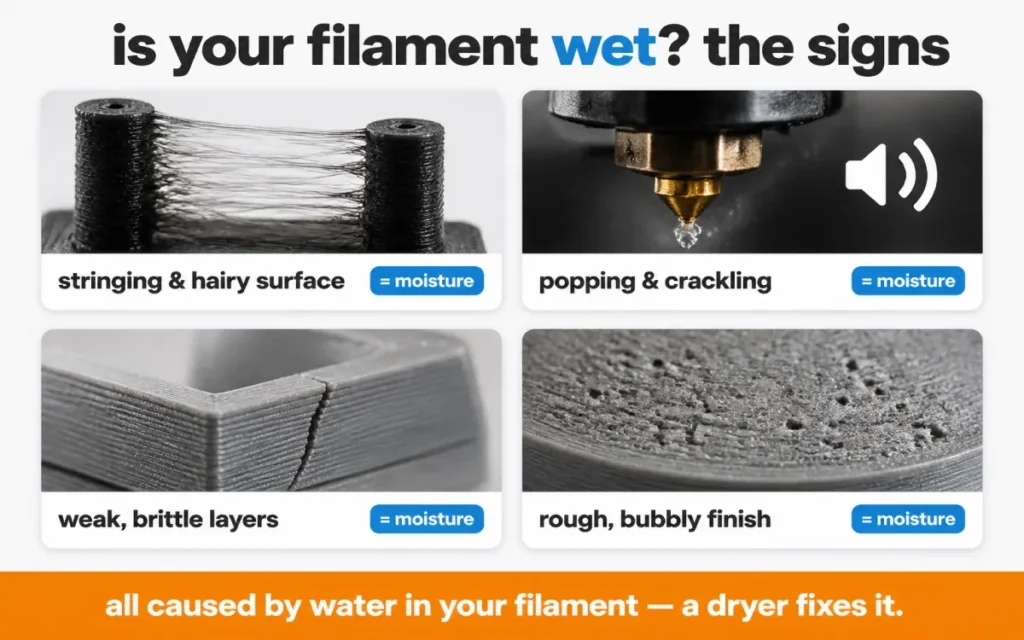
Most filaments are hygroscopic — they absorb water from the air. Wet filament turns to steam at the nozzle, causing stringing, popping/crackling sounds, bubbles, weak layer bonding, and a hairy surface finish. PLA is fairly tolerant, but PETG, TPU, nylon, and carbon-fiber blends can degrade within days of opening. A dryer both maintains dry spools and restores wet ones — cheaper than wasting a single failed engineering print. For the why-and-how of drying specifically, see how to dry PETG.
Best Filament Dryer for Bambu Lab
Sunlu S4 — best overall
The Sunlu S4 is the community default for a reason: it dries up to four spools at once, reaches the temperatures needed for engineering materials, and supports print-while-drying via PTFE feed ports — so you can dry and feed straight into the printer. Great value for the capacity. The two-spool Sunlu S2 is the smaller, cheaper sibling if desk space is tight.
Best for: most users, multi-spool setups, feeding while drying. Check Sunlu S4 on Amazon →
Eibos Cyclops / Polyphemus — best for high-temp engineering filament
When you print nylon, PC, or carbon-fiber blends, you need higher, more stable drying temperatures. Eibos units are built for this — strong sustained heat, even airflow, and reliable print-while-drying. They cost more, but for serious engineering work they keep expensive filament truly dry.
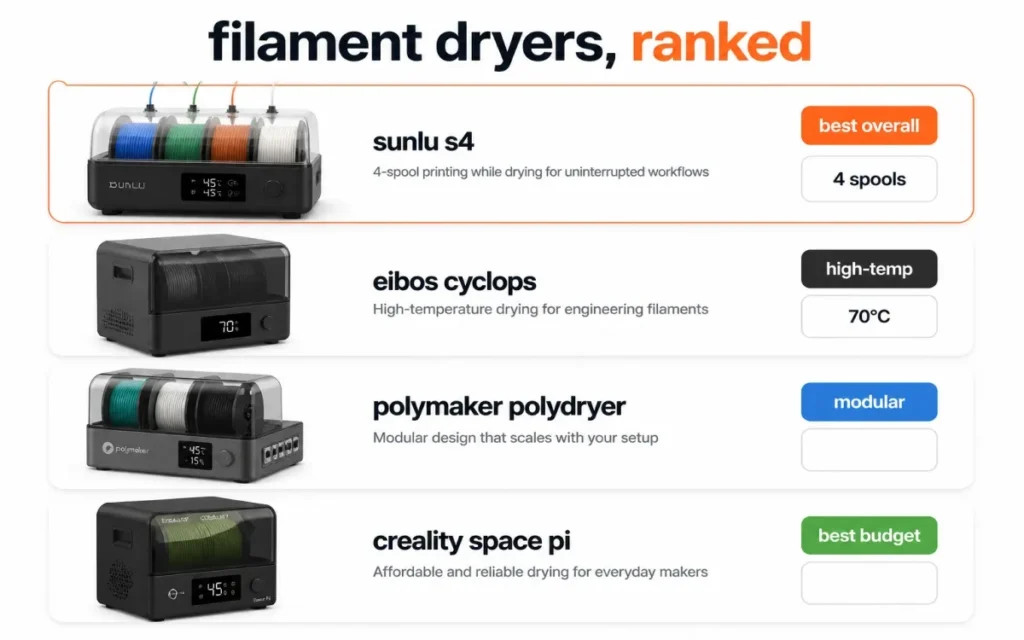
Best for: nylon, PC, CF blends, high-temp drying. Check Eibos filament dryer on Amazon →
Polymaker PolyDryer — best modular pick
The PolyDryer takes a modular approach — a heated base with stackable spool boxes that double as sealed dry storage. Clean design, good temperature control, and it pairs naturally with Polymaker’s own filaments. A tidy choice if you want drying and airtight storage in one system.
Creality Space Pi — best budget active dryer
The Creality Space Pi (and Plus) is an affordable single/dual-spool active dryer that still hits useful temperatures, making it a solid entry point if you mostly print PLA and PETG and want to dabble in tougher materials.
Best for: budget-conscious PLA/PETG printers. Check Creality Space Pi on Amazon →
Dry Box vs Active Dryer
They solve different problems — many people use both.
| Type | What it does |
|---|---|
| Dry box (passive) | A sealed container with desiccant. Maintains dryness and is great for storage and print-feeding, but won’t remove moisture already in the filament. The AMS is essentially a smart dry box. |
| Active dryer (heated) | Uses heat + airflow to pull moisture out of wet filament. The only way to truly restore a soaked spool. Many also feed while drying. |
Workflow that works: dry a fresh spool in an active dryer, then keep it in a dry box or the AMS with desiccant. Our filament storage guide covers the storage side.
Drying Temperatures by Material
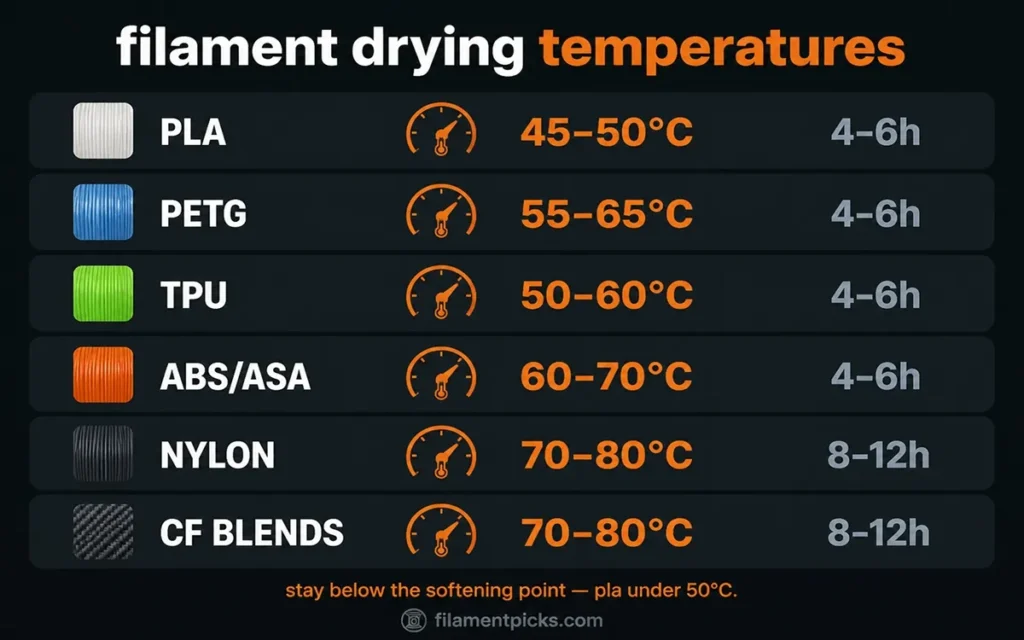
Set the dryer to the material, not a guess. Typical starting points (check the manufacturer’s spec):
| Material | Temp | Time |
|---|---|---|
| PLA | 45–50°C | 4–6 h |
| PETG | 55–65°C | 4–6 h |
| TPU | 50–60°C | 4–6 h |
| ABS / ASA | 60–70°C | 4–6 h |
| Nylon (PA) | 70–80°C | 8–12 h |
| CF blends (PA-CF, PET-CF) | 70–80°C | 8–12 h |
Stay below the material’s softening point — too hot and spools fuse or warp. PLA especially: keep it under ~50°C.
What to Look For
- Max temperature: 70°C+ if you print nylon, PC, or CF; 50–60°C is fine for PLA/PETG/TPU.
- Capacity: 1–2 spools for casual use, 4 if you print a lot or run an AMS.
- Print-while-drying: PTFE feed ports let you print straight from the dryer — hugely convenient for hygroscopic materials.
- Even airflow & fan: circulated heat dries evenly; static-heat boxes can leave the inner windings damp.
- Sealed storage: bonus if the unit doubles as an airtight dry box.
Price Guide 2026
| Dryer | Typical price | Notes |
|---|---|---|
| Creality Space Pi | ~$30–45 | Budget active dryer, 1–2 spools |
| Sunlu S2 | ~$40–50 | 2 spools, great value |
| Sunlu S4 | ~$60–75 | 4 spools, best overall |
| Polymaker PolyDryer | ~$70–90 | Modular drying + storage |
| Eibos Cyclops / Polyphemus | ~$80–120 | High-temp, engineering-grade |
Frequently Asked Questions
Do I need a filament dryer for a Bambu Lab printer?
If you only print PLA in a dry climate, you can often skip it. If you print PETG, TPU, nylon, or carbon-fiber blends — or live somewhere humid — a dryer pays for itself fast by preventing failed prints.
Can I just use the AMS to dry filament?
No. The AMS with desiccant is excellent storage that keeps dry filament dry, but it doesn’t apply heat, so it can’t pull moisture out of an already-wet spool. Use an active dryer for that.
Can I dry filament in my kitchen oven?
It’s risky — most home ovens are inaccurate at low temperatures and can spike hot enough to deform or fuse a spool. A dedicated dryer holds a safe, stable temperature and is the reliable choice.
Affiliate disclosure: FilamentPicks is reader-supported. As an Amazon Associate we earn from qualifying purchases. Product links may be affiliate links at no extra cost to you. Rankings are based on independent research and community data, not paid placement.