

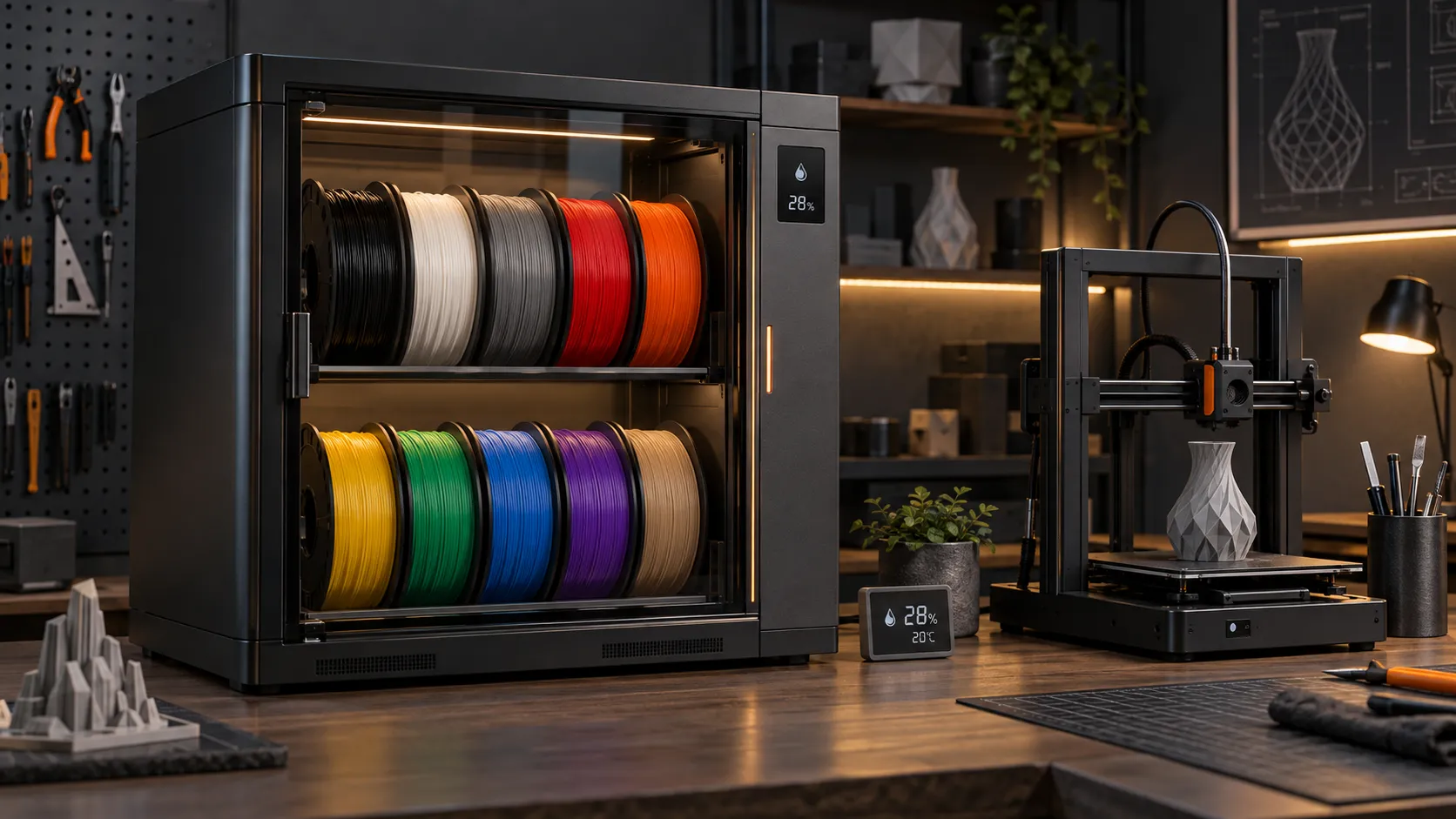
The SUNLU FilaDC i10 is a new 10-spool dehumidifying cabinet designed to keep dry filament dry at room temperature. It is not a conventional heated dryer—and that distinction determines whether the $179.99 pre-order makes sense for your setup.
Research-based guide, updated September 2026. FilamentPicks reviewed SUNLU’s current product specifications, published manual details and launch reporting. We have not physically tested the cabinet, so power, noise and performance figures below are manufacturer claims unless stated otherwise. Some links on this page are affiliate links: if you buy through them, FilamentPicks may earn a commission at no extra cost to you. See the Affiliate Disclosure.
What Is the SUNLU FilaDC i10?
SUNLU and INSLOGIC announced the FilaDC i10 as a sealed storage cabinet for up to ten standard 1 kg spools. Instead of constantly heating the spools, the cabinet circulates air through a molecular sieve that captures moisture. When that material approaches saturation, an internal regeneration cycle releases the collected water outside the cabinet.
The practical goal is simple: dry a moisture-sensitive spool once, then store it in a controlled environment so it does not immediately begin absorbing water again. This matters most for nylon, TPU, PETG and other materials that can develop stringing, popping, rough surfaces or inconsistent extrusion after exposure to humid air.
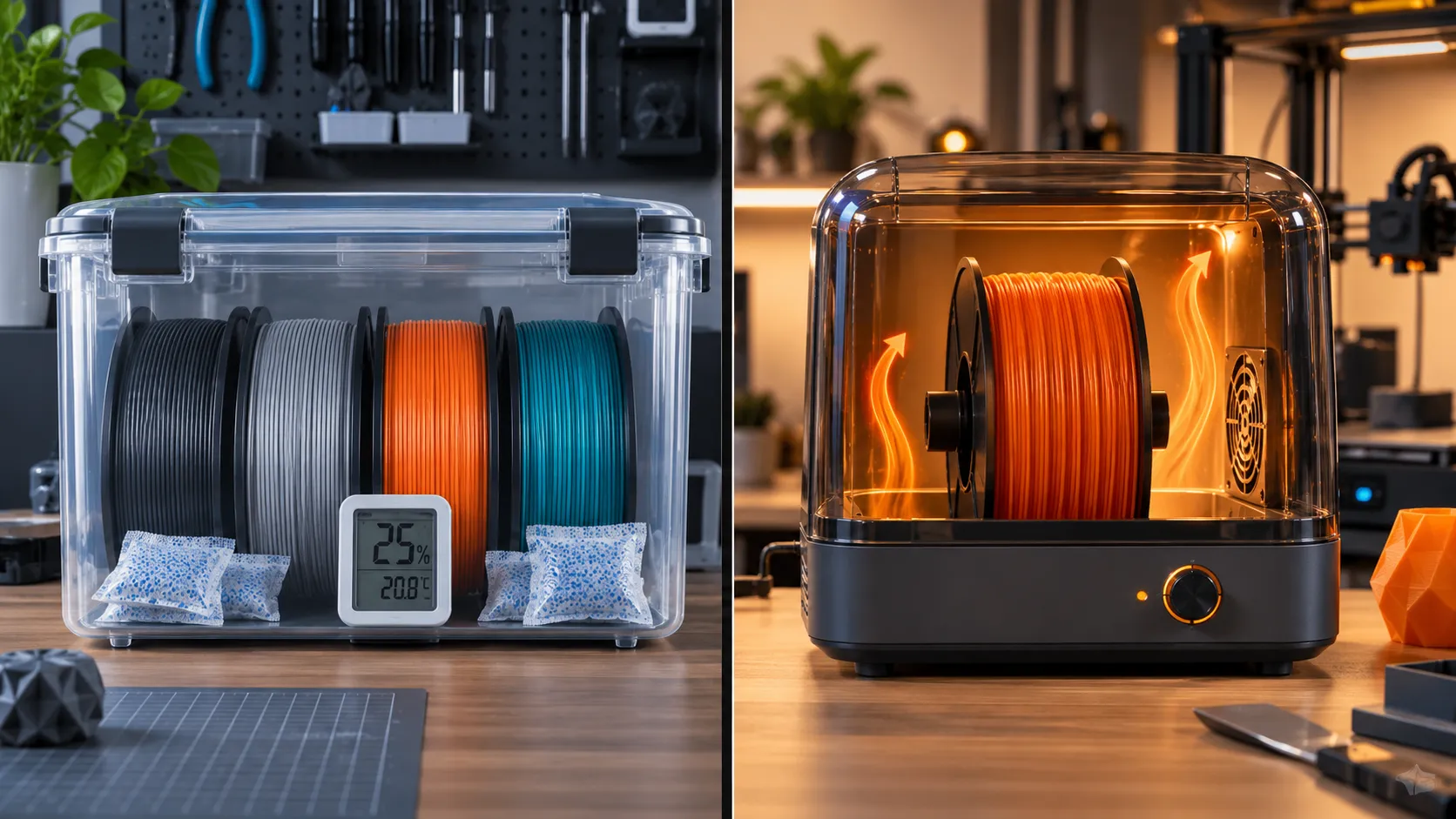
SUNLU FilaDC i10 vs a Heated Filament Dryer
| Feature | FilaDC i10 cabinet | Heated filament dryer |
|---|---|---|
| Main job | Long-term dry storage | Remove moisture already inside filament |
| Method | Dehumidifies surrounding air | Warms filament to drive moisture out |
| Capacity | Up to ten 1 kg spools | Usually one or two spools |
| Best timing | Between print jobs | Before printing or while feeding |
| Risk to low-temp spools | Minimal during normal room-temperature storage | Wrong temperature can soften a spool or material |
If your PETG is already brittle, popping or producing persistent stringing, start with our PETG drying temperature and time guide. Once the spool is conditioned, the cabinet can help preserve that result.
SUNLU FilaDC i10 Specifications That Matter
| Specification | Published value | Why it matters |
|---|---|---|
| Spool capacity | Up to 10 × 1 kg spools | One cabinet can cover an active material library |
| Humidity setting | 10–55% RH, ±5% accuracy | Lets users choose a realistic storage target |
| External size | 395 × 300 × 508 mm | Taller than a dry box; measure shelf clearance |
| Operating environment | 10–35°C, ambient RH up to 95% | Designed for ordinary indoor workshops |
| Dehumidification power | 1.5 W listed; 100 W during sieve regeneration | Average consumption depends on cycling frequency |
| Shipping | Expected from December 2026 | This is currently a pre-order, not immediate delivery |
The whole chamber uses one humidity target. That is straightforward, but it also means you cannot maintain separate zones for PLA and extremely hygroscopic nylon. Choose the target for the most sensitive material present, while staying inside the cabinet’s documented operating range.
Which Filaments Benefit Most?
Nylon and nylon composites
Strong candidates for controlled storage because they can absorb moisture rapidly after drying.
TPU
Long-term low humidity can reduce the need to re-dry flexible filament before every occasional job.
PETG
Useful when several open colors rotate through a Bambu AMS or multi-printer workflow.
PLA
Benefits in humid rooms, although casual users with one or two spools may be well served by sealed boxes.
For materials that live inside an AMS, compare the cabinet with our AMS 2 Pro drying guide. The right solution depends on whether you need active heat, print-from-storage convenience or high-capacity preservation.
Is the SUNLU FilaDC i10 Worth $179.99?
The current official listing shows a $179.99 pre-order price and shipping expected from December 2026. At that price, the cabinet is easier to justify for a print farm, engineering-material user or enthusiast with many open spools than for a beginner who keeps two PLA colors on a shelf.
A lower-cost workflow can still work: dry only when symptoms or exposure justify it, then use gasketed boxes, reusable desiccant and inexpensive hygrometers. The FilaDC i10 trades that manual routine for one larger actively controlled space.
| User | Likely fit | Reason |
|---|---|---|
| Print farm | Strong | Ten-spool capacity and less box-by-box maintenance |
| Nylon / TPU maker | Strong | Preserves expensive moisture-sensitive materials |
| Active hobbyist | Conditional | Convenient if many spools stay open |
| PLA beginner | Weak | Sealed bins may solve the same immediate problem for less |
Build a complete filament workflow
Use the right tool for each job: compare current dryers and storage supplies, choose a known filament profile, then track drying cycles, spool weight and print risk inside Print Radar.
Amazon links use our Associates tag filamentpicks-20. Use Polymaker code BALUTAVLAD for 15% off your first order. Eligible purchases may support FilamentPicks at no extra cost to you.
FilamentPicks Verdict
The SUNLU FilaDC i10 solves a real but specific problem: keeping a large group of already-dried spools in one stable low-humidity environment. It is not the answer to wet filament, and casual PLA users can spend less. For makers rotating nylon, TPU, PETG and composite spools, however, active 10-spool storage could remove a repetitive part of filament management.
Frequently Asked Questions
Does the SUNLU FilaDC i10 dry wet filament?
No. It dehumidifies the cabinet air at room temperature. Filament that has already absorbed significant moisture still needs an appropriate heated drying cycle.
Can you print directly from the cabinet?
The current product description focuses on storage rather than a multi-spool feed-through system. Confirm the final shipping configuration and manual before planning direct printer feeds.
How many spools fit inside?
SUNLU lists capacity for up to ten spools, each up to approximately 200 mm in diameter and 67 mm wide.
When will the FilaDC i10 ship?
The official store currently says dispatch is expected to begin in December 2026, gradually according to order sequence.