

👉 If you’re choosing filament: Best PETG Filament for Bambu Lab in 2026: Top 5 Picks — the complete comparison.
An Italian Workshop That Builds Machines Meant to Last
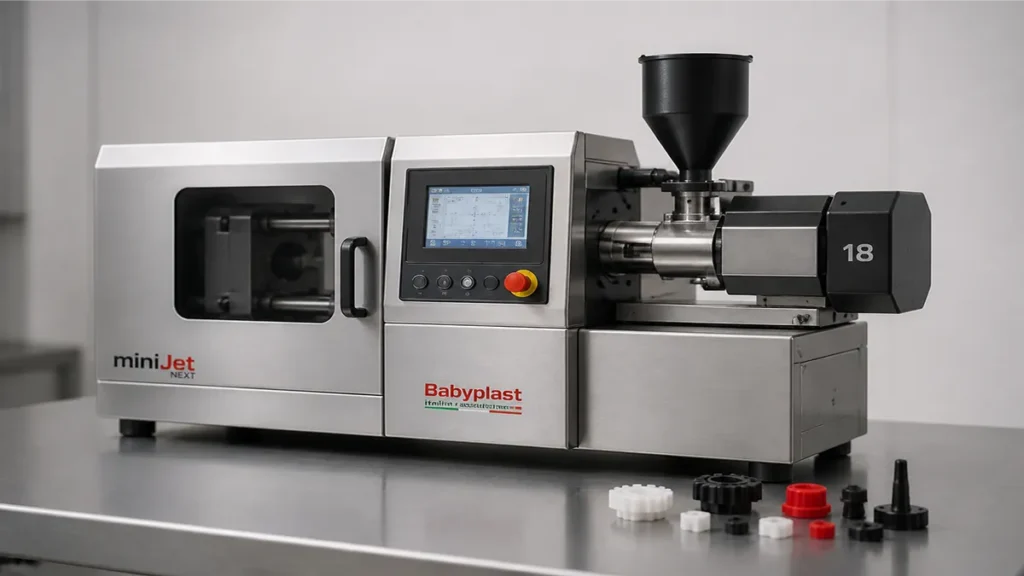 Robot Factory has never quite fit the disposable, plastic-bodied mold that so much of the desktop 3D printing industry settled into. Founded in 2006 by Andrea Martini in Mirano, near Venice, the company built its early reputation on robotics kits for education before expanding into CNC machines, then into stereolithography and material extrusion 3D printers built with the kind of metal-frame, machine-tool solidity rarely seen at desktop price points. Its latest move continues that pattern: rather than chasing faster prints or flashier multi-material systems, Robot Factory has doubled down on bench-top injection molding, a technology that sits right at the boundary between prototyping and real production.
From Pneumatic Beginnings to a Four-Ton Hydraulic System
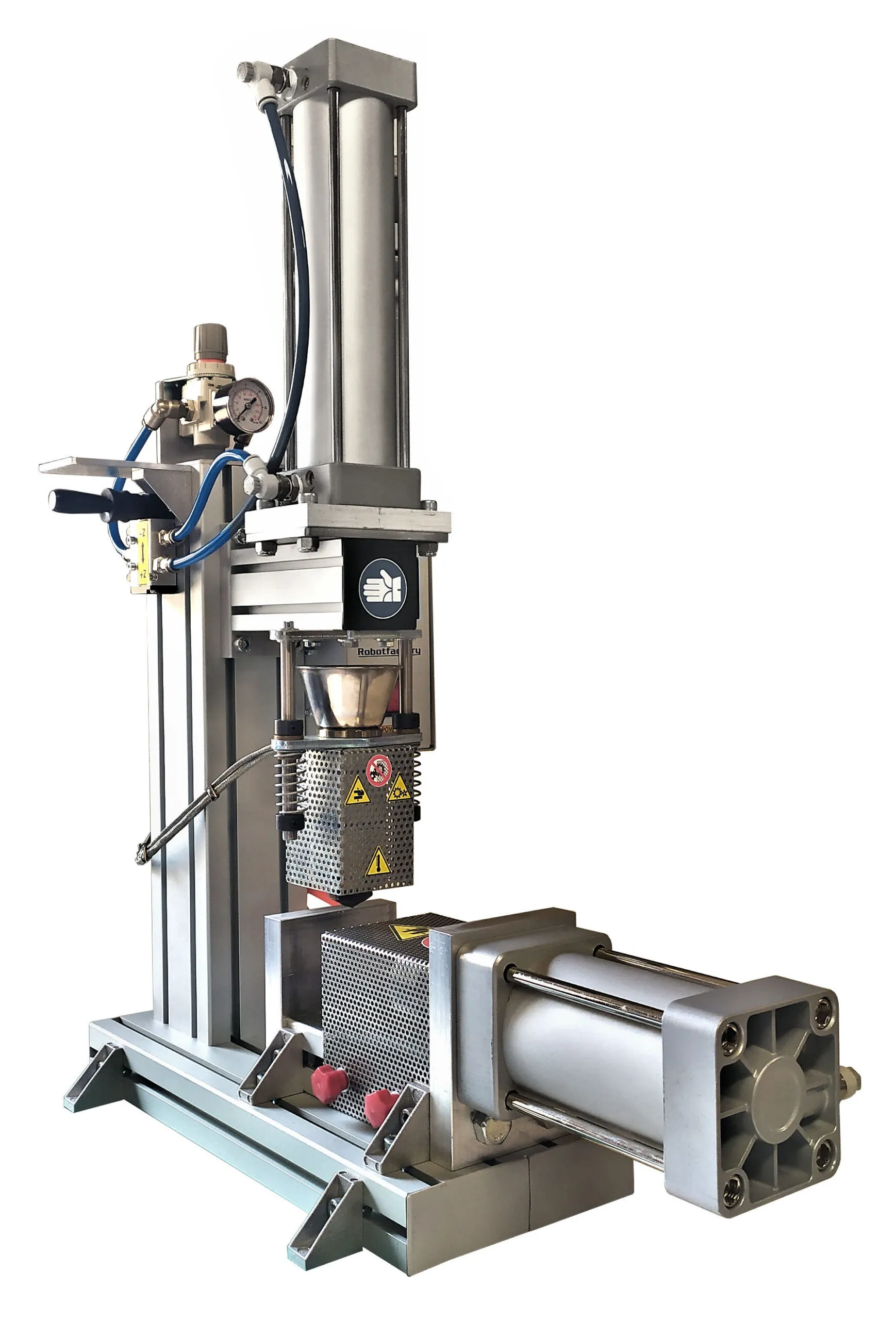
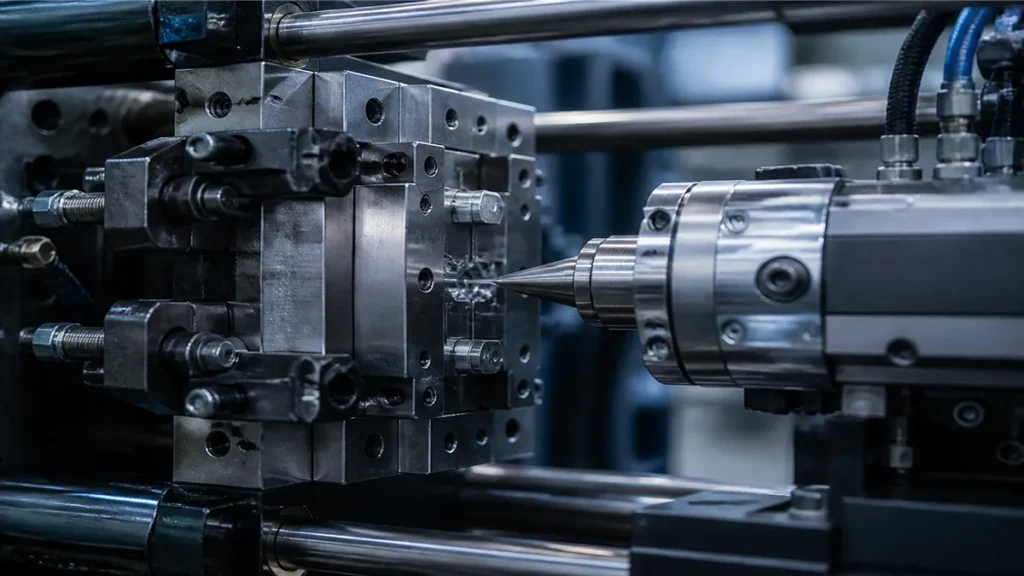 According to founder Andrea Martini, the push into injection molding came directly from customer frustration with a specific limitation of 3D printing: producing large quantities of small, high-resolution parts quickly. Printing each one individually does not scale, and beyond a certain volume, additive manufacturing simply loses to a process that, once tooled, can stamp out thousands of identical pieces with consistent surface quality. Robot Factory’s answer started small and pneumatic: a desk-friendly system powered by a simple air compressor, capable of handling shot volumes up to 32 cm³ using a 63 mm diameter injection cylinder.
As demand grew for larger parts and finer process control, the company developed an Oleodynamic, or hydraulic, version of the system, now available in both manual and automated configurations. The hydraulic pump delivers up to 1,900 kilograms of extrusion force and a clamping force of up to 4 tons, with a 100 cm³ injection chamber, a substantial jump in capability while keeping the equipment compact enough for a lab bench or small production cell. Customers run the systems at temperatures up to 350°C with materials including PP, PE, PC, PA, PET, engineering-grade plastics, GF-reinforced compounds, and regrind, the latter supported by an in-house shredder that lets users recycle scrap material rather than discard it.
According to founder Andrea Martini, the push into injection molding came directly from customer frustration with a specific limitation of 3D printing: producing large quantities of small, high-resolution parts quickly. Printing each one individually does not scale, and beyond a certain volume, additive manufacturing simply loses to a process that, once tooled, can stamp out thousands of identical pieces with consistent surface quality. Robot Factory’s answer started small and pneumatic: a desk-friendly system powered by a simple air compressor, capable of handling shot volumes up to 32 cm³ using a 63 mm diameter injection cylinder.
As demand grew for larger parts and finer process control, the company developed an Oleodynamic, or hydraulic, version of the system, now available in both manual and automated configurations. The hydraulic pump delivers up to 1,900 kilograms of extrusion force and a clamping force of up to 4 tons, with a 100 cm³ injection chamber, a substantial jump in capability while keeping the equipment compact enough for a lab bench or small production cell. Customers run the systems at temperatures up to 350°C with materials including PP, PE, PC, PA, PET, engineering-grade plastics, GF-reinforced compounds, and regrind, the latter supported by an in-house shredder that lets users recycle scrap material rather than discard it.
- Pneumatic system: up to 32 cm³ shot volume via a 63 mm diameter cylinder
- Oleodynamic (hydraulic) system: up to 1,900 kg extrusion force, 4 tons clamping force, 100 cm³ chamber
- Operating temperatures up to 350°C across PP, PE, PC, PA, PET, and reinforced compounds
- In-house shredder enables regrind recycling directly at the bench
Why This Matters to the Community
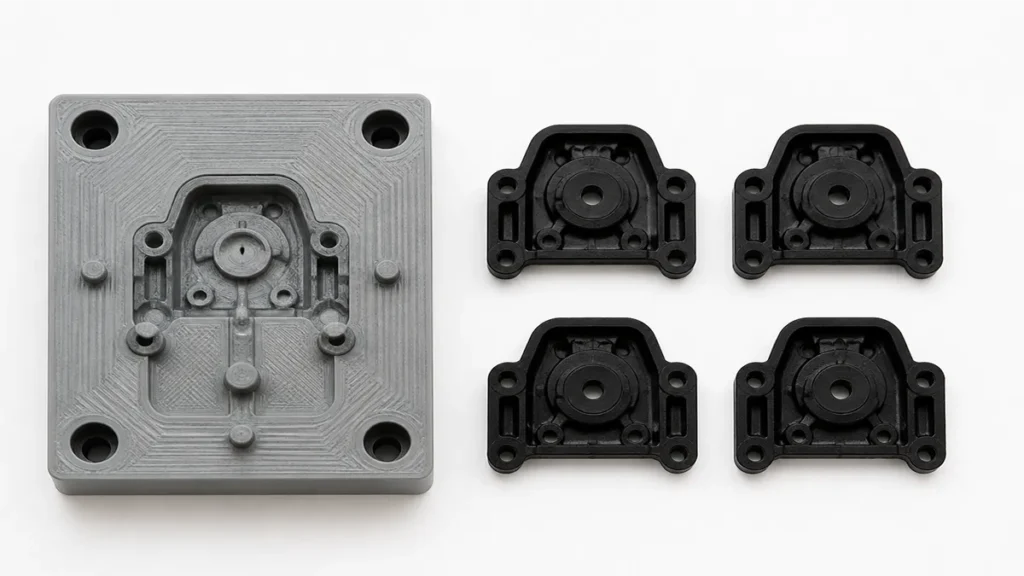
For most owners of Bambu Lab, Prusa, Creality, or Voron machines, FDM and resin printing already cover prototyping and one-off parts extremely well. The gap shows up the moment a maker tries to turn a successful design into a small business: printing five hundred identical brackets, knobs, or enclosure clips on a single printer, or even a small farm of them, eats hours and introduces part-to-part variation that injection molding simply does not have. A bench-top system like Robot Factory’s offers a realistic middle step between “I printed one good part” and “I need a full industrial mold shop,” letting a Voron builder or Bambu Lab P1S owner 3D print a mold insert, then injection-mold a production run of that same part in materials and finishes FDM cannot easily replicate. That matters most for the segment of the community already selling parts, kits, or accessories printed on their own machines. A maker running a Prusa farm or a cluster of Creality printers for a side business currently has no good option between “print everything” and “outsource everything overseas.” A compact pneumatic or hydraulic injection unit changes that calculus, letting small shops keep both prototyping and production in-house, using the same 3D printers they already own to generate the mold inserts. It also reframes how makerspaces and small workshops think about scaling past the printer farm model: instead of buying ten more machines to keep up with demand, a single bench-top injection system, paired with the 3D printers already on hand, can absorb the volume that FDM was never efficient at handling in the first place.Image credit: 3DPrint.com / Brand Official
Source: 3DPrint.com / Via FilamentPicks