

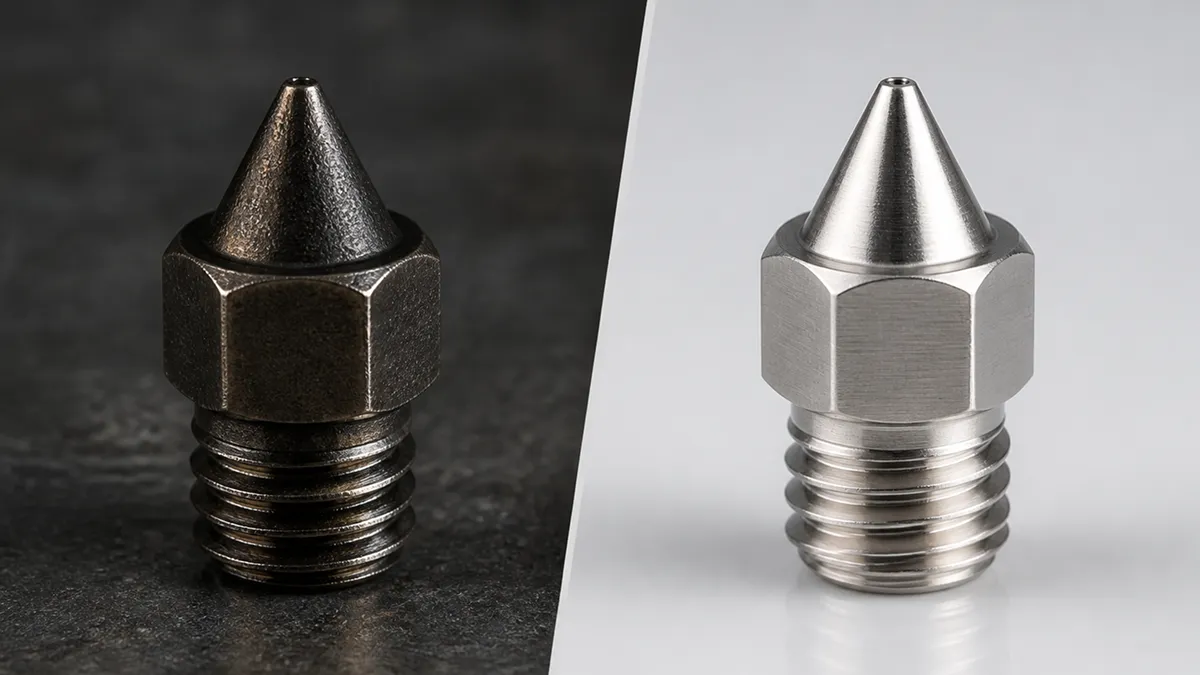
Your Bambu Lab printer shipped with one nozzle, and the wrong one can wear out inside a single spool. The hardened vs stainless nozzle choice on Bambu Lab is mostly about one thing: are you printing abrasive filament? This research-based guide explains the difference between stainless and hardened steel (plus tungsten carbide), which filaments demand which, how fast each wears, and when an upgrade is genuinely worth it — based on Bambu’s official documentation and widely reported community wear data.
The 10-second answer
Only printing PLA, PETG, ABS, TPU? → the stock stainless steel nozzle is fine
Printing any carbon fiber, glass fiber, wood, glow-in-the-dark or metal-fill? → hardened steel (or tungsten carbide on H2/P2S)
Print a mix? → most owners just run hardened steel for everything
In this guide
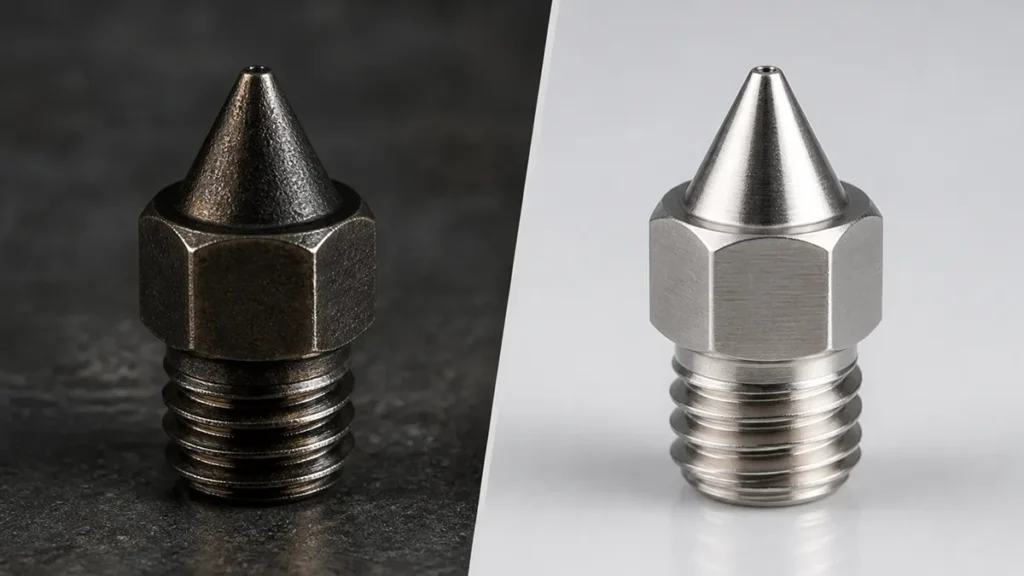
Hardened vs Stainless Nozzle: How Bambu Nozzles Work
Two things to know up front. First, Bambu uses an integrated hotend-and-nozzle assembly — you don’t unscrew a bare nozzle like on a Creality or Voron; you swap the whole hotend unit (a quick, plug-and-play job). Second, Bambu does not sell brass nozzles at all. The real choice is between stainless steel, hardened steel and — on the newest machines — tungsten carbide.
The three nozzle materials
|
Material |
Best for |
Abrasive filament? |
|---|---|---|
|
Stainless steel |
PLA, PETG, ABS, ASA, TPU, PVA |
No — wears out fast |
|
Hardened steel |
Everything, incl. CF, GF, wood, glow |
Yes — the practical default |
|
Tungsten carbide |
Heavy fiber-reinforced printing (H2/P2S) |
Yes — best wear resistance |
Tungsten carbide rates HRA 90 versus hardened steel’s 74, giving roughly 50% more lifespan on abrasive fiber-reinforced filament. It’s currently offered for the H2/P2S hotend system.
Why abrasive filament is the deciding factor
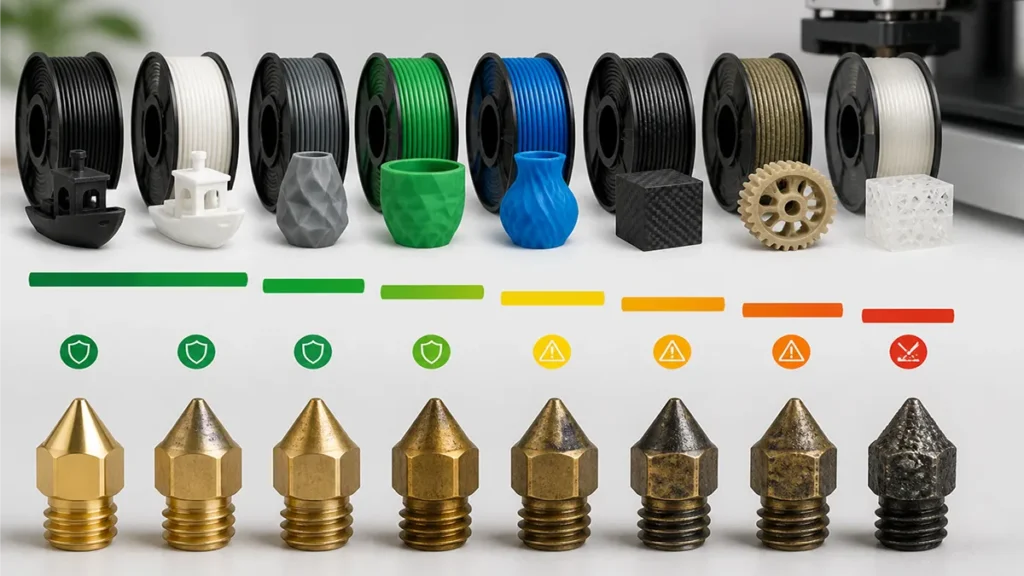
Carbon fiber, glass fiber, wood-fill, glow-in-the-dark and metal-fill filaments carry hard particles that act like sandpaper inside the nozzle. On a softer stainless nozzle, those particles erode the orifice — it grows larger and rounder, wrecking dimensional accuracy and surface quality. Bambu’s own documentation shows a stainless nozzle visibly enlarged after just 10 hours of PETG-CF, and for the most abrasive materials a single print can do damage. Bambu’s wiki is blunt about it: for carbon/glass-fiber filament, do not use stainless or brass — use hardened steel.
How long each nozzle lasts
|
Use case |
Nozzle |
Typical lifespan |
|---|---|---|
|
PLA / PETG (non-abrasive) |
Stainless or hardened |
500–1,000+ hours |
|
Carbon / glass fiber |
Hardened steel |
200–500 hours |
|
Wood, metal-fill, glow-in-dark |
Hardened steel |
50–200 hours (very abrasive) |
|
Abrasive, high volume |
Tungsten carbide |
~50% longer than hardened |
Wood and metal-fill are deceptively harsh — some users report visible orifice deformation after under 1 kg even through a hardened nozzle. If you print a lot of wood filament, treat the nozzle as a consumable.
What size should you get?
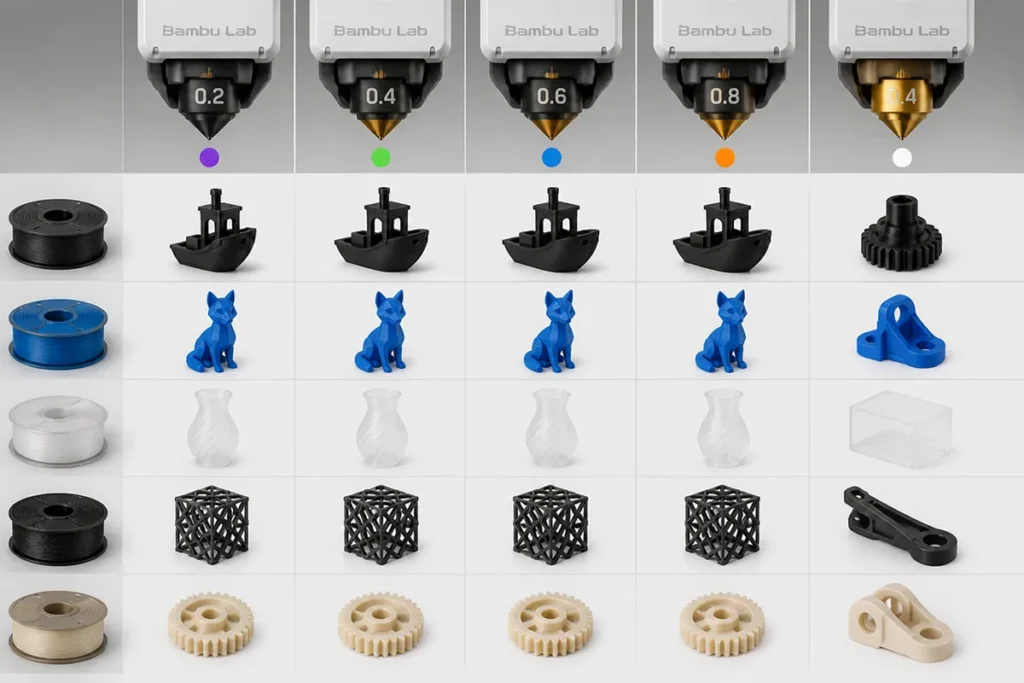
Bambu’s lineup covers 0.2, 0.4, 0.6 and 0.8 mm. The 0.2 mm ships in stainless steel only; the others are available in hardened steel. Guidance:
- 0.4 mm — the all-rounder; best balance of detail, strength and speed for almost everyone.
- 0.6 mm — Bambu’s first choice for carbon/glass-fiber filament: lower clogging risk and faster, while still detailed enough for most parts.
- 0.8 mm — fast, strong, large-format prints; less fine detail.
- 0.2 mm — miniatures and fine detail; stainless only, so keep abrasive filament away from it.
One thing to tune after you swap
Hardened steel has slightly lower thermal conductivity than stainless. If you notice under-extrusion or poor surface quality after switching, raise the nozzle temperature about 5–10°C to compensate. Otherwise the swap is genuinely plug-and-play.
Should you upgrade?
If you print only PLA, PETG and ABS, the factory stainless nozzle is the correct choice — no upgrade needed. The moment a carbon-fiber, glass-fiber, wood, glow or metal-fill spool enters your queue, fit a hardened steel hotend before that print, not after. Hotend assemblies are cheap (roughly $11 for A1-series, $16 for X1C/P1), so many owners just standardize on hardened steel and keep a spare for material swaps.
Where to buy
As an Amazon Associate we earn from qualifying purchases. Match the part to your printer series (A1, P1, X1, H2/P2S use different hotends).
- Bambu hardened steel hotend on Amazon — the abrasive-ready default
- Bambu stainless steel hotend on Amazon — replacement for PLA/PETG
- Bambu high flow nozzle on Amazon — for faster, high-volume printing
Frequently asked questions
Does a hardened nozzle hurt PLA or PETG quality?
No — hardened steel prints standard filaments perfectly. The only quirk is slightly lower heat conductivity, fixed by a 5–10°C temperature bump. This is why most owners just run hardened for everything.
Can I print carbon fiber with the stock nozzle?
Only if it’s already hardened steel. A stainless or brass nozzle will be eroded quickly — sometimes within one print — by CF or GF particles. Check our best carbon fiber filament guide for material picks.
Is wood filament really abrasive?
Yes, surprisingly so. Wood, metal-fill and glow-in-the-dark are among the harshest on nozzles — plan to replace nozzles more often, and never run them through a 0.2 mm stainless nozzle.
What about tungsten carbide?
It’s the most wear-resistant option (HRA 90) and lasts roughly 50% longer than hardened steel on abrasive filament. Currently aimed at the H2/P2S hotend system and worth it only if you print fiber-reinforced material heavily.
The bottom line
On the hardened vs stainless nozzle question for Bambu Lab, stainless steel handles PLA, PETG, ABS and TPU and ships on most Bambu machines. The instant you add an abrasive filament — carbon fiber, glass fiber, wood, glow-in-the-dark or metal-fill — move to hardened steel, and to tungsten carbide if you print fiber-reinforced material in volume. Given how cheap the hotends are, standardizing on hardened steel is the no-regrets move for most owners.
Related reading: Best carbon fiber filament for Bambu • Best wood filament for Bambu • Bambu filament tier list
Affiliate disclosure: FilamentPicks is reader-supported. When you buy through links on this page we may earn a small commission at no extra cost to you. We only recommend filaments based on manufacturer specifications, published technical data sheets and community reports — this is a research-based guide, not a hands-on lab test.