

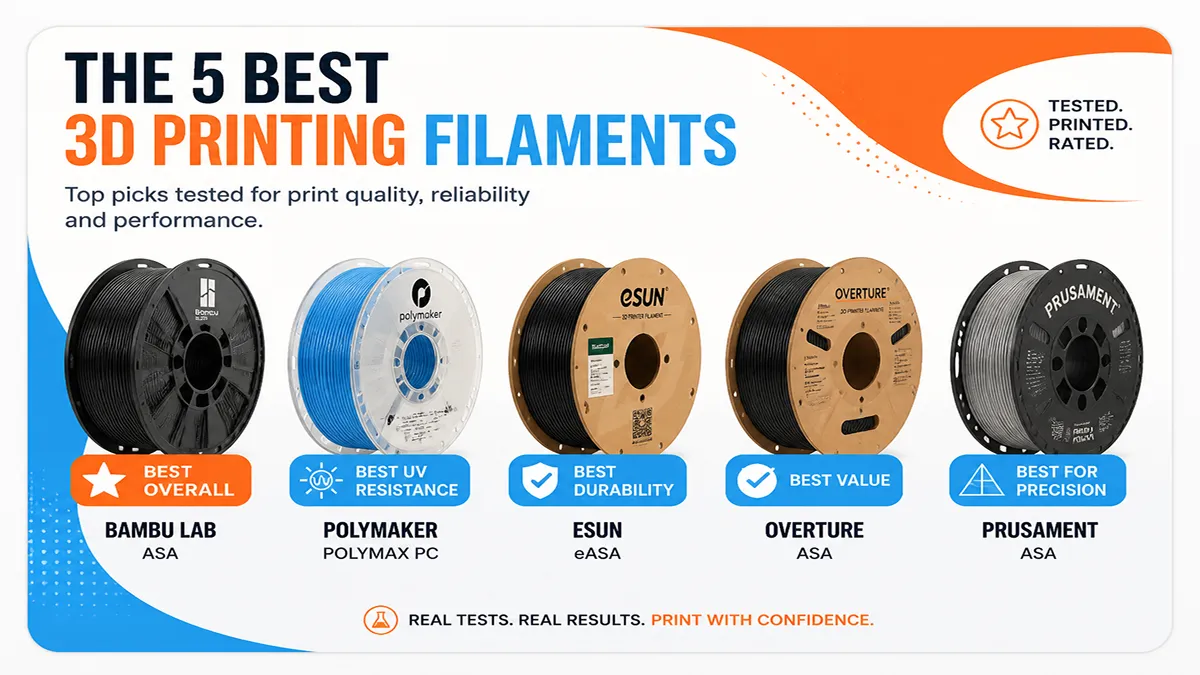
The best ASA filament for Bambu Lab is Bambu Lab ASA if you want plug-and-play AMS reliability with a factory-tuned profile, and Polymaker PolyLite ASA if you want the strongest UV and weather resistance from a third-party spool. Both print cleanly inside an enclosed Bambu machine (X1C, P1S, P2S, H2D) and hold up far better outdoors than ABS or PLA.
ASA is essentially “UV-resistant ABS”: a styrene copolymer with the same toughness and heat resistance as ABS, but engineered to resist yellowing, cracking, and color fade in sunlight. That makes it the right pick for outdoor brackets, automotive trim, RC and drone bodies, garden hardware, and anything that lives in the sun. Below is our research-based ranking, the print settings that actually work on Bambu hardware, and how to keep large parts from warping.
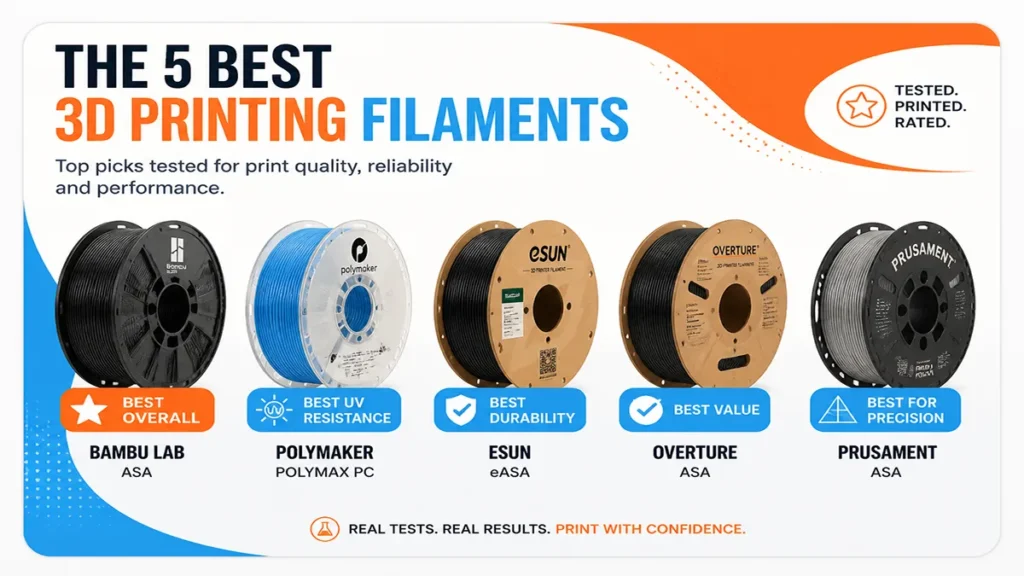
Quick picks at a glance
| Use case | Our pick | Why |
|---|---|---|
| Best overall (AMS plug-and-play) | Bambu Lab ASA | RFID auto-detect, factory profile, premium pigments |
| Best UV / weather resistance | Polymaker PolyLite ASA | Excellent UV stability, wider color range, cardboard spool |
| Best budget | eSUN eASA | Widely available, prints ~250°C, great value |
| Best for large flat parts | Fillamentum Extrafill ASA | Glass-filled, minimal warping, superb color stability |
| Best high-impact / functional | 3DXTech ASA+ | High-impact formula, moisture indicator |
What makes the best ASA filament for Bambu Lab
ASA is a demanding material, but Bambu’s enclosed printers handle it well when you match the spool to your hardware. Four things separate a good ASA experience from a frustrating one:
UV and weather resistance. This is the entire reason to choose ASA over ABS. Quality ASA keeps its color and impact strength after months in direct sun, where ABS turns brittle and yellow. Polymaker, Fillamentum, and 3DXTech are widely reported to hold color best.
Warping control. ASA warps less than ABS, but large, flat parts (over roughly 100 × 100 mm) still lift on the corners without an enclosure. Glass-filled formulas like Fillamentum Extrafill resist warping best; for everything else, an enclosure and a clean plate do most of the work.
Moisture sensitivity. ASA absorbs water from the air, which causes popping, stringing, and a rough surface. Drying before printing is not optional — see our guide on how to store filament and grab a filament dryer if you print ASA regularly.
Hotend temperature headroom. Premium ASA (Polymaker, Fillamentum) prints best at 250–260°C. Bambu’s stock hotend handles this fine, but if you run a lower-temp setup, Bambu Lab ASA and eSUN eASA print comfortably around 250°C.
The 5 best ASA filaments for Bambu Lab
1. Bambu Lab ASA — best overall for AMS
If you value out-of-the-box reliability, Bambu Lab ASA is the safest pick. The RFID tag means the AMS auto-detects it, the Bambu Studio profile is tuned for it, and the pigments are dense and consistent. It prints around 250°C and feeds reliably through the AMS in an enclosed X1C, P1S, P2S, or H2D. You pay a few dollars more per kilogram than third-party options, but you remove almost all of the guesswork.
✔ Recommended
Bambu Lab ASA — best plug-and-play pick
Factory-tuned profile, RFID AMS auto-detect, premium pigments. The least fussy ASA for Bambu owners.
2. Polymaker PolyLite ASA — best UV resistance & color range
Polymaker PolyLite ASA is the strongest third-party choice and arguably the best for outdoor parts. UV resistance is excellent, warping is minimal inside an X1C or P1S enclosure, and the color range beats Bambu’s own ASA lineup. It withstands temperatures up to about 100°C, ships on a recycled cardboard spool, and prints at 250°C nozzle / 90°C bed at around 50 mm/s. If you need outdoor-rated parts in a specific color, this is the pick.
✔ Recommended
Polymaker PolyLite ASA — best for outdoor & weather resistance
Excellent UV stability, wide color range, ~100°C heat resistance, cardboard spool. The third-party ASA to beat.
3. eSUN eASA — best budget
eSUN eASA is the value play: widely available, easy to source, and consistent enough for everyday functional parts. It prints around 250°C and behaves much like Polymaker on small-to-medium prints. The trade-off is that large flat parts need extra care — a brim, a clean plate, and careful drying — to avoid lifting. For brackets, clips, and jigs, it’s hard to beat the price.
✔ Recommended
eSUN eASA — best value
Budget-friendly, easy to find, prints ~250°C. Great for small functional parts; add a brim for big ones.
4. Fillamentum Extrafill ASA — best for large flat parts
Fillamentum Extrafill ASA is glass-reinforced for minimal warping and superb color stability, which makes it the standout for large outdoor panels and flat parts that would normally curl. Color consistency is excellent batch to batch. It costs more than budget spools and benefits from a hardened nozzle, but for big weather-exposed prints it earns its place.
✔ Recommended
Fillamentum Extrafill ASA — best for big, flat outdoor parts
Glass-filled, low-warp formula with outstanding color stability. Pair with a hardened nozzle.
5. 3DXTech ASA+ — best high-impact / functional
3DXTech ASA+ is a high-impact formulation aimed at demanding functional parts, and it includes a moisture indicator on the spool — a genuinely useful touch for a hygroscopic material. It runs at a premium price and is best suited to users who already print engineering materials and want maximum toughness with full UV resistance.
✔ Recommended
3DXTech ASA+ — best high-impact
High-impact formula with a built-in moisture indicator. For functional parts that take abuse outdoors.
ASA print settings for Bambu Lab
These are safe starting points for Bambu printers. ASA needs an enclosure, a hot bed, and very little part cooling — too much fan causes layer splitting. Always dry the spool first.
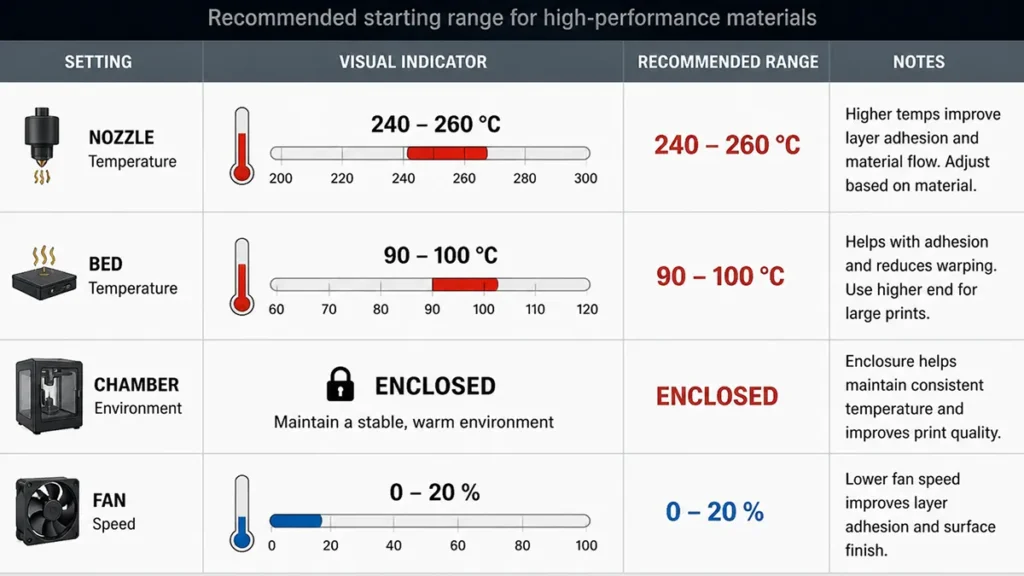
| Setting | Recommended | Notes |
|---|---|---|
| Nozzle temp | 240–260°C | 250°C is a safe midpoint; premium ASA likes the high end |
| Bed temp | 90–100°C | Clean with IPA; textured PEI grips well |
| Chamber | Enclosed | X1C / P1S / P2S / H2D ideal; keep the door closed |
| Part cooling fan | 0–20% | 0% for solid parts; up to 20% only for steep overhangs |
| First layer speed | 15–25 mm/s | Slow and steady prevents corner lift |
| Drying | 65°C for 4–6 h | Mandatory after storage; ASA is hygroscopic |
| Nozzle | Brass OK (steel for CF/GF) | Glass- or carbon-filled ASA needs a hardened nozzle |
How to stop ASA warping
Warping is the number-one ASA complaint, and it comes down to thermal stress. Keep these five habits and most prints come out flat:
1. Keep the enclosure closed. Opening the door mid-print drops the ambient temperature and can delaminate layers instantly. 2. Kill the part cooling fan on solid parts — 0–20% maximum. 3. Use a brim (5–8 mm) on anything large or tall. 4. Start with a clean plate wiped with IPA; finger oils ruin first-layer adhesion. 5. Dry the filament — wet ASA prints rough and adheres poorly. For large flat parts, a glass-filled ASA like Fillamentum Extrafill is the most reliable fix.
ASA vs ABS — which should you pick?
Short version: choose ASA for anything outdoors and ABS for indoor parts on a budget. Mechanically they are very close — comparable tensile strength and heat deflection (ASA’s HDT is marginally higher at ~86°C vs ~81°C). The meaningful differences are UV stability (ASA wins decisively), warping (ASA is slightly easier), and post-processing (ABS can be acetone-smoothed; ASA cannot). We break the full comparison down in ABS vs ASA on Bambu Lab.
Frequently asked questions
Can you print ASA on a Bambu A1 or A1 Mini?
It’s possible but not ideal. The A1 and A1 Mini are open-frame, so ASA warps easily and benefits from a DIY enclosure to hold ambient heat above 40°C. For reliable ASA, an enclosed P1S, X1C, P2S, or H2D is strongly preferred. See our best filament for the A1 Mini guide for open-frame-friendly alternatives.
Does ASA need to be dried?
Yes. ASA is hygroscopic and absorbs moisture from the air, causing popping, stringing, and a rough surface. Dry at 65°C for 4–6 hours before printing, especially after the spool has been open for a while.
Is ASA stronger than ABS?
Only marginally. Their tensile strength and heat resistance are comparable; ASA’s real advantage is UV and weather resistance, not raw strength. For indoor structural parts, either performs similarly.
Do I need a hardened nozzle for ASA?
Not for standard ASA — brass is fine. You only need a hardened steel nozzle for glass-filled or carbon-filled ASA variants, which are abrasive.
The bottom line
ASA is the material to reach for when a part has to survive the sun. For the smoothest experience on a Bambu printer, run Bambu Lab ASA and let the AMS handle it; for the best outdoor durability and color selection, Polymaker PolyLite ASA is the third-party pick; and for big flat parts that tend to warp, Fillamentum Extrafill ASA is worth the premium. Whatever you choose, keep the enclosure closed, dry the spool, and ease off the cooling fan — do that and ASA is no harder than ABS, with far better weather resistance. Next, compare your options across every material in our Bambu filament tier list.
Disclosure: FilamentPicks is reader-supported. When you buy through links on our site, we may earn an affiliate commission at no extra cost to you. We are not sponsored by any filament manufacturer, and our recommendations are based on manufacturer specifications, published test data, and aggregated community reports — not paid placements. Full affiliate disclosure.