

👉 If you’re choosing filament: Best PETG Filament for Bambu Lab in 2026: Top 5 Picks — the complete comparison.
When a Plastic Profile Challenges a Steel Rebar
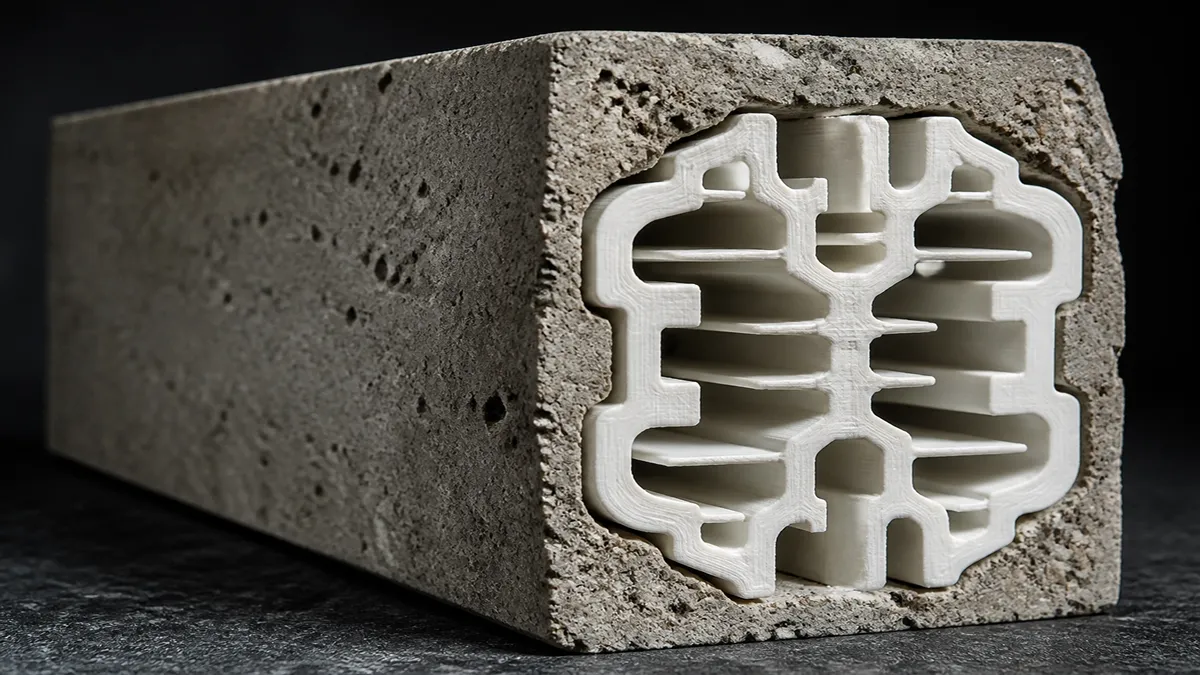
A research team at the University of Sharjah, led by Dr. Muhammad Talha Junaid, has published findings that could quietly reshape how the construction industry thinks about reinforced concrete. By replacing traditional steel rebar with FDM-printed PLA profiles inside cement mortar beams, the team demonstrated that a polymer filament — the same kind fed through desktop 3D printers every day — can achieve nearly 80% of steel’s bending strength while fully matching its ductility. The catch, and the breakthrough, is that none of this performance comes from the material itself. It comes entirely from geometry.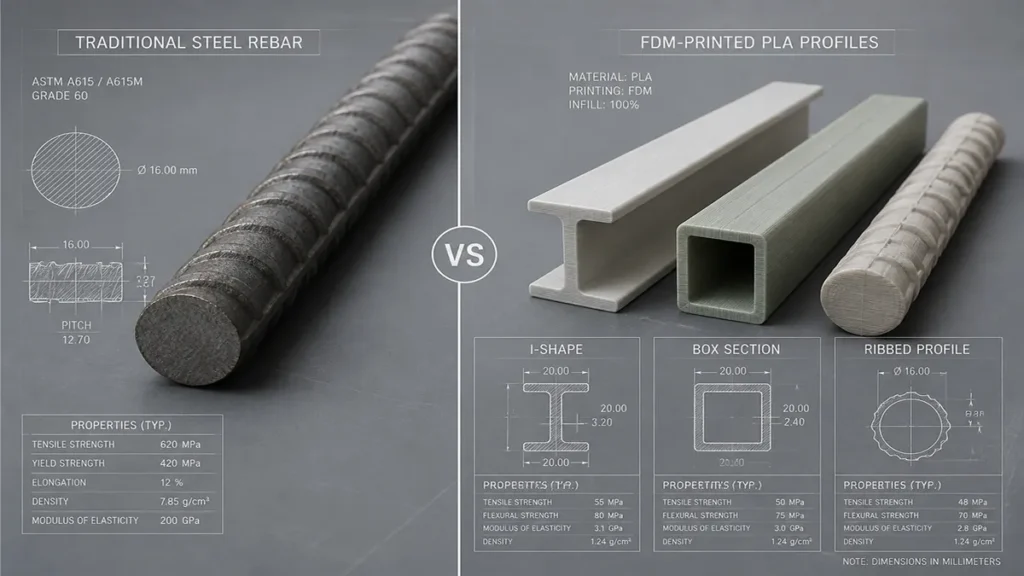
The Problem Concrete Has Always Had
Concrete is one of the most compression-resistant building materials humans have ever devised. It can bear enormous compressive loads without cracking. But put it under tension — pull it, bend it, flex it — and it fails fast. This is why steel rebar has been embedded in concrete for over a century. Steel’s high tensile strength and natural ductility compensate precisely where concrete falls short, creating a composite system that handles both compression and bending loads. The limitation? Steel is heavy, expensive, prone to corrosion over decades, and energy-intensive to produce. Researchers have long searched for viable alternatives, from carbon fiber to basalt rods to glass fiber-reinforced polymers. FDM-printed PLA is a far less conventional candidate — but that’s exactly what makes this study significant.The Experiment: Geometry as the Primary Variable
The University of Sharjah team fabricated a range of PLA reinforcement profiles using standard FDM 3D printing and embedded them in cement mortar beams under controlled conditions. Crucially, the study was designed to isolate surface geometry as the primary experimental variable — testing different cross-sectional profiles and surface textures to determine which configurations delivered the strongest bond with the surrounding mortar and the best structural performance under bending loads. This is a methodologically elegant approach. Rather than asking “how strong is PLA versus steel?” — a question that would almost always favor steel — the researchers asked “what shape of PLA performs best, and how close can it get?” The answer turned out to be far closer than most engineers would have predicted.The Results: Numbers That Demand Attention
The best-performing PLA geometry configuration reached approximately 80% of steel rebar’s bending strength in the tested beam configurations. More importantly, it also matched steel’s ductility — the ability to deform significantly before fracturing. Ductility is actually the harder metric to replicate. A material can be engineered to be stiff and strong, but ductile behavior — the gradual yielding that gives engineers a visible warning before catastrophic failure — is the property that makes steel so trusted in seismic zones and load-bearing structures. Achieving ductility parity with steel using a biodegradable thermoplastic printed on an FDM machine is the result that most warrants follow-up research. The team’s conclusion is clear: in the context of reinforced mortar beams, surface geometry is the dominant performance driver, outweighing raw material properties in determining how effectively the reinforcement interacts with the cementitious matrix.What FDM Makes Possible That Conventional Manufacturing Cannot
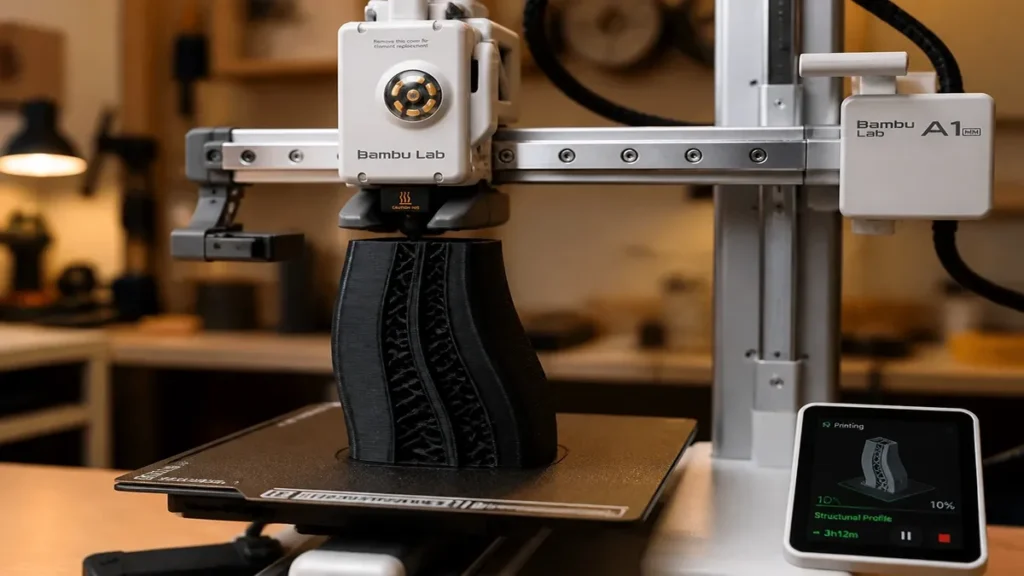 This is where additive manufacturing’s unique value becomes structurally relevant. Extruded steel rebar has a limited geometry palette — round, ribbed, deformed. The ribs are there specifically to improve mechanical interlock with concrete, and they are effective, but they represent the practical ceiling of what rolling mills can produce economically. FDM printing has no such constraint. Every surface feature, every channel, every micro-texture, every cross-sectional shape is fully programmable. A researcher or engineer can iterate through dozens of geometric configurations in a single print session and test them empirically — exactly what Dr. Junaid’s team did.
This opens a design space that has never been accessible before: reinforcement profiles optimized not just for strength, but for bond behavior with specific mix designs, for weight reduction, for corrosion resistance in marine or chemical environments, or for tailored anisotropic stiffness in directions where the structure actually needs it.
This is where additive manufacturing’s unique value becomes structurally relevant. Extruded steel rebar has a limited geometry palette — round, ribbed, deformed. The ribs are there specifically to improve mechanical interlock with concrete, and they are effective, but they represent the practical ceiling of what rolling mills can produce economically. FDM printing has no such constraint. Every surface feature, every channel, every micro-texture, every cross-sectional shape is fully programmable. A researcher or engineer can iterate through dozens of geometric configurations in a single print session and test them empirically — exactly what Dr. Junaid’s team did.
This opens a design space that has never been accessible before: reinforcement profiles optimized not just for strength, but for bond behavior with specific mix designs, for weight reduction, for corrosion resistance in marine or chemical environments, or for tailored anisotropic stiffness in directions where the structure actually needs it.
Why This Matters to the Community
For makers and 3D printing enthusiasts, this research lands as validation of something the community has intuitively believed for years: that FDM-printed geometry can do serious engineering work. The study doesn’t require industrial-grade composite printers or exotic materials. The PLA used here is the same filament sitting on shelves next to Bambu Lab A1s and Prusa MK4Ses worldwide. What unlocks the performance is geometric intelligence, not material cost. For professional users working in engineering, architecture, or construction-adjacent fields, the implications are more specific. A PLA reinforcement profile that approaches 80% of steel’s bending strength while matching its ductility is not yet a replacement for structural rebar in load-bearing applications — and the researchers are careful not to overstate that case. But it is a legitimate candidate for low-load secondary structural elements, architectural concrete forms, repair patching in non-critical zones, or developing-world construction contexts where steel availability and corrosion resistance are real constraints. The fact that PLA is biodegradable and non-corroding adds a long-term durability argument that steel simply cannot make. For the Bambu Lab, Prusa, Creality, and Voron ecosystems specifically, the research highlights a use case that most users haven’t considered: their machines are already capable of producing structurally meaningful components. The limiting factor isn’t printer capability — it’s geometric design knowledge. Studies like this one provide the empirical foundation for that design knowledge. Expect to see geometry-optimized reinforcement profiles shared as open-source models on Printables and MakerWorld within months of this paper circulating more widely. The pipeline from peer-reviewed research to community-printable STLs has never been shorter.Source: 3D Printing Industry / Via FilamentPicks Automation