

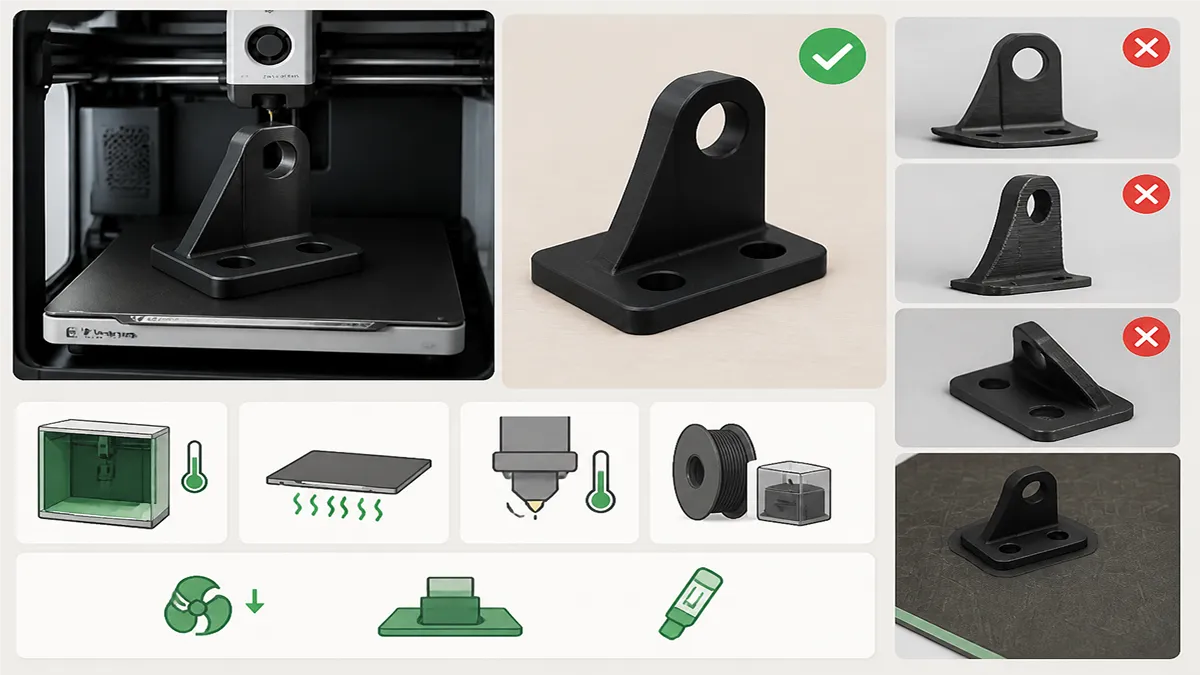
ABS is the filament most people fail at first, so learning how to print ABS without warping is the single biggest unlock on a Bambu printer. On a Bambu Lab printer the warping isn’t bad luck — it’s physics: ABS shrinks as it cools, the upper layers pull the edges inward, and the corners lift into a “potato chip.” The good news is that warping is very controllable once you understand the one factor that matters most. This research-based guide walks through the fixes in priority order, drawn from Bambu’s wiki and widely reported community results.
The single most important thing
Everything about how to print ABS without warping starts here: chamber temperature beats every other fix. A hot, sealed chamber lets ABS cool slowly and evenly so it doesn’t shrink unevenly. Everything else — brim, bed temp, glue — helps, but a cold chamber will warp ABS no matter what.
In this guide
Why ABS warps — and how to print ABS without warping
ABS and ASA shrink significantly as the extruded plastic cools. When a fresh hot layer lands on a cooler layer below, the new layer contracts and tugs the edges of the print inward and upward. The fix is to keep the whole part warm so it all cools together. That’s why an enclosed, heated chamber is the dominant factor — and why Bambu’s open-frame machines (like the A1) struggle with ABS unless you compensate hard on bed adhesion.
Step 1 — Enclose and preheat the chamber
The first rule of how to print ABS without warping: for ABS, ASA, PA and PC, an enclosed printer is essential. On an X1C, P1S or P2S, keep the top cover on and the door closed for the entire print. Then preheat before you start:
- Set the bed to 100–120°C and home the bed so it rises to the top of the chamber.
- Turn on the auxiliary fan to circulate the warm air.
- Wait about 15 minutes, or until the chamber reaches roughly 50°C.
- On a P1S (no chamber sensor), use the nozzle temperature in Bambu Studio as a rough proxy, or add a small temperature display visible to the onboard camera.
Open-frame printer? You can still print small ABS parts: raise the bed temperature an extra +10°C and build a makeshift enclosure to trap heat — but expect limits on large flat parts.
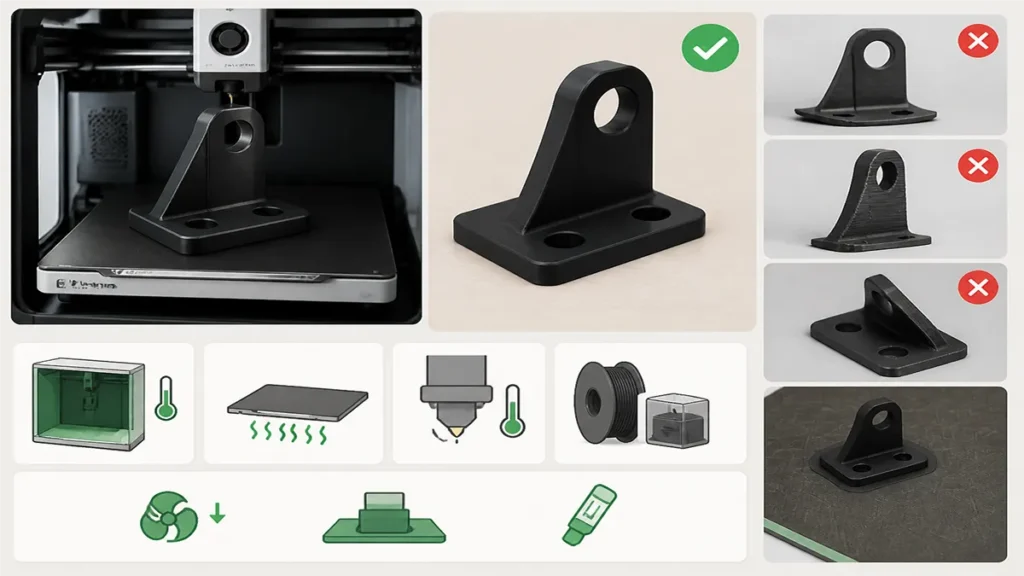
Step 2 — Nail the bed adhesion
- Clean the plate properly. Wash with dish soap and hot water and don’t touch the surface with bare hands — skin oils kill adhesion. The Smooth/High-Temp PEI plate grips ABS best, with the Textured PEI plate a close second.
- Run the bed hot. 100°C is the standard; nudge to 105–110°C if corners still lift.
- Add glue if needed. A thin, even layer of glue stick on a cold plate adds extra grip — useful insurance on big parts.
- Check your first layer. Re-run auto bed leveling, confirm the Z-offset, and make sure the first layer is properly squished. Most “warping” is really poor first-layer adhesion.
Step 3 — Use a brim (the easy 95% fix)
A brim is the single most effective slicer setting for ABS. Add a 5–8 mm outer brim with the brim-object gap set to 0.0 mm — that anchors the corners that want to lift. For parts where you don’t want a full brim, use Brim Ears (mouse ears) on just the corners, or add small discs at the corners in Bambu Studio. A brim prevents corner lift on the large majority of parts and is far faster than reprinting a warped one.
Step 4 — Control cooling
|
Setting |
ABS value |
Why |
|---|---|---|
|
Part-cooling fan |
Off or very low |
Fast cooling is exactly what causes warping |
|
Chamber / aux fan during print |
Off |
Keep chamber heat in |
|
Door / top cover |
Closed for whole print |
Prevents drafts and heat loss |
|
After the print |
Let it cool slowly, door shut |
Sudden cooling can still pop corners loose |
Counterintuitive but critical: with ABS you want less cooling, not more. The aggressive part-cooling that makes PLA crisp is what makes ABS warp.
Step 5 — Design and material checks
- Dry the filament. Crackling or popping sounds and rough surfaces mean wet ABS, which worsens warping. Dry it and store with desiccant — see our filament dryer guide.
- Print per-object on big plates. Printing parts one at a time (rather than a full layer across many) keeps each part hotter and warps less.
- Avoid large flat thin parts. They’re the most warp-prone; add relief cuts or break them up where you can.
- Consider ASA for outdoors. If the part lives outside, ASA adds UV stability — though Bambu ASA can warp a touch more than Bambu ABS. See our ABS vs ASA comparison.
Don’t forget ventilation
ABS and ASA give off styrene fumes. They’re not acutely dangerous in a ventilated room, but don’t print them in a sealed bedroom. The X1C’s HEPA-plus-carbon filter handles most of it (replace the carbon filter every 3–6 months with heavy use); a HEPA kit fits the P1S/P2S. Otherwise vent the enclosure exhaust toward a window or run the printer in a garage or workshop.
Where to buy
As an Amazon Associate we earn from qualifying purchases.
- Bambu ABS on Amazon — warps less than most generic ABS
- Glue stick on Amazon — cheap bed-adhesion insurance
- Filament dryer on Amazon — keep ABS dry for clean prints
Frequently asked questions
Can I print ABS on a Bambu A1 (open frame)?
Small parts, yes — raise the bed temp +10°C and improvise an enclosure to trap heat. Large flat ABS parts will likely warp without a proper heated chamber; for those, an enclosed X1C, P1S or P2S is the right tool.
Is a brim or a raft better for ABS?
A brim, in most community experience — set the brim-object gap to 0.0 mm and 5–8 mm wide. Rafts use more material and time and often don’t beat a good brim plus a hot chamber.
What bed temperature should I use for ABS?
Start at 100°C on a clean Smooth/High-Temp PEI plate. If corners still lift, go to 105–110°C and add a brim and glue stick before changing anything else.
Why does my ABS warp only after the print finishes?
Opening the door too soon lets the part cool suddenly and unevenly. Leave it in the closed, warm chamber to cool slowly, especially for large parts.
The bottom line
When it comes to how to print ABS without warping, it is a heat problem, not a filament problem. Enclose and preheat the chamber, run a clean hot PEI plate, add a 5–8 mm brim, and keep the part-cooling fan off with the door shut throughout. Do those four things on an enclosed Bambu and ABS goes from your most frustrating material to a reliable one — flat corners and all.
Related reading: Best ABS filament for Bambu Lab • ABS vs ASA for Bambu Lab • Best ASA filament for Bambu
Affiliate disclosure: FilamentPicks is reader-supported. When you buy through links on this page we may earn a small commission at no extra cost to you. We only recommend filaments based on manufacturer specifications, published technical data sheets and community reports — this is a research-based guide, not a hands-on lab test.