

👉 See also: The Bambu Lab Filament Tier List for 2026: Every Major Brand Ranked — our full research-based guide.
A Filament Built for the Living Room, Not the Garage
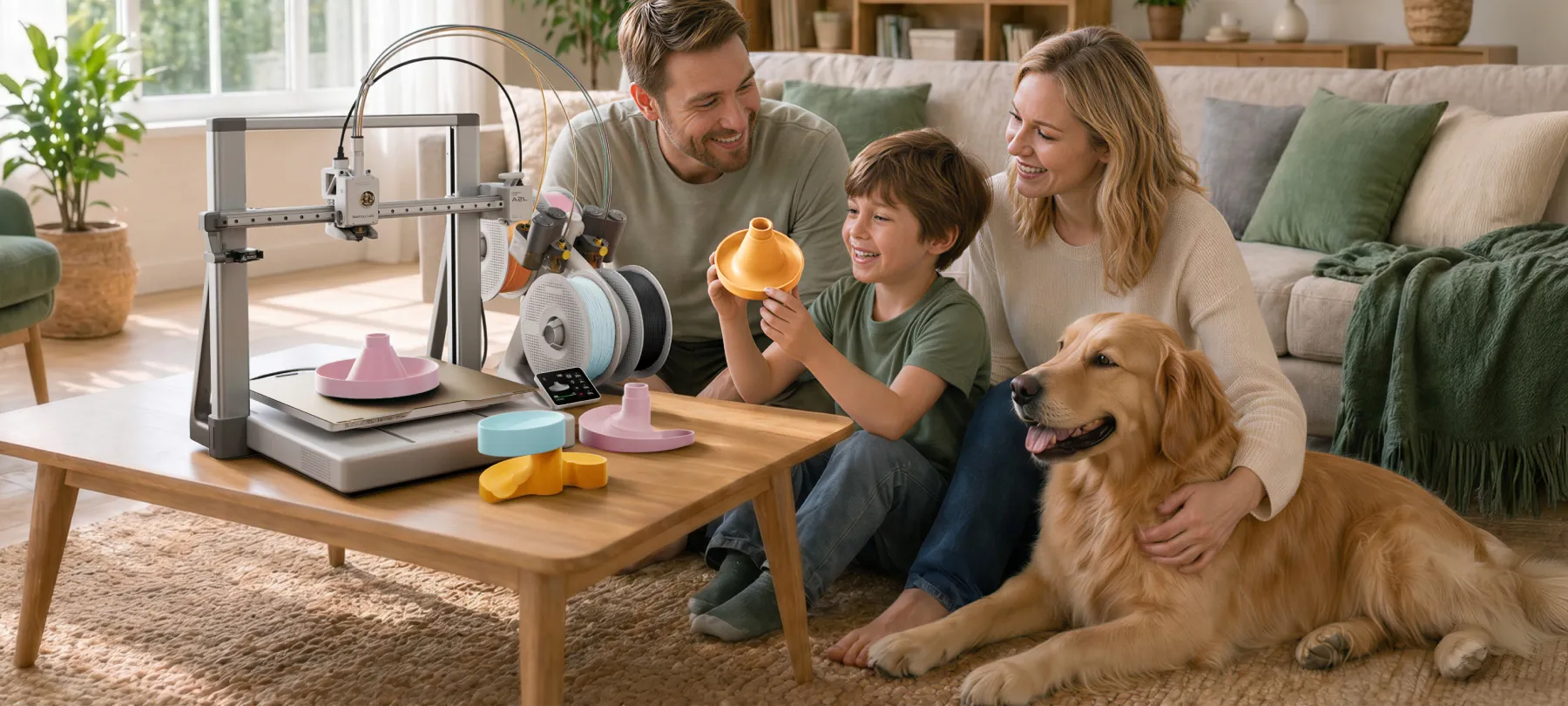
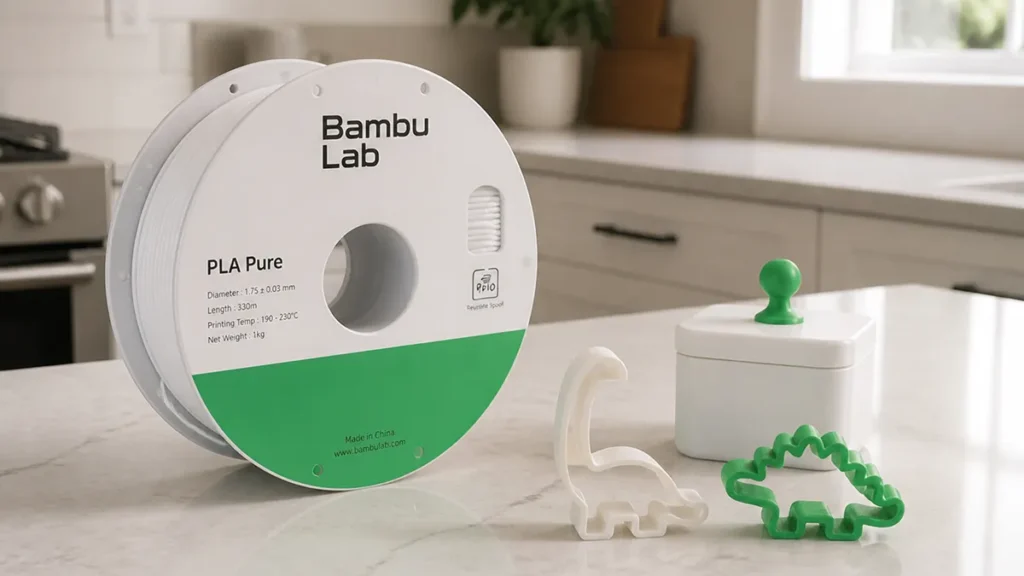 Bambu Lab has spent the better part of three years winning over makers with print speed, multi-color tool changers, and increasingly hands-off workflows. This week, the company shifted its attention to something far less flashy but arguably more consequential for where desktop 3D printing is heading next: what is actually inside the spool. The newly launched PLA Pure filament is, on the surface, just another PLA option in an already saturated material lineup. Underneath that, though, it represents a deliberate pivot toward treating 3D printing as a household activity rather than a workshop hobby, complete with the kind of ingredient transparency and safety testing usually reserved for products that share space with food, toys, and children.
Five Ingredients, Full Traceability
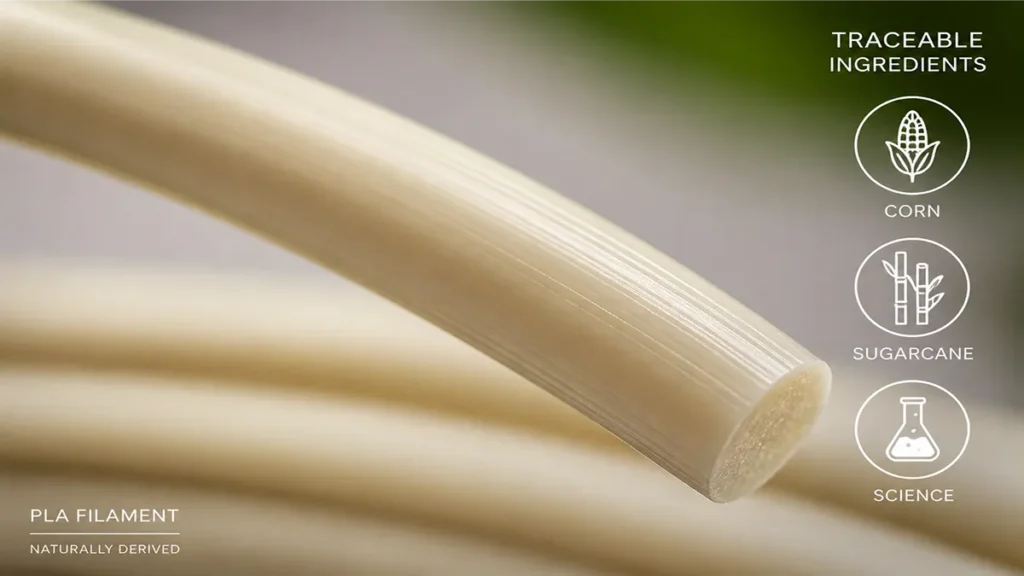 Where most filament marketing leans on tensile strength figures or layer adhesion claims, Bambu Lab built the PLA Pure pitch almost entirely around what is not in the material, and what is verifiably traceable about what is. The formulation is limited to five components: PLA sourced from corn and sugarcane, an acrylic copolymer, color pigments, EBS (ethylene bis-stearamide) as a processing aid, and talc. Each ingredient is listed as compliant with EU 10/2011, the European Union framework regulation governing plastics intended for food contact, and each appears on that regulation’s positive list of approved substances.
Bambu Lab has also named its raw material suppliers publicly, tracing the PLA Pure formulation back to TotalEnergies, Corbion, Dow, Chemours, and BASF. That level of supply chain disclosure is unusual in the desktop filament market, where ingredient sourcing is typically treated as a trade secret rather than a selling point. The spool has additionally been certified for low emissions and tested against European toy safety standards, a detail clearly aimed at the growing number of households printing toys, cookie cutters, pill boxes, and other items that end up in children’s hands or kitchens.
Where most filament marketing leans on tensile strength figures or layer adhesion claims, Bambu Lab built the PLA Pure pitch almost entirely around what is not in the material, and what is verifiably traceable about what is. The formulation is limited to five components: PLA sourced from corn and sugarcane, an acrylic copolymer, color pigments, EBS (ethylene bis-stearamide) as a processing aid, and talc. Each ingredient is listed as compliant with EU 10/2011, the European Union framework regulation governing plastics intended for food contact, and each appears on that regulation’s positive list of approved substances.
Bambu Lab has also named its raw material suppliers publicly, tracing the PLA Pure formulation back to TotalEnergies, Corbion, Dow, Chemours, and BASF. That level of supply chain disclosure is unusual in the desktop filament market, where ingredient sourcing is typically treated as a trade secret rather than a selling point. The spool has additionally been certified for low emissions and tested against European toy safety standards, a detail clearly aimed at the growing number of households printing toys, cookie cutters, pill boxes, and other items that end up in children’s hands or kitchens.
- Formulation limited to five traceable ingredients, all EU 10/2011-listed
- Raw materials sourced from TotalEnergies, Corbion, Dow, Chemours, and BASF
- Certified for low emissions and tested against European toy safety standards
- Priced at $24.99 with a spool and $21.99 for refills, in line with standard premium PLA
Why This Matters to the Community
 For the installed base of Bambu Lab printers already sitting on kitchen counters and in kids’ bedrooms, PLA Pure formalizes something many users were already assuming, but couldn’t verify: that the plastic melting a few inches from a dinner table is not quietly off-gassing something nobody asked about. That matters most for the X1 Carbon, P1S, and A1 crowd, machines explicitly marketed at families and first-time printer owners rather than dedicated workshop spaces, where enclosed builds and after-school maker projects are the norm rather than the exception.
The ripple effect is likely to extend well beyond Bambu Lab’s own ecosystem. Prusa has long built its reputation on engineering rigor and open documentation, and its community will likely expect Prusament to respond with similarly explicit ingredient and emissions disclosures rather than ceding the “trustworthy filament” narrative to a competitor. Creality, which has pushed hard into the budget and family segment with machines like the Ender and Hi line, faces a tougher question: its value proposition has always leaned on price, and matching full-traceability sourcing without eroding margins won’t be simple. Meanwhile, the Voron community, built around open-source, self-assembled machines often run in enclosed home offices and garages rather than open workshops, may see this less as a buying decision and more as a useful data point: a publicly available case study in what “safe for the room you’re printing in” can look like when a manufacturer actually documents it.
The bigger signal here is about where the competitive battleground in desktop 3D printing is moving. Print speed and multi-material capability have become table stakes across Bambu Lab, Prusa, Creality, and the broader FDM field. Material trust, by contrast, is still wide open territory, and PLA Pure suggests Bambu Lab intends to own it before anyone else gets there.
For the installed base of Bambu Lab printers already sitting on kitchen counters and in kids’ bedrooms, PLA Pure formalizes something many users were already assuming, but couldn’t verify: that the plastic melting a few inches from a dinner table is not quietly off-gassing something nobody asked about. That matters most for the X1 Carbon, P1S, and A1 crowd, machines explicitly marketed at families and first-time printer owners rather than dedicated workshop spaces, where enclosed builds and after-school maker projects are the norm rather than the exception.
The ripple effect is likely to extend well beyond Bambu Lab’s own ecosystem. Prusa has long built its reputation on engineering rigor and open documentation, and its community will likely expect Prusament to respond with similarly explicit ingredient and emissions disclosures rather than ceding the “trustworthy filament” narrative to a competitor. Creality, which has pushed hard into the budget and family segment with machines like the Ender and Hi line, faces a tougher question: its value proposition has always leaned on price, and matching full-traceability sourcing without eroding margins won’t be simple. Meanwhile, the Voron community, built around open-source, self-assembled machines often run in enclosed home offices and garages rather than open workshops, may see this less as a buying decision and more as a useful data point: a publicly available case study in what “safe for the room you’re printing in” can look like when a manufacturer actually documents it.
The bigger signal here is about where the competitive battleground in desktop 3D printing is moving. Print speed and multi-material capability have become table stakes across Bambu Lab, Prusa, Creality, and the broader FDM field. Material trust, by contrast, is still wide open territory, and PLA Pure suggests Bambu Lab intends to own it before anyone else gets there.
Image credit: 3DPrint.com / Brand Official
Source: 3DPrint.com / Via FilamentPicks