

👉 Related on FilamentPicks: Bambu Filament vs Third-Party: Is the Price Premium Worth It? (2026) — ranked picks from community data.
A Calculated Provocation: America’s Best, But Not the World’s
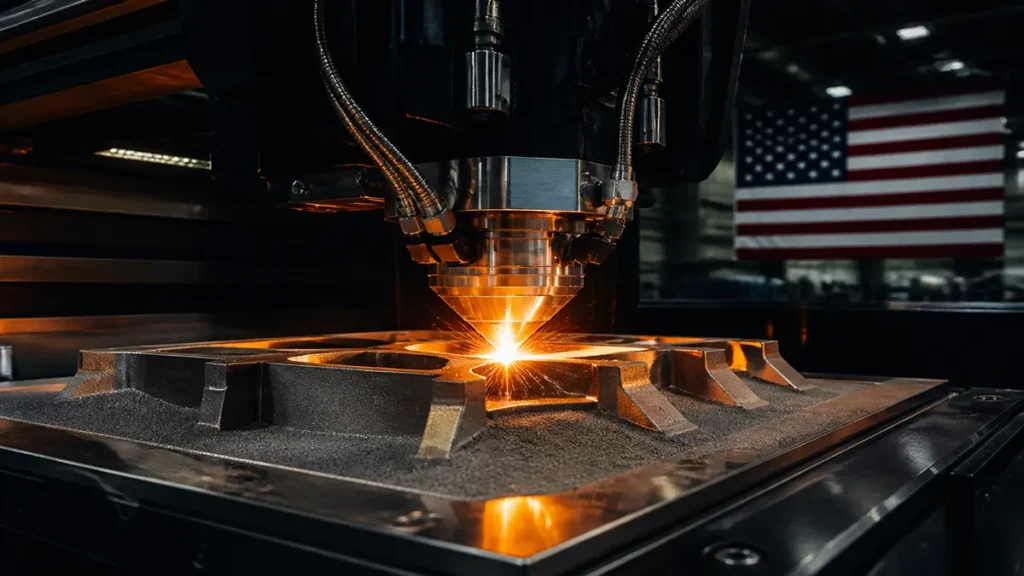 When a company announces what it calls “the most advanced industrial metal 3D printer in the United States,” the language choice is deliberate. Divergent Technologies, the Los Angeles-based additive manufacturing powerhouse backed by over $1.1 billion in investment, has unveiled the Monolith One — a large-format Laser Powder Bed Fusion (LPBF) system developed entirely in-house over the course of 28 months. The implicit admission buried in that announcement is significant: by limiting the superlative to US borders, Divergent implicitly concedes that German powerhouses like EOS and Nikon SLM Solutions, along with Chinese giants such as BLT and Farsoon, remain at or beyond the frontier of industrial metal printing. It’s a rare moment of candor in an industry that often runs on hyperbole.
That framing, however, does not diminish the achievement. The Monolith One represents a serious engineering effort by a company that has long been scrutinized for its billion-dollar ambitions and theatrical PR. This time, the hardware exists — and it’s designed not just to print metal parts, but to anchor a vertically integrated defense and aerospace manufacturing operation at a scale the US additive industry has rarely attempted.
When a company announces what it calls “the most advanced industrial metal 3D printer in the United States,” the language choice is deliberate. Divergent Technologies, the Los Angeles-based additive manufacturing powerhouse backed by over $1.1 billion in investment, has unveiled the Monolith One — a large-format Laser Powder Bed Fusion (LPBF) system developed entirely in-house over the course of 28 months. The implicit admission buried in that announcement is significant: by limiting the superlative to US borders, Divergent implicitly concedes that German powerhouses like EOS and Nikon SLM Solutions, along with Chinese giants such as BLT and Farsoon, remain at or beyond the frontier of industrial metal printing. It’s a rare moment of candor in an industry that often runs on hyperbole.
That framing, however, does not diminish the achievement. The Monolith One represents a serious engineering effort by a company that has long been scrutinized for its billion-dollar ambitions and theatrical PR. This time, the hardware exists — and it’s designed not just to print metal parts, but to anchor a vertically integrated defense and aerospace manufacturing operation at a scale the US additive industry has rarely attempted.
Monolith One: Specifications, Architecture, and Novel Capabilities
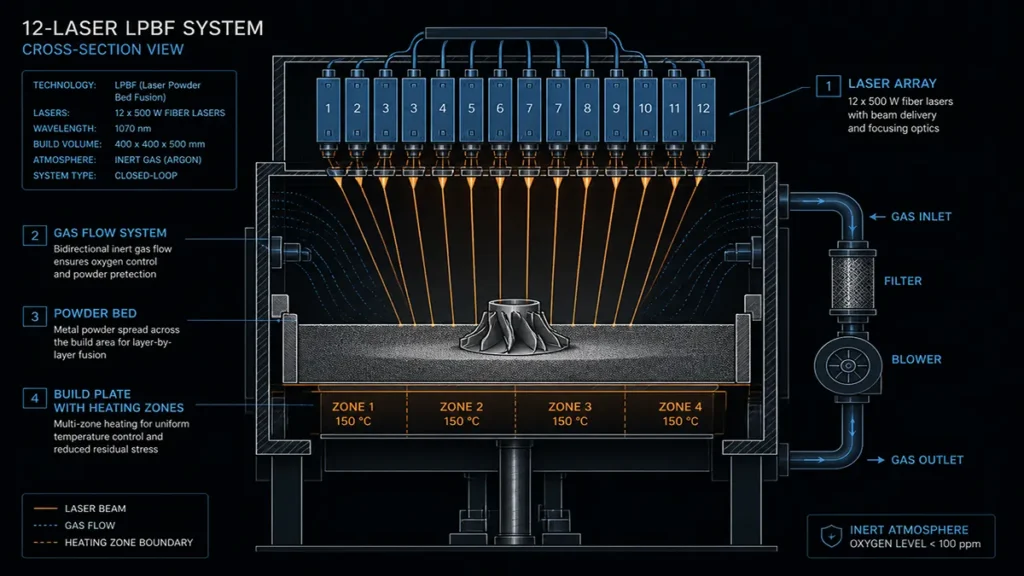 At its core, the Monolith One is a 12-laser LPBF system with each laser rated at 2 kW, delivering a total optical output of 24 kW. The build envelope measures 700 × 700 × 835 mm, yielding a usable volume of roughly 409 liters — meaningful for structural aerospace and defense components, though notably smaller than leading Chinese competitors such as the Farsoon FS1521M or the BLT-S1500, which offer build volumes several times larger.
The system handles a broad material portfolio including aluminum, nickel-based superalloys, steel, and titanium — the canonical roster for defense and high-performance automotive applications. What makes the Monolith One specification stand out, however, is not merely the laser array but the engineering attention paid to production continuity:
At its core, the Monolith One is a 12-laser LPBF system with each laser rated at 2 kW, delivering a total optical output of 24 kW. The build envelope measures 700 × 700 × 835 mm, yielding a usable volume of roughly 409 liters — meaningful for structural aerospace and defense components, though notably smaller than leading Chinese competitors such as the Farsoon FS1521M or the BLT-S1500, which offer build volumes several times larger.
The system handles a broad material portfolio including aluminum, nickel-based superalloys, steel, and titanium — the canonical roster for defense and high-performance automotive applications. What makes the Monolith One specification stand out, however, is not merely the laser array but the engineering attention paid to production continuity:
- 4-axis scanners with spot-size zoom capability — allowing dynamic adjustment of the laser footprint mid-build, which can significantly improve throughput in thick-section geometries while maintaining resolution in fine features
- 1,700 cm²/min gas-flow unit — designed to reduce optical window contamination and extend uninterrupted print runs, a chronic operational bottleneck in high-productivity LPBF environments
- Closed-loop powder handling — eliminating manual intervention in the powder circuit, reducing operator exposure and improving material traceability
- Build plate heating and cooling up to 200°C — enabling better dimensional stability and repeatability, particularly critical for titanium and nickel parts where residual stress management is paramount
- Interchangeable build volumes — allowing faster turnaround between jobs by swapping build chambers rather than waiting for in-situ cooldown
The Long Beach Expansion: 430,000 Square Feet and 64 Machines
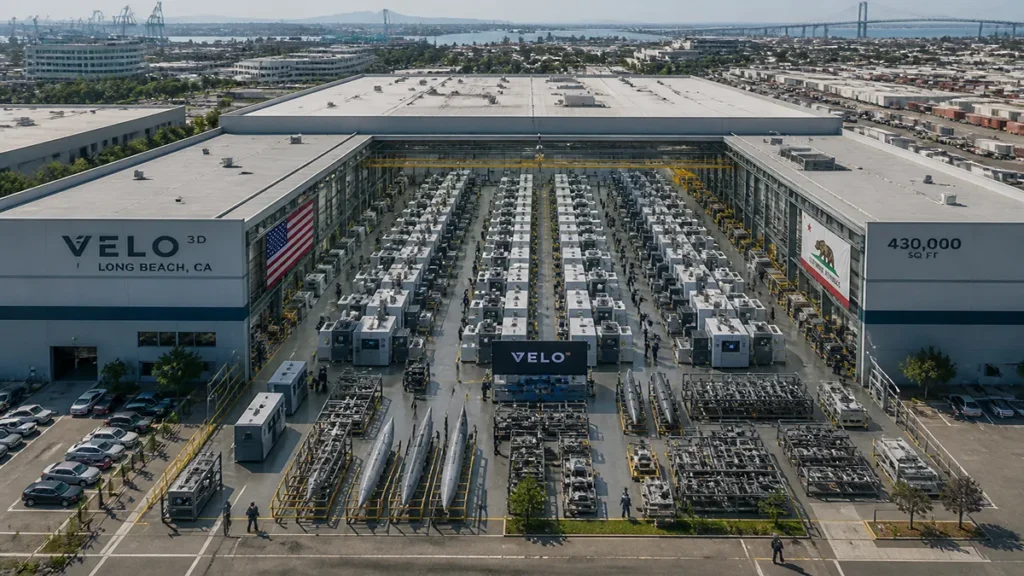 Hardware announcements are only half the story. Divergent has simultaneously revealed a major expansion of its manufacturing footprint with a 430,000 square-foot facility in Long Beach, California. Currently, six Monolith One machines are operational at this site — by Divergent’s own accounting, approximately a tenth of the installed capacity of several competing service bureaus already operating in the Long Beach area. The ambition, however, is the scale of the planned buildout: 64 additional Monolith One machines are targeted for installation over the next two years.
If fully realized, this would make Divergent one of the largest single-site LPBF operators in North America by machine count, with a total of 70 systems under one roof. CEO Lukas Czinger framed the vision bluntly:
“The Monolith One is the first metal 3D printer designed ground up for scaled production of critical hardware. Importantly, its design encompasses the years of operational insights we have earned delivering production structures to the defense and commercial sectors. Monolith One is an American machine with an American supply chain. We are building them at rate today and our Long Beach factory will house 64 more of them. With annual output in the tens of thousands of munitions airframes or hundreds of thousands of critical piece parts, our second factory represents the new industrial age at scale.”
CTO Brian Erhartic reinforced the system-integration angle, noting that the printer was designed specifically for tight coupling with Divergent’s proprietary Digital Additive Production System (DAPS) software platform — the argument being that a purpose-built machine delivers compounding efficiency gains that off-the-shelf printers cannot match when embedded in a closed software-hardware loop.
Hardware announcements are only half the story. Divergent has simultaneously revealed a major expansion of its manufacturing footprint with a 430,000 square-foot facility in Long Beach, California. Currently, six Monolith One machines are operational at this site — by Divergent’s own accounting, approximately a tenth of the installed capacity of several competing service bureaus already operating in the Long Beach area. The ambition, however, is the scale of the planned buildout: 64 additional Monolith One machines are targeted for installation over the next two years.
If fully realized, this would make Divergent one of the largest single-site LPBF operators in North America by machine count, with a total of 70 systems under one roof. CEO Lukas Czinger framed the vision bluntly:
“The Monolith One is the first metal 3D printer designed ground up for scaled production of critical hardware. Importantly, its design encompasses the years of operational insights we have earned delivering production structures to the defense and commercial sectors. Monolith One is an American machine with an American supply chain. We are building them at rate today and our Long Beach factory will house 64 more of them. With annual output in the tens of thousands of munitions airframes or hundreds of thousands of critical piece parts, our second factory represents the new industrial age at scale.”
CTO Brian Erhartic reinforced the system-integration angle, noting that the printer was designed specifically for tight coupling with Divergent’s proprietary Digital Additive Production System (DAPS) software platform — the argument being that a purpose-built machine delivers compounding efficiency gains that off-the-shelf printers cannot match when embedded in a closed software-hardware loop.
Production Targets: Missiles, Warheads, and Hypercars in the Same Factory
With 64 machines installed and running, Divergent projects it could produce, on an either/or basis depending on configuration:- Over 30,000 missile airframes per year
- More than 60,000 warhead casings (100 lb class)
- 25,000+ automotive subframes annually
- 30,000+ automotive suspension systems
Context: Where Does the Monolith One Stand in the Global LPBF Landscape?
To properly assess the Monolith One’s positioning, it’s worth holding it against the global competitive field. The machine’s 24 kW total laser power is genuinely impressive for a mid-format system — exceeding the Nikon SLM NXG XII 600E (12 kW across 12 lasers at 1 kW each) on a power-density basis, thanks to its 2 kW per-laser configuration. However, in terms of raw build volume, the machine sits well below behemoths like the Eplus3D EP-M3050 (over 11,000 liters), BLT-S1500, or even Farsoon’s FS1521M family. The Monolith One’s real competitive argument is not volume supremacy but operational integration: the claim that a machine engineered from scratch to work within a specific software-hardware production ecosystem will outperform larger, more generic platforms when total production efficiency — uptime, consistency, turnaround time, supply chain locality — is the actual metric. For US defense procurement, the all-domestic supply chain argument adds a non-negligible dimension that Chinese-built machines simply cannot match regardless of spec sheets. Companies like Seurat Technologies and VulcanForms are pursuing related strategies with different technical approaches, suggesting the market is converging on the idea that the next breakthrough in metal AM is not a bigger build box but a better-integrated production system.Why This Matters to the Community
At first glance, a $2.3 billion defense-industrial LPBF operation seems a long way from the benchtop printers in a maker’s garage or the Bambu Lab X1 Carbon on an engineer’s desk. But the downstream implications of Divergent’s Monolith One rollout are real and meaningful across the broader 3D printing ecosystem. For professional workflow users, the Monolith One’s architectural choices — closed-loop powder handling, interchangeable build volumes, software-native process optimization — represent a blueprint for where production-grade metal AM is heading. Shops currently using EOS M series or Nikon SLM platforms will watch whether Divergent’s higher-power-per-laser approach (2 kW vs. the typical 1 kW) translates into repeatable throughput gains or introduces new challenges around melt pool stability and part microstructure. For the defense and aerospace supply chain, a domestic US LPBF producer capable of 30,000+ missile airframes per year changes the calculus for how quickly advanced munitions can be scaled. If Divergent delivers on its timelines, it validates the argument that additive manufacturing can function not just as a prototyping tool but as a genuine alternative to traditional forging and casting for high-volume critical hardware. For the maker and enthusiast communities — including users of Bambu Lab, Prusa, Creality, and Voron builds — the Monolith One story matters as an inflection-point signal. Every time industrial metal AM proves it can deliver parts at production volumes and tolerances comparable to subtractive manufacturing, it accelerates the normalization of the entire additive paradigm. That normalization benefits every tier of the market: lower material costs, better software tools, more engineers trained in design-for-AM principles, and a larger ecosystem of companies betting on 3D printing as infrastructure rather than novelty. The metal frontier Divergent is pushing today will ripple downward into accessible hardware and materials in years to come. The counterpoint — and a fair one — is that Divergent has a long track record of bold claims and slower deliveries. The 3D printing community has learned to temper its enthusiasm for unicorn announcements. What Divergent needs to show is not more renders and CEO quotes, but actual part volumes, documented customer deliveries, and transparent production data. The hardware now exists. The next chapter belongs to the scoreboard.Image credit: 3DPrint.com / Brand Official
Source: 3DPrint.com / Via FilamentPicks Automation