

👉 See also: The Bambu Lab Filament Tier List for 2026: Every Major Brand Ranked — our full research-based guide.
ELEGOO Teams Up With emoji® for a Limited-Edition Centauri Carbon 2 Combo
For most of its history, the desktop 3D printing market has been driven almost entirely by specs. Build volume, print speed, nozzle temperature, motion system rigidity — these are the numbers that have dominated marketing copy, forum debates, and buying decisions for over a decade. Aesthetics were an afterthought, with most machines arriving in the same predictable palette of matte black, gunmetal gray, or the occasional safety-orange accent. That formula is now being challenged in a way few saw coming. ELEGOO, one of the fastest-growing names in consumer FDM and resin printing, has announced a partnership with emoji®, the company behind the globally recognized yellow emoji characters that appear on billions of phones, apps, and social platforms, to release a special-edition version of its Centauri Carbon 2 Combo.
What’s Actually Inside the Box
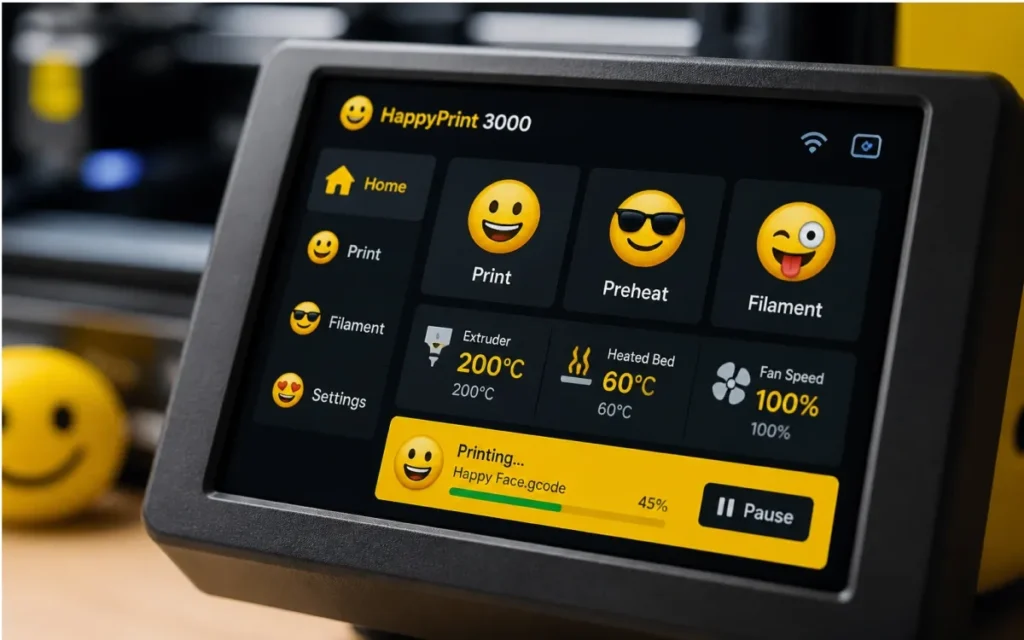
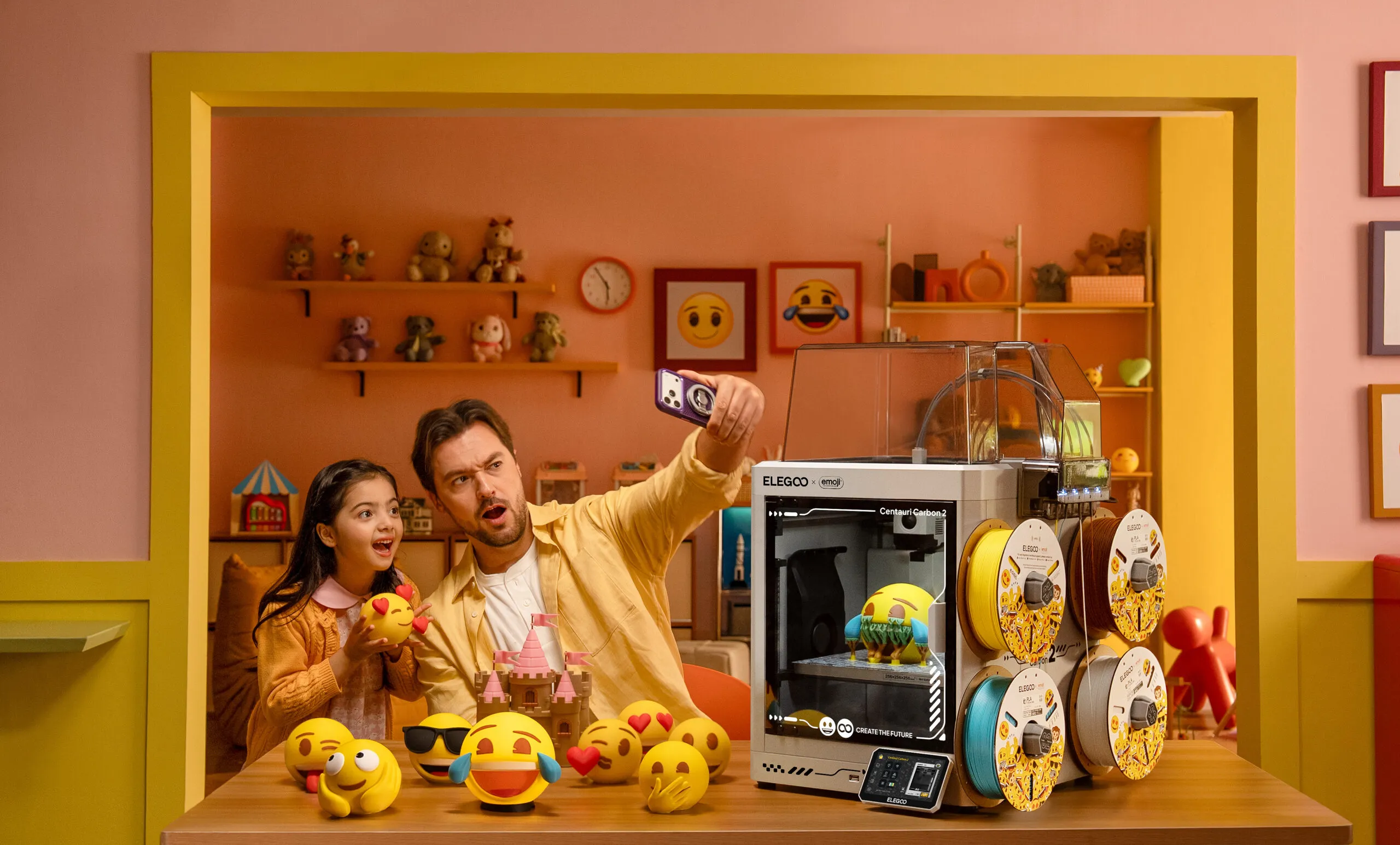
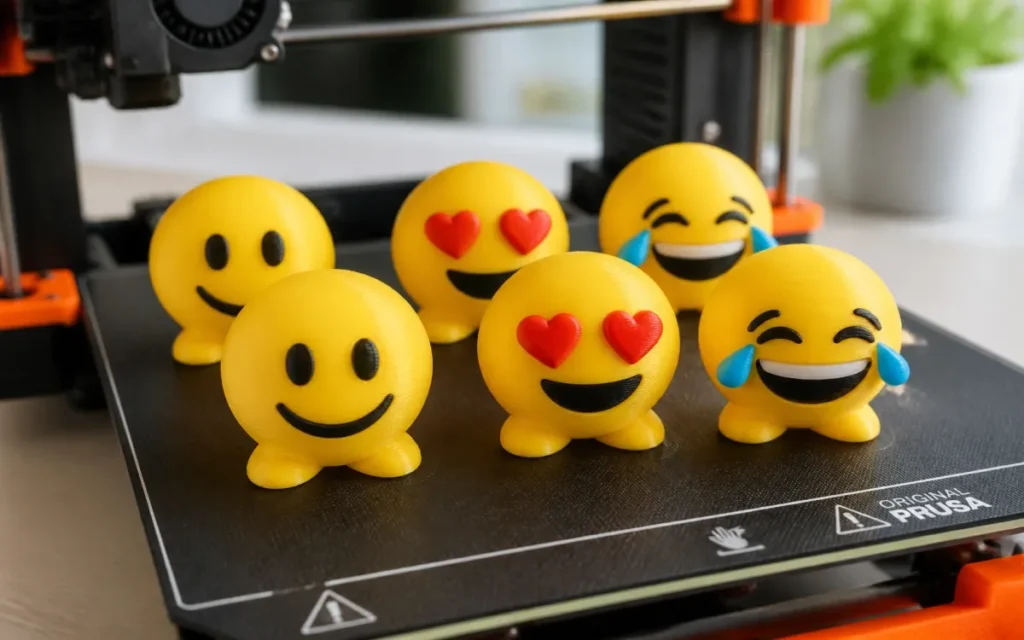
The ELEGOO × emoji® Centauri Carbon 2 Combo is built on the architecture of ELEGOO’s existing Centauri Carbon 2 line — an enclosed, high-speed CoreXY machine designed to compete directly with the closed-frame, multi-material ecosystems that have become the standard for prosumer desktop printing. The “Combo” designation refers to the bundled multi-filament unit, ELEGOO’s answer to automated material-switching systems, allowing users to load several spools and print multi-color models without manual filament swaps. What sets this particular unit apart isn’t the motion system or the hotend — it’s everything wrapped around it. The special edition ships in a striking silver-and-white shell with emoji-branded panel graphics, a redesigned touchscreen interface skinned with emoji iconography, custom startup chimes and boot animations, and a curated library of officially licensed emoji 3D models that are ready to print straight out of the box.
Pricing has been set at $489 USD, putting it squarely in the mainstream prosumer bracket rather than the premium tier. ELEGOO is rolling the printer out broadly, with availability confirmed for the United States, Canada, Europe, Australia, Japan, and the United Kingdom through the company’s official online storefront. emoji® Founder and CEO Marco Hüsges framed the collaboration as a way of bringing “digital self-expression into the physical world,” describing the printer as a tool that turns creativity into something people can “see, hold, and share with the world.”
From Spec Sheets to Lifestyle Products
The significance of this launch goes well beyond a fun-looking color scheme. It represents one of the clearest signals yet that desktop 3D printing is being pulled into the same orbit as sneakers, gaming consoles, headphones, and collectible toys — categories where licensed intellectual property has become a primary driver of sales, not a marketing afterthought. Companies like Pop Mart and Miniso have built enormous businesses around character-based merchandise, and the runaway popularity of collectible figures like Labubu shows just how far consumers are willing to go to express identity through branded objects. Theme parks have followed the same playbook, leaning hard into franchise tie-ins to drive attendance. The emoji partnership suggests ELEGOO sees the same opportunity in the printer itself: not as a tool defined purely by what it can manufacture, but as an object that says something about the person who owns it.
There’s historical precedent for why this matters. LEGO’s first major licensing deal — the 1999 Star Wars partnership — arrived at a moment when the company was struggling and needed a new way to connect with a broader audience. That single licensing relationship went on to become one of the most successful toy partnerships in history and reshaped LEGO’s entire business model around licensed IP. ELEGOO isn’t in LEGO’s 1999 position; the desktop 3D printing market is currently healthy and growing. But the emoji collaboration suggests the company is looking past its existing maker and hobbyist base toward a much larger pool of potential buyers — families, students, gift-shoppers, and casual creators who have never considered owning a 3D printer before, but who might be drawn in by a recognizable, fun, personality-driven brand.
Why This Matters to the Community
For the established maker community — the Bambu Lab, Prusa, Creality, and Voron crowd that has spent years optimizing flow rates, tuning input shaping, and chasing first-layer perfection — a branded, emoji-themed printer might initially look like a novelty that has nothing to do with their workflows. But the ripple effects are worth paying close attention to, because shifts in who buys 3D printers eventually reshape what printer manufacturers prioritize, support, and fund.
- A larger entry-level market funds better hardware for everyone. When companies like ELEGOO succeed at pulling in casual, lifestyle-driven buyers, the revenue generated often gets reinvested into core R&D — better motion systems, improved extrusion hardware, and firmware refinements that eventually trickle into the more serious machines enthusiasts actually buy. Bambu Lab’s own success in mainstreaming the AMS multi-color workflow is a prime example of how a feature aimed at convenience-driven buyers became a must-have for advanced users too.
- Competitive pressure on the “Combo” / multi-material category intensifies. ELEGOO positioning its Centauri Carbon 2 Combo — bundled multi-filament hardware included — as a $489 lifestyle product puts direct pricing pressure on Bambu Lab’s AMS-equipped bundles and on Creality’s and Prusa’s own multi-material offerings (Prusa’s MMU3, for instance). Expect manufacturers across the board to respond with more aggressive bundling and pricing on combo units over the coming year.
- Out-of-the-box content libraries become a battleground. The inclusion of pre-loaded, licensed emoji models out of the box hints at a future where printer manufacturers compete not just on hardware, but on curated content ecosystems — something the Voron and open-source community has always sourced independently through Printables, Thingiverse, and MakerWorld, but which may increasingly come bundled and licensed for mainstream buyers.
- Brand collaborations could become a recurring category. If the emoji partnership performs well, expect more limited-edition runs tied to entertainment franchises — the source article itself floats the idea of a Star Wars or Harry Potter-branded printer. For the community, that raises an interesting long-term question: will future limited editions offer genuine hardware upgrades, or will they remain cosmetic variants of existing CoreXY platforms? Enthusiasts evaluating special-edition units on the secondary market will want to watch closely for whether “branded” comes with any meaningful difference in print quality, firmware support, or long-term spare-parts availability compared to the standard Centauri Carbon 2 Combo.
- A bigger, more casual user base changes support expectations. As printers increasingly land in the hands of families, teachers, and gift recipients rather than dedicated tinkerers, manufacturers will likely lean further into auto-calibration, simplified slicers, and walled-garden ecosystems — a trend Bambu Lab has already pushed hard and that Prusa and Creality have had to respond to. Voron’s fully open-source, build-it-yourself ethos may increasingly become the explicit alternative for users who specifically want to avoid this consumer-electronics direction.
Whether or not the emoji-branded Centauri Carbon 2 Combo becomes a bestseller, its real value may be as a signal. It tells us that at least one major desktop manufacturer believes the market is big enough — and mainstream enough — to support products built around identity and fun rather than pure performance. For the rest of the industry, including the ecosystems the FilamentPicks community lives in every day, that’s a trend worth watching closely.
Image credit: 3DPrint.com / Brand Official
Source: 3DPrint.com / Via FilamentPicks Automation