

👉 Related on FilamentPicks: Bambu Filament vs Third-Party: Is the Price Premium Worth It? (2026) — ranked picks from community data.
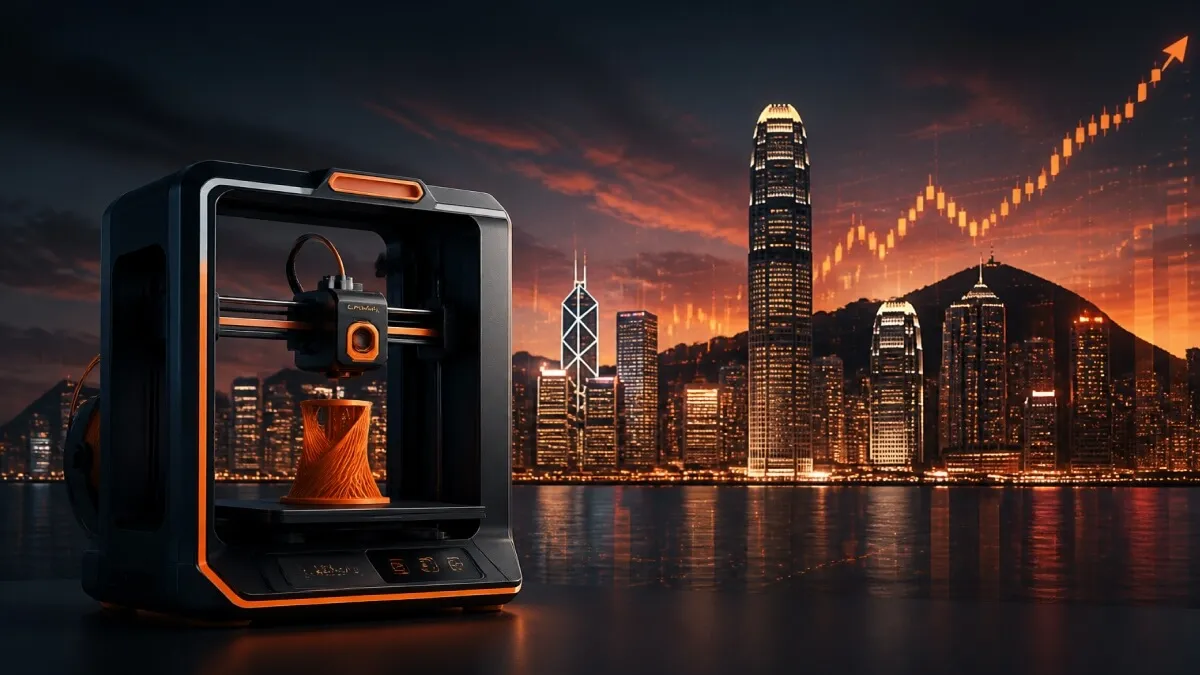
Creality, the Shenzhen-based company that helped put affordable desktop 3D printing into millions of homes and workshops, has completed its initial public offering on the Hong Kong Stock Exchange, raising approximately $177 million and pushing its market capitalization to roughly $1.12 billion. The listing marks one of the most significant financial events in the history of consumer additive manufacturing, and it arrives at a moment when the desktop printer market is more competitive — and more global — than ever before.
An Oversubscribed Debut
The Hong Kong tranche of Creality’s offering was reportedly oversubscribed by an extraordinary margin, with retail demand outstripping available shares by nearly 3,829 times. The international institutional tranche was oversubscribed by close to 27 times, and cornerstone investors — large strategic backers who commit to holding shares for a set lockup period — picked up close to half of the total offering. Shares opened trading at HK$33.80, well above the HK$18.80 IPO price, giving Creality an opening-day valuation north of HK$16 billion.
For a company that built its early reputation on budget-friendly kits like the Ender series, this kind of investor enthusiasm signals that the financial world now views desktop and benchtop additive manufacturing as a durable consumer electronics category rather than a niche hobbyist curiosity.
Strong Revenue, but a Return to Losses
The IPO prospectus paints a more complicated picture beneath the surface-level excitement. Creality’s gross margins held steady near 31 percent, a healthy figure for a hardware manufacturer. However, the company’s bottom line swung from a net profit of roughly RMB 88.7 million in 2024 to a net loss of about RMB 182.4 million in 2025, with operating cash flow turning negative over the same period.
That swing reflects the brutal economics of the current desktop printer market: aggressive pricing, heavy investment in new product lines (laser engravers, 3D scanners, and AI-enabled tooling), and the rising cost of competing against rivals that have captured significant volume share. Creality’s leadership will need to convince shareholders that this is a temporary investment phase rather than a structural margin problem.
Creality vs. Bambu Lab: The Real Competitive Story
Perhaps the most telling numbers in the prospectus concern market share. In 2024, Bambu Lab reportedly shipped around 1.2 million printers — about 29 percent of annual unit shipments — while Creality shipped roughly 700,000 units, good for around 16.9 percent. In value terms, Creality still holds a strong position: its printer gross merchandise value (GMV) ranked second globally at 11.2 percent share in 2025, its 3D scanner business led the category outright with 45.3 percent share, and its laser engraving line placed among the top four categories worldwide.
In other words, Creality remains a dominant, diversified player — but it is no longer the unchallenged leader in printer unit volume that it was during the original Ender K1 era. The IPO proceeds give it fresh ammunition to respond.
The Pivot to a “Platform” Strategy
Perhaps the most important signal in Creality’s IPO documents is strategic rather than financial. The company is explicitly repositioning itself as a platform business rather than purely a hardware seller. References to Creality’s “Nexbie” initiative, AI-assisted tools, consumables (including filament), software, and community engagement all point toward an ecosystem strategy that mirrors — and directly competes with — the closed-loop hardware-software-consumables approach that Bambu Lab has used so effectively with Bambu Studio, the AMS multi-material system, and MakerWorld.
Whether Creality can execute on this vision will determine whether the IPO proceeds translate into long-term market share gains or simply fund another round of price competition.
Why This Matters to the Community
For the millions of makers who own a Creality printer — from the original Ender 3 to the K1 Max and the newer Hi/K2 series — this IPO is not just a finance story. It’s a direct signal about the company’s ability to fund firmware development, expand its parts and accessories supply chain, and sustain long-term support for existing hardware. A well-capitalized Creality is generally good news for owners worried about discontinued spare parts or abandoned firmware branches, a real concern in a market where budget brands have come and gone quickly.

The competitive dynamics described in the prospectus also ripple outward across the entire desktop printing ecosystem:
- Bambu Lab owners should expect Creality to respond more aggressively on price and ecosystem features — multi-material systems, cloud slicing, and AI-driven print monitoring — which historically pushes the entire market toward faster feature parity. Increased competition at the top of the consumer segment tends to accelerate firmware updates and software polish industry-wide, a dynamic Bambu Lab users have already benefited from.
- Prusa Research occupies a different niche — open-source, Czech-manufactured, community-first — but a better-funded Creality intensifies the pricing pressure on the mid-range market where Prusa’s Core One and MK4 series compete. Prusa has leaned heavily on its open ecosystem and reputation for reliability; expect that differentiation to become even more central to its marketing as Chinese manufacturers scale.
- Creality’s own hardware lines (Ender, K1, K2, Hi series) are the most directly affected. Fresh capital typically means faster R&D cycles, which could bring quicker successors to the K2 platform, expanded AMS-style multi-color systems, and broader rollout of AI print-failure detection — features that have become must-haves since Bambu Lab popularized them.
- Voron builders and the broader DIY/open-hardware community benefit indirectly. Much of the open-source motion system, hotend, and electronics ecosystem that Voron relies on is sourced from the same Shenzhen-area supply chains that Creality draws on. Increased capital flowing into that regional manufacturing base tends to improve component availability and reduce lead times for the boards, extruders, and linear rails that DIY builders depend on.
Longer term, the most important question for the community isn’t the share price — it’s whether Creality’s “platform” ambitions result in genuinely open, well-documented ecosystems, or whether the entire desktop printing market trends toward more closed, app-gated experiences as every major manufacturer races to build its own version of MakerWorld. That tension between openness and ecosystem lock-in is likely to define the next several years of desktop 3D printing, and Creality’s IPO has just added a major new financial engine to that race.
Source: Brand Official / Via FilamentPicks Automation